

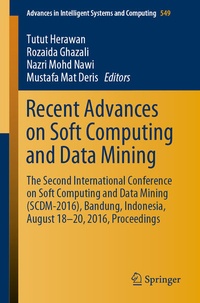
Recent Advances on Soft Computing and Data Mining
The Second International Conference on Soft Computing and Data Mining (SCDM-2016), Bandung, Indonesia, August 18-20, 2016 Proceedings
Published on 29. December 2016
Book
Paperback/Softback
XXI, 649 pages
978-3-319-51279-2 (ISBN)
Description
This book provides a comprehensive introduction and practical look at the concepts and techniques readers need to get the most out of their data in real-world, large-scale data mining projects. It also guides readers through the data-analytic thinking necessary for extracting useful knowledge and business value from the data.
The book is based on the Soft Computing and Data Mining (SCDM-16) conference, which was held in Bandung, Indonesia on August 18th-20th 2016 to discuss the state of the art in soft computing techniques, and offer participants sufficient knowledge to tackle a wide range of complex systems. The scope of the conference is reflected in the book, which presents a balance of soft computing techniques and data mining approaches. The two constituents are introduced to the reader systematically and brought together using different combinations of applications and practices. It offers engineers, data analysts, practitioners, scientists and managers the insights into the concepts, tools and techniques employed, and as such enables them to better understand the design choice and options of soft computing techniques and data mining approaches that are necessary to thrive in this data-driven ecosystem.
The book is based on the Soft Computing and Data Mining (SCDM-16) conference, which was held in Bandung, Indonesia on August 18th-20th 2016 to discuss the state of the art in soft computing techniques, and offer participants sufficient knowledge to tackle a wide range of complex systems. The scope of the conference is reflected in the book, which presents a balance of soft computing techniques and data mining approaches. The two constituents are introduced to the reader systematically and brought together using different combinations of applications and practices. It offers engineers, data analysts, practitioners, scientists and managers the insights into the concepts, tools and techniques employed, and as such enables them to better understand the design choice and options of soft computing techniques and data mining approaches that are necessary to thrive in this data-driven ecosystem.
More details
Series
Edition
1st ed. 2017
Language
English
Place of publication
Cham
Switzerland
Publishing group
Springer International Publishing
Target group
Professional and scholarly
Illustrations
98 s/w Abbildungen, 117 farbige Abbildungen
XXI, 649 p. 215 illus., 117 illus. in color.
Dimensions
Height: 235 mm
Width: 155 mm
Thickness: 37 mm
Weight
1007 gr
ISBN-13
978-3-319-51279-2 (9783319512792)
DOI
10.1007/978-3-319-51281-5
Schweitzer Classification
Other editions
Additional editions
Tutut Herawan | Rozaida Ghazali | Nazri Mohd Nawi
Recent Advances on Soft Computing and Data Mining
The Second International Conference on Soft Computing and Data Mining (SCDM-2016), Bandung, Indonesia, August 18-20, 2016 Proceedings
E-Book
12/2016
Springer
€213.99
Available for download
Content
Cluster Validation Analysis on Attribute Relative of Soft Set Theory.- Optimizing Weights in Elman Recurrent Neural Networks with Wolf Search Algorithm.- Optimization of ANFIS using Artificial Bee Colony Algorithm for Classification of Malaysian SMEs.- Forecasting of Malaysian Oil Production and Oil Consumption Using Fuzzy Time Series.- A Fuzzy TOPSIS with Z-Numbers Approach for Evaluation on Accident at the Construction Site.- Formation Control Optimization for Odor Localization.- A New Search Direction for Broyden's Family Method in Solving Unconstrained Optimization Problems.- Improved Functional Link Neural Network Learning Using Modified Bee-Firefly Algorithm for Classification Task.- Artificial Neural Network with Hyperbolic Tangent Activation Function to Improve the Accuracy of COCOMO II Model.- A study of data imputation using Fuzzy C-Means with Particle Swarm Optimization.