

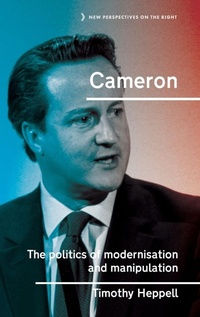
Cameron
The Politics of Modernisation and Manipulation
Published on 4. November 2019
Book
Hardback
192 pages
978-0-7190-9645-7 (ISBN)
Description
David Cameron was leader of the Conservative Party (2005-16) and Prime Minister of the United Kingdom (2010-16). His legacy may be one of the most significant of any post-war British prime minister. But did he have a distinctive political strategy, and if so how should we characterise it?
This book provides a new and distinctive interpretation of 'Cameronism', focusing on the twin themes of modernisation and manipulation.
Heppell identifies three core aspects of Cameron's modernisation strategy: his attempts to detoxify the image of the Conservative Party; his efforts to delegitimise the Labour Party by blaming it for the financial crisis and austerity; and Cameron's use of the 'Big Society' narrative as a means of reducing the perceived responsibilities of the state. Manipulation is explored in relation to the Coalition Government and the exploitation of the Liberal Democrats, on policies such as austerity, tuition fees and electoral reform.
Finally, the book examines Cameronism in relation to current challenges to the existing political order: Brexit, Scottish independence, and the rise of populism.
This timely book is essential reading to those interested in British party politics and Prime Ministerial leadership. -- .
This book provides a new and distinctive interpretation of 'Cameronism', focusing on the twin themes of modernisation and manipulation.
Heppell identifies three core aspects of Cameron's modernisation strategy: his attempts to detoxify the image of the Conservative Party; his efforts to delegitimise the Labour Party by blaming it for the financial crisis and austerity; and Cameron's use of the 'Big Society' narrative as a means of reducing the perceived responsibilities of the state. Manipulation is explored in relation to the Coalition Government and the exploitation of the Liberal Democrats, on policies such as austerity, tuition fees and electoral reform.
Finally, the book examines Cameronism in relation to current challenges to the existing political order: Brexit, Scottish independence, and the rise of populism.
This timely book is essential reading to those interested in British party politics and Prime Ministerial leadership. -- .
Reviews / Votes
'In his admirably objective study, drawing on compendious reading of relevant sources, Heppell demonstrates that while Cameron's attempts to 'de-toxify' his party are important to his legacy, it is equally profitable to regard him as a manipulator of the broader political landscape. ... This is a very useful corrective to the previous literature on Cameron. ... Heppell maintains an admirable tone of objectivity in a survey which demonstrates compendious reading of relevant sources.'Mark Garnett, LSE Review of Books -- .
More details
Series
Language
English
Place of publication
Manchester
United Kingdom
Target group
College/higher education
Professional and scholarly
Dimensions
Height: 240 mm
Width: 161 mm
Thickness: 15 mm
Weight
458 gr
ISBN-13
978-0-7190-9645-7 (9780719096457)
Copyright in bibliographic data and cover images is held by Nielsen Book Services Limited or by the publishers or by their respective licensors: all rights reserved.
Schweitzer Classification
Other editions
Additional editions
E-Book
11/2019
1st Edition
Manchester University Press
€181.99
Available for download
E-Book
11/2019
1st Edition
Manchester University Press
from
€181.99
Available for download
Person
Timothy Heppell is Associate Professor of British Politics at the University of Leeds -- .
Content
1 Introduction
2 The politics of detoxification: Restyling and reconstructing Conservatism
3 The politics of delegitimisation: Critiquing New Labour and post-New Labour
4 The politics of depoliticisation: The Big Society narrative
5 Controlling the coalition agenda: Marginalising the Liberal Democrats
6 Political binding: The legislative exploitation of the Liberal Democrats
7 Managing political dimensions: The rise of multi-party politics
8 Conclusion
Bibliography
Index -- .
2 The politics of detoxification: Restyling and reconstructing Conservatism
3 The politics of delegitimisation: Critiquing New Labour and post-New Labour
4 The politics of depoliticisation: The Big Society narrative
5 Controlling the coalition agenda: Marginalising the Liberal Democrats
6 Political binding: The legislative exploitation of the Liberal Democrats
7 Managing political dimensions: The rise of multi-party politics
8 Conclusion
Bibliography
Index -- .