

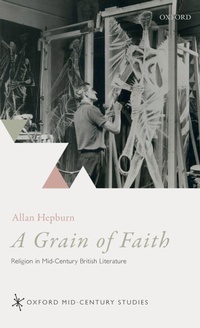
A Grain of Faith
Religion in Mid-Century British Literature
Published on 6. December 2018
Book
Hardback
278 pages
978-0-19-882857-0 (ISBN)
Description
During and after the Second World War, there was a concerted thinking about religion in Britain. Not only were leading international thinkers of the day theologians--Ronald Niebuhr, Paul Tillich, Jacques Maritain--but leading writers contributed to discussions about religion. Graham Greene, Muriel Spark, and Barbara Pym incorporated miracles, evil, and church-going into their novels, while Louis MacNeice, T. S. Eliot, and C. S. Lewis gave radio broadcasts about the role of Christianity in contemporary society. Certainly the war revived interest in aspects of Christian life. Salvation and redemption were on many people's minds. The Ministry of Information used images of bombed churches to stoke patriotic fervour, and King George VI led a series of Days of National Prayer that coincided with crucial events in the Allied campaign.
After the war and throughout the 1950s, approximately 1.4 million Britons converted to Roman Catholicism as a way of expressing their spiritual ambitions and solidarity with humanity on a world-wide scale. Religion provided one way for writers to answer the question, 'what is man?' It also afforded ways to think about social obligation and ethical engagement. Moreover, the mid-century turn to religion offered ways to articulate statehood, not from the perspective of nationhood and politics, but from the perspective of moral action and social improvement. Instead of being a retreat into seclusion and solitude, the mid-century turn to religion is a call to responsibility.
After the war and throughout the 1950s, approximately 1.4 million Britons converted to Roman Catholicism as a way of expressing their spiritual ambitions and solidarity with humanity on a world-wide scale. Religion provided one way for writers to answer the question, 'what is man?' It also afforded ways to think about social obligation and ethical engagement. Moreover, the mid-century turn to religion offered ways to articulate statehood, not from the perspective of nationhood and politics, but from the perspective of moral action and social improvement. Instead of being a retreat into seclusion and solitude, the mid-century turn to religion is a call to responsibility.
Reviews / Votes
Recommended. * CHOICE * Hepburn's background research is voluminous and his insights are astute; there is much fascinating material to discover in the reading of this book. This is one to recommend to anyone whose interest in mid-twentieth-century Britain would bepiqued by a deeper understanding of its religious context. * Deborah Bowen, The Glass *More details
Series
Language
English
Place of publication
Oxford
United Kingdom
Target group
Professional and scholarly
College/higher education
Illustrations
28 halftones
Dimensions
Height: 222 mm
Width: 145 mm
Thickness: 19 mm
Weight
484 gr
ISBN-13
978-0-19-882857-0 (9780198828570)
Copyright in bibliographic data and cover images is held by Nielsen Book Services Limited or by the publishers or by their respective licensors: all rights reserved.
Schweitzer Classification
Other editions
Additional editions
E-Book
11/2018
1st Edition
OUP eBook
€57.49
Available for download
E-Book
11/2018
1st Edition
OUP eBook
€56.99
Available for download
Person
Allan Hepburn, author of Intrigue: Espionage and Culture and Enchanted Objects: Visual Art in Contemporary Fiction, is James McGill Professor of Twentieth-Century Literature at McGill University. He has edited four volumes of works by Elizabeth Bowen as well as a collection of essays about inheritance entitled Troubled Legacies, and another collection dealing with citizenship and human rights entitled Around 1945. He has published essays on collecting, belatedness, poverty, catastrophe, children, opera, and other topics. With Adam Piette and Lyndsey Stonebridge, he co-edits the Oxford Mid-Century Studies series.
Content
1: Introduction
2: Bombed Churches
3: Saints and Miracles: The End of the Affair
4: Muriel Spark and Evil
5: Rebuilding the Church: Barbara Pym's Parochialism
6: Conclusion
Works Cited
2: Bombed Churches
3: Saints and Miracles: The End of the Affair
4: Muriel Spark and Evil
5: Rebuilding the Church: Barbara Pym's Parochialism
6: Conclusion
Works Cited