

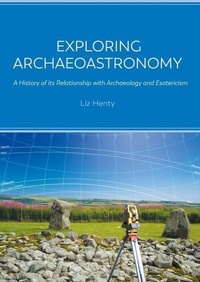
Exploring Archaeoastronomy
A History of its Relationship with Archaeology and Esotericism
Published on 15. February 2022
Book
Paperback/Softback
288 pages
978-1-78925-786-1 (ISBN)
Description
Archaeoastronomy and archaeology are two distinct fields of study which examine the cultural aspect of societies, but from different perspectives. Archaeoastronomy seeks to discover how the impact of the skyscape is materialised in culture, by alignments to celestial events or sky-based symbolism; yet by contrast, archaeology's approach examines all aspects of culture, but rarely considers the sky. Despite this omission, archaeology is the dominant discipline while archaeoastronomy is relegated to the sidelines. The reasons for archaeoastronomy's marginalised status may be found by assessing its history. For such an exploration to be useful, archaeoastronomy cannot just be investigated in a vacuum but must be contextualised by exploring other contemporaneous developments, particularly in archaeology. On the periphery of both, there are various strands of esoteric thought and pseudoscientific theories which paint an alternative view of monumental remains and these also play a part in the background.
The discipline of archaeology has had an unbroken lineage from the late 19th-century to the present. On the other hand, archaeoastronomy has not been consistently titled, having adopted various different names such as alignment studies, orientation theory, astro-archaeology, megalithic science, archaeotopography, archaeoastronomy and cultural astronomy: names which depict variants of its methods and theory, sometimes in tandem with those of archaeology and sometimes in opposition. Similarly, its academic status has always been unclear, so to bring it closer to archaeology there was a proposal in 2015 to integrate archaeoastronomy research with that of archaeology and call it skyscape archaeology. This volume examines how all these different variants came about and consider archaeoastronomy's often troubled relationship with archaeology and its appropriation by esotericism, to shed light on its position today.
The discipline of archaeology has had an unbroken lineage from the late 19th-century to the present. On the other hand, archaeoastronomy has not been consistently titled, having adopted various different names such as alignment studies, orientation theory, astro-archaeology, megalithic science, archaeotopography, archaeoastronomy and cultural astronomy: names which depict variants of its methods and theory, sometimes in tandem with those of archaeology and sometimes in opposition. Similarly, its academic status has always been unclear, so to bring it closer to archaeology there was a proposal in 2015 to integrate archaeoastronomy research with that of archaeology and call it skyscape archaeology. This volume examines how all these different variants came about and consider archaeoastronomy's often troubled relationship with archaeology and its appropriation by esotericism, to shed light on its position today.
More details
Language
English
Place of publication
Oxford
United Kingdom
Target group
Professional and scholarly
Illustrations
B/w and colour
Dimensions
Height: 239 mm
Width: 169 mm
Thickness: 16 mm
Weight
690 gr
ISBN-13
978-1-78925-786-1 (9781789257861)
Copyright in bibliographic data and cover images is held by Nielsen Book Services Limited or by the publishers or by their respective licensors: all rights reserved.
Schweitzer Classification
Person
Liz Henty is an honorary research fellow at the University of Wales Trinity Saint David and co-founder and co-editor of the Journal of Skyscape Archaeology. Apart from her research into the history of archaeoastronomy she also conducts archaeoastronomical surveys at the Recumbent Stone Circles of Northeast Scotland.
Content
1. Introduction: contesting the past
2. Antiquarianism: the longue duree
3. The emergence of archaeoastronomical thought
4. 'The great subject of orientation'
5. Lines in the landscape
6. 'God in the machine'
7. Megalithic science
8. New World archaeoastronomy
9. A turning point for British archaeoastronomy
10. Archaeoastronomy and cultural astronomy in Europe
11. Archaeoastronomy in the 21st century
12. Final Thoughts
Glossary
Bibliography
2. Antiquarianism: the longue duree
3. The emergence of archaeoastronomical thought
4. 'The great subject of orientation'
5. Lines in the landscape
6. 'God in the machine'
7. Megalithic science
8. New World archaeoastronomy
9. A turning point for British archaeoastronomy
10. Archaeoastronomy and cultural astronomy in Europe
11. Archaeoastronomy in the 21st century
12. Final Thoughts
Glossary
Bibliography