

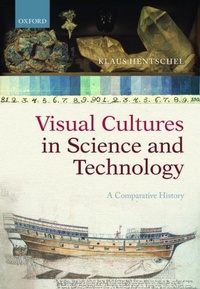
Visual Cultures in Science and Technology
A Comparative History
Published on 30. October 2014
Book
Hardback
512 pages
978-0-19-871787-4 (ISBN)
Description
This book is offers a broad, comparative survey of a booming field within the history of science: the history, generation, use, and function of images in scientific practice. It explores every aspect of visuality in science, arguing for the concept of visual domains. What makes a good scientific image? What cultural baggage is essential to it? Is science indeed defined by its pictures?
This book attempts a synthesis. It delves into the rich reservoir of case studies on visual representations in scientific and technological practice that have accumulated over the past couple of decades by historians, sociologists, and philosophers of science. The main aim is thus located on the meta-level. It adopts an integrative view of recurrently noted general features of visual cultures in science and technology, something hitherto unachieved and believed by many to be a mission impossible.
By systematic comparison of numerous case studies, the purview broadens away from myopic microanalysis in search of overriding patterns. The many different disciplines and research areas involved encompass mathematics, technology, natural history, medicine, the geosciences, astronomy, chemistry, and physics. The chosen examples span the period from the Renaissance to the late 20th century. The broad range of visual representations in scientific practice is treated, as well as schooling in pattern recognition, design and implementation of visual devices, and a narrowing in on the special role of illustrators and image specialists.
This book attempts a synthesis. It delves into the rich reservoir of case studies on visual representations in scientific and technological practice that have accumulated over the past couple of decades by historians, sociologists, and philosophers of science. The main aim is thus located on the meta-level. It adopts an integrative view of recurrently noted general features of visual cultures in science and technology, something hitherto unachieved and believed by many to be a mission impossible.
By systematic comparison of numerous case studies, the purview broadens away from myopic microanalysis in search of overriding patterns. The many different disciplines and research areas involved encompass mathematics, technology, natural history, medicine, the geosciences, astronomy, chemistry, and physics. The chosen examples span the period from the Renaissance to the late 20th century. The broad range of visual representations in scientific practice is treated, as well as schooling in pattern recognition, design and implementation of visual devices, and a narrowing in on the special role of illustrators and image specialists.
Reviews / Votes
This fine work is a survey of the history, use, and function of the image in the practice of science. ... The book is very readable, amply illustrated, and carefully documented; the biography alone exceeds 80 pages. Highly recommended. * Choice * a very useful synthesis of the study of the history and historiography of visual representation in the early modern and modern periods up to the late 20th century within the Western tradition * Renzo Baldasso, Centaurus * The spotlight that Hentschel casts on members of the latter group, a diverse cast of woodcutters, illustrators, illuminators, and other technicians, is a particular strength of the book. * Evan Hepler-Smith, Historical Studies in the Natural Sciences * a timely but colossal endeavour to take stock of the literature on visual cultures of science ... He has written a work that operates both as a major resource, friendly to those who want to merely dip in and out, and as a major scholarly contribution with a sustained argument about what constitutes visual cultures in science. Indeed, Hentschel must be congratulated on a fine contribution, one that actually gives much-needed shape to the field of visual cultures and the sciences. * Omar W. Nasim, The British Journal for the History of Science * Hentschel's is a clear and useful book which critically discusses and compares a bulk of historical case studies to reveal general principles within a broad pattern. The book is supplemented with remarkable pictures, which perfectly illustrate the notion of layered visual culture, as well as a rich bibliography and suggestions for further reading. ... Hentschel's book can be recommended to both students and specialized scholars. * Marco Tamborini, Annals of Natural History * Visual Cultures in Science and Technology is intended to provide a systematic and integrative account of the formation and development of a plurality of visual cultures throughout the history of Western science, technology, and medicine. At the core of its methodology is an exhaustive -- and new -- comparative approach based on a large number of case studies covering a period that extends from the early modern era to the present day. The selection and range of examples is indeed phenomenal. And so are the visual materials and bibliography that support the argument. * Jose Ramon Marcaida, ISIS *More details
Language
English
Place of publication
Oxford
United Kingdom
Target group
College/higher education
Professional and scholarly
Product notice
sewn/stitched
Cloth over boards
Illustrations
126 b/w illustrations, 16pp colour plates
Dimensions
Height: 246 mm
Width: 173 mm
Thickness: 38 mm
Weight
1225 gr
ISBN-13
978-0-19-871787-4 (9780198717874)
Copyright in bibliographic data and cover images is held by Nielsen Book Services Limited or by the publishers or by their respective licensors: all rights reserved.
Schweitzer Classification
Other editions
Additional editions
Book
11/2018
Oxford University Press
€66.70
Shipment within 15-20 days
E-Book
10/2014
1st Edition
OUP eBook
€26.49
Available for download
Person
Prior to his current full professorship in the history of science and technology at the University of Stuttgart, Klaus Hentschel was a Lecturer/Researcher at the Universities of Berlin, Goettingen and Berne, a Fellow at the Dibner Institute for the History of Science & Technology at MIT in Cambridge, Massachusetts 1996/97 and Ernst Cassirer Guest Professor at the University of Hamburg 2003.
Content
1. Introduction ; 2. Historiographic layers of visual science cultures ; 3. Formation of visual science cultures ; 4. Pioneers of visual science cultures ; 5. Transfer of visual techniques ; 6. Support by illustrators and image technicians ; 7. One image rarely comes alone ; 8. Practical training in visual skills ; 9. Mastery of pattern recognition ; 10. Visual thinking in scientic and technological practice ; 11. Recurrent color taxonomies ; 12. Aesthetic fascination as a visual culture's binding glue ; 13. Issues of visual perception ; 14. Visuality through and through