

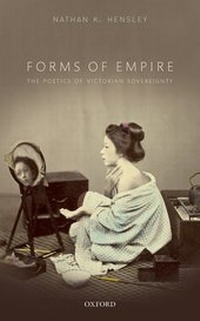
Forms of Empire
The Poetics of Victorian Sovereignty
Published on 13. September 2018
Book
Paperback/Softback
326 pages
978-0-19-883074-0 (ISBN)
Description
Forms of Empire shows how the modern state's anguished relationship to violence pushed writers to expand the capacities of literary form. The Victorian era is often imagined as an 'age of equipoise,' but the period between 1837 and 1901 included more than 200 separate wars. What is the difference, though, between peace and war? The much-vaunted equipoise of the nineteenth-century state depended on physical force to guarantee it. But the sovereign violence hidden in the shadows of all law shuddered most visibly into being at the edges of law's reach, in the Empire, where emergency was the rule and death perversely routinized. George Eliot, Charles Dickens, Wilkie Collins, A. C. Swinburne, H. Rider Haggard, and Robert Louis Stevenson, among others, all generated new formal techniques to account for the sometimes sickening interplay between order and force in their liberal Empire. In contrast to the progressive idealism we have inherited from the Victorians, these writers moved beyond embarrassment and denial in the face of modernity's uncanny relation to killing. They sought aesthetic effects-free indirect discourse, lyric tension, and the idea of literary 'character' itself-able to render thinkable the conceptual vertigoes of liberal violence. In so doing, they touched the dark core of our post-Victorian modernity. Archival work, literary analyses, and a theoretical framework that troubles the distinction between 'historicist' and 'formalist' approaches helps this book link the Victorian period to the present and articulate a forceful vision of why literary thinking matters now.
Reviews / Votes
Hensley presents a powerful intellect and a lucid voice on the scholarly scene. * Regenia Gagnier, Novel: A Forum on Fiction * The forms of Nathan Hensley's Forms of Empire: The Poetics of Victorian Sovereignty are not just sociopolitical but also literary constructs, and it is Hensley's use of form to forge connections between literature and liberal law that is the most striking feature of this book ... Original in its method, Forms of Empire also provides striking and original readings of the texts it treats. * Andrea Henderson, Studies in English Literature * Hensley manages to keep multiple strains of thought going simultaneously, such that reading Forms of Empire is like listening to music on a dozen different channels. Hardly any other critic can achieve such an ambitiously impressive stereophonic analysis. * Talia Schaffer, author of Romance's Rival: Familiar Marriage in Victorian Fiction * Well written, bracingly argued, replete with insights, the book is a significant achievement. * James Buzard, Journal of British Studies * ... Now Lauren Goodlad and Nathan Hensley offer two new ways of understanding Victorian society's commitment to expansion, conquest, and domination, and Victorian literature's commitment to staying at home ... specialists in the Victorian era -- like Goodlad and Hensley -- have shown us a great deal about the way its literature reflects upon imperialism without ever going to the colonies. * Nasser Mufti, Review 19 * A masterful and beautifully written book of commanding scope, Hensleys Forms of Empire posits a new method of reading the Victorian periods, and more broadly liberalisms, constitutive antimony: the intimate, scandalous intertwinement of violence and law (9) * Maeve Adams, Victorian Studies for the 21st Century * Stunningly smart and erudite, Forms of Empire convincingly argues that violence necessarily constitutes the other face of liberal modernity. Not only does Nathan Hensley probe the very logic of empire, but, in so doing, he also proffers an incisive meditation on contemporary habits and assumptions of literary criticism. That the book pulls these different threads together with rigor as well as elegance is but one example of its brilliance. Forms of Empire is a spectacular achievement. * Sukanya Banerjee, author of Becoming Imperial Citizens: Indians in the Late-Victorian Empire * Forms of Empire is gratifying in its determination to put not only empire but the violence upon which it depends at the center of Victorian literature and the critical project of Victorian studies * Tanya Agathocleous, Victorian Studies for the 21st Century * The book is filled with rich, illuminating writing, informed equally by rigorous archival research and sensitive close readings ... Hensley's innovative contribution is a deft amalgam of surface-oriented close reading, sensitive to the present while grounded in history * Zach Fruit, Victorian Studies for the 21st Century * A gripping, at times formidable, study that consistently and inventively gauges the depth to which in Victorian Britain the liberal state (of mind, of nationhood) was infused by its reprobated and ostensibly superseded opposite: the infliction of brutal violence on subjected bodies around the imperial globe ... This book is going to get noticed. * Herbert Tucker, John C. Coleman Professor of English, University of Virginia, author of Epic: Britain's Heroic Muse, 1790-1910 *More details
Language
English
Place of publication
Oxford
United Kingdom
Target group
College/higher education
Professional and scholarly
Dimensions
Height: 217 mm
Width: 141 mm
Thickness: 18 mm
Weight
412 gr
ISBN-13
978-0-19-883074-0 (9780198830740)
Copyright in bibliographic data and cover images is held by Nielsen Book Services Limited or by the publishers or by their respective licensors: all rights reserved.
Schweitzer Classification
Other editions
Additional editions
E-Book
11/2016
1st Edition
OUP eBook
€23.99
Available for download
E-Book
11/2016
1st Edition
OUP eBook
€23.99
Available for download
Person
Nathan K. Hensley is Assistant Professor of English at Georgetown University. His writing has appeared in Victorian Studies, Novel: A Forum on Fiction, Victorian Periodicals Review, The Stanford Arcade, and other venues.
Content
Introduction: Reading Endless War
I: Equipoise
1: Time and Violence in the Age of Equipoise
2: Reform Fiction's Logic of Belonging
II: And Elsewhere
3: Form and Excess, Morant Bay and Swinburne
4: The Philosophy of Romance Form
Conclusion: Endless War Then and Now
Notes
References
Index
I: Equipoise
1: Time and Violence in the Age of Equipoise
2: Reform Fiction's Logic of Belonging
II: And Elsewhere
3: Form and Excess, Morant Bay and Swinburne
4: The Philosophy of Romance Form
Conclusion: Endless War Then and Now
Notes
References
Index