

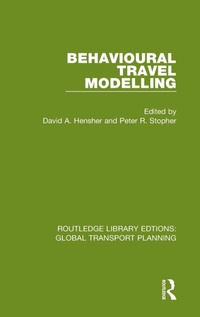
Behavioural Travel Modelling
1st Edition
Published on 12. May 2021
Book
Hardback
868 pages
978-0-367-74087-0 (ISBN)
Description
Originally published in 1979, this study deals on a fully comprehensive level with both passenger and freight travel. The 40 chapters deal with an extensive range of related topics, including equilibrium modelling, theoretical and conceptual developments in demand modelling, goods movement and forecasting and policy. It outlines approaches to understanding travel behaviour, which move beyond the individual choice theory towards a broader consideration of activities.
More details
Series
Language
English
Place of publication
London
United Kingdom
Publishing group
Taylor & Francis Ltd
Target group
College/higher education
Postgraduate, Undergraduate Advanced, and Undergraduate Core
Dimensions
Height: 240 mm
Width: 161 mm
Thickness: 51 mm
Weight
1456 gr
ISBN-13
978-0-367-74087-0 (9780367740870)
Copyright in bibliographic data and cover images is held by Nielsen Book Services Limited or by the publishers or by their respective licensors: all rights reserved.
Schweitzer Classification
Other editions
Additional editions
David A. Hensher | Peter R. Stopher
Behavioural Travel Modelling
Book
04/2023
1st Edition
Routledge
€56.94
Shipment within 15-20 days
David A. Hensher | Peter R. Stopher
Behavioural Travel Modelling
E-Book
05/2021
1st Edition
Routledge
€64.49
Available for download
David A. Hensher | Peter R. Stopher
Behavioural Travel Modelling
E-Book
05/2021
1st Edition
Routledge
€64.49
Available for download
Persons
David A. Hensher was founding Director of the Institute of Transport and Logistics Studies (ITLS) at the University of Sydney, Australia. Peter R. Stopher is Emeritus Professor at ITLS, University of Sydney, Australia.
Content
1. Behavioural Travel Modelling 2. New Approaches to Understanding Travel Behaviour: The Human Activity Approach 3. Urban-Travel Linkages: A Review 5. An Activity Model and Its Validation 5. New Approaches to Understanding Traveller Behaviour 6. Six Notes of Equilibrium and their Implications for Travel Modelling Examined in an Aggregate Direct Demand Framework 7. Equilibrium and Transport System Dynamics 8 An Equilibrium Model for Integrate Regional Development 9. Equilibrium Modelling 10. Market Segmentation: A Tool for Transport Decision-Making 11. Market Segmentation in Behavioural Travel Modelling 12. Consumer Segmentation 13. Quantitive Methods for Analysing Travel Behaviour of Individuals: Some Recent Development 14. Some Developments in Transport Demand Modelling 15. Measuring the Value of Travel Time Savings from Demand Functions 16. A Model Based on Non-Homogeneity in Allocation Problems 17. Theoretical and Conceptual Developments in Demand Modelling 18. The Role of Disaggregate Modelling Tools in the Policy Arena 19. Roles of Behavioural Traveller Models in Urban Policy Analysis 20. The Role of Disaggregate Travel Models in Transport Policy Analysis 21. Values of Time, Modal Split and Forecasting 22. Behavioural Modelling: An Evaluator's Perspective 23. Relationship Between Behavioural Models, Evaluation, Forecasting and Policy 24. Urban Goods Movement: Process, Planning Approach and Policy and 25. Urban Goods Movement: Behavioural Demand Forecasting Procedures 26. Indicators for Urban Commodity Movements 27. Urban Goods Movement: Research Review 28. The Applicability of Behavioural Modelling to the Analysis of Goods Movement 29. Behavioural Modelling, Accessibility, Mobility and Need: Concepts and Measurement 30. Disaggregate Travel and Mobility Choice Models and Measures of Accessibility 31. Mobility, Accessibility and Travel Impacts of Transportation Programs for the Elderly and Handicapped 32. Behavioral Modelling, Accessibility, Mobility and Travel Needs 33. Application of Psychological Measurement and Modelling to Behavioural Travel-Demand Analysis 34. Attitude-Behaviour Relationships in Travel Demand Modelling 35. The Development of Attitudinal Modelling Approaches in Transport Research 36. Attitudes, Attitudinal Measurement, and the Relationship Between Attitudes and Behaviour 37. Evaluating the Social and Environmental Impacts of Transport Investments 38. Behavioural Modelling and the Evaluation of Social and Environmental Impacts of Transport Investment 39. Summary of the Conference Findings and Recommendations