

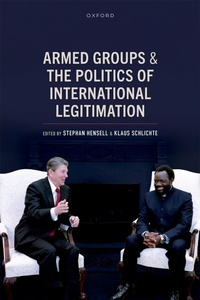
Armed Groups and the Politics of International Legitimation
Will be published approx. on 20. January 2026
Book
Hardback
320 pages
978-0-19-897451-2 (ISBN)
Description
Non-state armed groups - rebels, guerrillas, militias, liberation movements - not only fight for state power but also for international legitimacy. Why are some armed groups successful in turning the power of the gun into legitimate authority that is internationally recognized while others fail? Contributing to a vibrant scholarly debate, this book is the first comparative study of armed groups that try to gain international legitimacy. It analyses how and when these attempts are successful.
The volume presents a new framework for analysing the politics of legitimation that evolve around armed groups. Based on practice theory and global history, it highlights the interaction of practices and publics in the process of legitimation and introduces four different historical times, spanning from 1945 to the present, that have set different structural conditions for armed groups' pursuit of international legitimacy. Armed Groups and the Politics of International Legitimation encompasses in-depth case studies on Indonesia, Vietnam, Western Sahara, Nicaragua, El Salvador, Uganda, Angola, Palestine, Afghanistan, and Libya. Written by experts on these contexts, it suggests a research strategy of 'reiterative case comparison' that bridges the gap between political science, history, and sociology. It advances a new theoretical understanding of armed groups as international actors that co-shape international politics and as forces with a genuine quest for legitimacy, which allows us new insights into the fabric of international relations.
The volume presents a new framework for analysing the politics of legitimation that evolve around armed groups. Based on practice theory and global history, it highlights the interaction of practices and publics in the process of legitimation and introduces four different historical times, spanning from 1945 to the present, that have set different structural conditions for armed groups' pursuit of international legitimacy. Armed Groups and the Politics of International Legitimation encompasses in-depth case studies on Indonesia, Vietnam, Western Sahara, Nicaragua, El Salvador, Uganda, Angola, Palestine, Afghanistan, and Libya. Written by experts on these contexts, it suggests a research strategy of 'reiterative case comparison' that bridges the gap between political science, history, and sociology. It advances a new theoretical understanding of armed groups as international actors that co-shape international politics and as forces with a genuine quest for legitimacy, which allows us new insights into the fabric of international relations.
More details
Language
English
Place of publication
Oxford
United Kingdom
Target group
Professional and scholarly
Product notice
sewn/stitched
Cloth over boards
With dust jacket
Dimensions
Height: 240 mm
Width: 166 mm
Thickness: 28 mm
Weight
612 gr
ISBN-13
978-0-19-897451-2 (9780198974512)
Copyright in bibliographic data and cover images is held by Nielsen Book Services Limited or by the publishers or by their respective licensors: all rights reserved.
Schweitzer Classification
Persons
Stephan Hensell is a Senior Researcher at the Institute of Intercultural and International Studies (InIIS) at the University of Bremen. He has held positions as researcher and lecturer at the Institute for Peace Research and Security Policy and at the Institute of Political Science at the University of Hamburg. He was Visiting Research Fellow at the Changing Character of War Programme, University of Oxford and has done field research in Georgia, Albania, Kosovo, Morocco, Western Sahara, Algeria, and Belgium. His research interests include state theory, civil wars, armed groups, international organizations, and EU politics.
Klaus Schlichte is Professor of International Relations and World Society at the University of Bremen. With an interest in global political sociology, Schlichte carried out research in Senegal, Mali, Serbia, France and Uganda and taught at Science-Po, Paris, the University of Washington, Seattle, the OECD Academy in Bishkek, and at several German universities. Apart from numerous works in German, he is the author of In the Shadow of Violence: The Politics of Armed Groups (Campus, Frankfurt/Main, 2009), and the co-editor of The Historicity of International Politics: Imperialism and the Presence of the Past (Cambridge University Press, 2023).
Klaus Schlichte is Professor of International Relations and World Society at the University of Bremen. With an interest in global political sociology, Schlichte carried out research in Senegal, Mali, Serbia, France and Uganda and taught at Science-Po, Paris, the University of Washington, Seattle, the OECD Academy in Bishkek, and at several German universities. Apart from numerous works in German, he is the author of In the Shadow of Violence: The Politics of Armed Groups (Campus, Frankfurt/Main, 2009), and the co-editor of The Historicity of International Politics: Imperialism and the Presence of the Past (Cambridge University Press, 2023).
Volume editor
Senior ResearcherSenior Researcher, Institute of Intercultural and International Studies (InIIS), University of Bremen
Professor of International Relations and World SocietyProfessor of International Relations and World Society, Institute of Intercultural and International Studies (InIIS), University of Bremen
Content
- 1: Stephan Hensell and Klaus Schlichte: Fighting for Legitimacy: Armed Groups and the Politics of International Legitimation
- 2: Robert J. McMahon: Decolonization and the Cold War: The Superpowers and the Anti-colonial Insurgencies in Indonesia and Vietnam
- 3: Stephan Hensell: Western Sahara, the Polisario, and the Struggle for International Legitimacy
- 4: Eline van Ommen: The FSLN and the Politics of Legitimation in the Cold War: Sandinista Revolutionaries and Transnational Activism
- 5: Andrea Oñate-Madrazo: Tequila Diplomacy: Mexican-FMLN Relations in the Early Salvadoran Civil War
- 6: Klaus Schlichte: 'When we became stronger, they listened more': The Politics of Legitimation of the NRA in Uganda (1981-1986)
- 7: Reyko Huang: The Politics of Mutual Legitimation: UNITA, Lobbyists, and Washington in the Angolan Civil War
- 8: Christian Olsson: Between the 'Dome of the Rock' and a Hard Place: Fatah and the Trade-off between Armed Struggle and International Legitimacy
- 9: Leila Seurat: From Government to Armed Struggle: Hamas's Legitimation Politics
- 10: Ahmed Elsayed: Recognition on their Own Terms?: The Paradox of the Taliban's Quest for International Legitimacy
- 11: Wolfram Lacher: The Astonishingly Easy Path to International Legitimacy of Khalifa Haftar's LAAF
- Conclusions
- Some Further Thoughts