

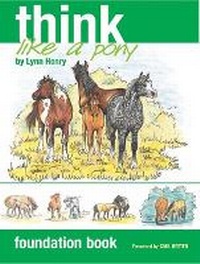
Think Like a Pony: Foundation Book
Published on 2. April 2007
Book
Paperback/Softback
80 pages
978-1-905693-09-2 (ISBN)
Description
Some parents have young children who are 'pony mad', but they themselves have no understanding or knowledge of ponies. By reading this book with their children, they can learn together and enjoy the fascinating journey of understanding pony behaviour.
Armed with this knowledge and understanding readers can appreciate how a pony can become:
safe to be with
safe to handle
safe to ride
a willing friend and partner.
No matter how long a parent or child has been involved with ponies, there are always new things to learn and understand. There may be 'that pony' who makes you think that you know nothing at all!
Whether a child reads this book alone or with an adult, it is the beginning of a wonderful journey for both child and pony.
Foreword by Carl Hester.
Armed with this knowledge and understanding readers can appreciate how a pony can become:
safe to be with
safe to handle
safe to ride
a willing friend and partner.
No matter how long a parent or child has been involved with ponies, there are always new things to learn and understand. There may be 'that pony' who makes you think that you know nothing at all!
Whether a child reads this book alone or with an adult, it is the beginning of a wonderful journey for both child and pony.
Foreword by Carl Hester.
Reviews / Votes
This great book is easy to understand and is a must for any boy or girl who wants to be around horses and ponies. It is also great for non-horsey parents and may teach them a thing or two as well! -- Carl Hester This book is a great way for pony-mad kids (and their parents) to learn to understand the way ponies think and why they behave as they do. The book has backing from top dressage rider Carl Hester, who stresses how important it is to know how to work with horses and ponies in a safe way. Think Like a Pony takes a fun and informative approach to looking at equine behaviour, which through illustrations and punchy paragraphs, offers the reader a delightful pictorial guide to understanding horses and ponies. The ideal reading choice for non-horsey parents and pony mad kids, this book helps combine educational reading with an interesting topic that also helps both adults and children stay safe around horses and ponies and would be an ideal Christmas gift for pony mad girls.More details
Series
Language
English
Place of publication
United Kingdom
Target group
Children/juvenile
US School Grade: Preschool and over, Interest Age: From 8 years
Product notice
Paper over boards
Dimensions
Height: 240 mm
Width: 185 mm
Thickness: 12 mm
ISBN-13
978-1-905693-09-2 (9781905693092)
Copyright in bibliographic data and cover images is held by Nielsen Book Services Limited or by the publishers or by their respective licensors: all rights reserved.
Schweitzer Classification
Persons
Lynn Henry is a registered Equine Ethology Instructor, living in West Yorkshire. A dedicated senior school teacher before leaving to bring up her family of 3 boys and a girl. Lynn has a lifelong passion for teaching and particularly the teaching of children.
Content
Foreword by Carl Hester
Introduction
1. How does your pony make you feel
2. Friendship
3. From the beginning
4. Mare and foal
5. How does the mare teach her foal body language
6. Comfort and discomfort
7. In the herd
8. Listen to me
9. The pony's voice
10. Body language
11. Personal space
12. Can I move your feet?
13. Looking for a leader
14. Thinking like a pony
15. Using a pony's language
16. Does your pony see you as a leader?
17. Becoming a horseman
18. So what do you do now?
Introduction
1. How does your pony make you feel
2. Friendship
3. From the beginning
4. Mare and foal
5. How does the mare teach her foal body language
6. Comfort and discomfort
7. In the herd
8. Listen to me
9. The pony's voice
10. Body language
11. Personal space
12. Can I move your feet?
13. Looking for a leader
14. Thinking like a pony
15. Using a pony's language
16. Does your pony see you as a leader?
17. Becoming a horseman
18. So what do you do now?