

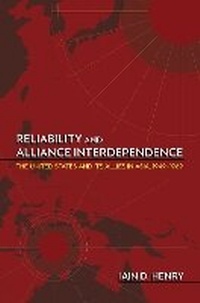
Reliability and Alliance Interdependence
The United States and Its Allies in Asia, 1949-1969
Published on 15. May 2022
Book
Paperback/Softback
258 pages
978-1-5017-6554-4 (ISBN)
Description
In Reliability and Alliance Interdependence, Iain D. Henry argues for a more sophisticated approach to alliance politics and ideas of interdependence.
It is often assumed that if the United States failed to defend an ally, then this disloyalty would instantly and irrevocably damage US alliances across the globe. Henry proposes that such damage is by no means inevitable and that predictions of disaster are dangerously simplistic. If other allies fear the risks of military escalation more than the consequences of the United States abandoning an ally, then they will welcome, encourage, and even praise such an instance of disloyalty. It is also often assumed that alliance interdependence only constrains US policy options, but Henry shows how the United States can manipulate interdependence to set an example of what constitutes acceptable allied behavior.
Using declassified documents, Henry explores five case studies involving US alliances with South Korea, Japan, the Republic of China, the Philippines, Australia, and New Zealand. Reliability and Alliance Interdependence makes a substantial contribution to our understanding of how America's alliances in Asia function as an interdependent system.
It is often assumed that if the United States failed to defend an ally, then this disloyalty would instantly and irrevocably damage US alliances across the globe. Henry proposes that such damage is by no means inevitable and that predictions of disaster are dangerously simplistic. If other allies fear the risks of military escalation more than the consequences of the United States abandoning an ally, then they will welcome, encourage, and even praise such an instance of disloyalty. It is also often assumed that alliance interdependence only constrains US policy options, but Henry shows how the United States can manipulate interdependence to set an example of what constitutes acceptable allied behavior.
Using declassified documents, Henry explores five case studies involving US alliances with South Korea, Japan, the Republic of China, the Philippines, Australia, and New Zealand. Reliability and Alliance Interdependence makes a substantial contribution to our understanding of how America's alliances in Asia function as an interdependent system.
More details
Series
Language
English
Place of publication
Ithaca
United States
Product notice
Paperback (trade)
Illustrations
2 maps, 2 diagrams - 2 Maps - 2 Diagrams
Dimensions
Height: 229 mm
Width: 152 mm
Thickness: 19 mm
Weight
454 gr
ISBN-13
978-1-5017-6554-4 (9781501765544)
Copyright in bibliographic data and cover images is held by Nielsen Book Services Limited or by the publishers or by their respective licensors: all rights reserved.
Schweitzer Classification
Other editions
Additional editions
Iain D. Henry
Reliability and Alliance Interdependence
The United States and Its Allies in Asia, 1949-1969
E-Book
05/2022
Cornell University Press
€0.00
Available for download
Person
Iain D. Henry is Senior Lecturer at the Strategic and Defense Studies Centre at Australian National University. Follow him on X @IainDHenry.
Content
Introduction
1. Alliances, Reliability, and Interdependence
2. Forming Alliances in Asia, 1949-1951
3. Unleashing and Re-leashing Chiang Kai-shek, 1953-1954
4. Allies Encourage Limits on US Loyalty to Formosa, 1954-1955
5. Revision of the U.S.-Japan Alliance, 1955-1960
6. Negotiating the Reversion of Okinawa, 1967-1969
Conclusion
1. Alliances, Reliability, and Interdependence
2. Forming Alliances in Asia, 1949-1951
3. Unleashing and Re-leashing Chiang Kai-shek, 1953-1954
4. Allies Encourage Limits on US Loyalty to Formosa, 1954-1955
5. Revision of the U.S.-Japan Alliance, 1955-1960
6. Negotiating the Reversion of Okinawa, 1967-1969
Conclusion