

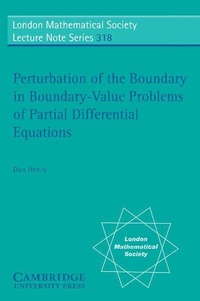
Perturbation of the Boundary in Boundary-Value Problems of Partial Differential Equations
Published on 26. May 2005
Book
Paperback/Softback
216 pages
978-0-521-57491-4 (ISBN)
Description
Perturbation of the boundary is a rather neglected topic in the study of PDEs for two main reasons. First, on the surface it appears trivial, merely a change of variables and an application of the chain rule. Second, carrying out such a change of variables frequently results in long and difficult calculations. In this book, first published in 2005, the author carefully discusses a calculus that allows the computational morass to be bypassed, and he goes on to develop more general forms of standard theorems, which help answer a wide range of problems involving boundary perturbations. Many examples are presented to demonstrate the usefulness of the author's approach, while on the other hand many tantalizing open questions remain. Anyone whose research involves PDEs will find something of interest in this book.
More details
Series
Language
English
Place of publication
Cambridge
United Kingdom
Target group
Professional and scholarly
Product notice
Paperback (trade)
Illustrations
13 Line drawings, unspecified
Dimensions
Height: 229 mm
Width: 152 mm
Thickness: 14 mm
Weight
358 gr
ISBN-13
978-0-521-57491-4 (9780521574914)
Copyright in bibliographic data and cover images is held by Nielsen Book Services Limited or by the publishers or by their respective licensors: all rights reserved.
Schweitzer Classification
Other editions
Additional editions
Dan Henry | Jack Hale | Antonio Luiz Pereira
Perturbation of the Boundary in Boundary-Value Problems of Partial Differential Equations
Edited by Jack / Pereira, Antônio Luiz Hale
E-Book
07/2005
1st Edition
Cambridge University Press
€82.99
Available for download
Content
Introduction; 1. Geometrical preliminaries; 2. Differential calculus of boundary perturbations; 3. Examples using the implicit function theorem; 4. Bifurcation problems; 5. The transversality theorem; 6. Generic perturbation of the boundary; 7. Boundary operators for second-order elliptic equations; 8. The method of rapidly-oscillating solutions.