

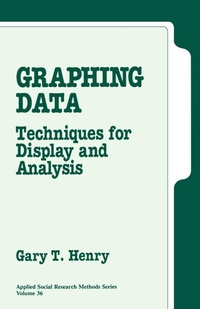
Graphing Data
Techniques for Display and Analysis
1st Edition
Published on 11. November 1994
Book
Paperback/Softback
164 pages
978-0-8039-5675-9 (ISBN)
Description
Gary Henry has provided an excellent little book which discusses not only the basic 'techniques for display and analysis' which are available, but offers some very timely hints for their effective use. His audience is the 'applied researcher'. . . anybody engaged in empirical research at all. . . . He does. . . provide empirically grounded and valuable advice throughout on how best to design effective, accurate and reliable displays. . . . he provides a theoretical framework to guide the design of competent graphical displays. . . . Graphing Data. . . is well worth a good read. --Randy Banks in ESRC Data Archive Bulletin "Graphing Data is an accurate and factual presentation of effective techniques for graphically displaying quantitative data. The ideas postulated within the book represent effective techniques for graphing quantitative data and are consistent with the ideas of contemporary authors about the visual display of quantitative information. Graphing Data provides guidelines for researchers with desktop publishing capability who desire to incorporate graphs displaying quantitative data into research and evaluation reports. . . . The book is worthy of consideration as a course text for the introduction to graphing data or as a supplementary text for an introductory course on statistics where communicating research results are discussed. . . . Graphing Data serves as a legitimate reference for selecting appropriate data displays depending on the type of data and the purpose of data. . . . I would recommend this book for researchers and scholars interested in the effective communication of quantitative data to broad audiences." --Robert C. Branch in a prepublication review for Evaluation and Program Planning How can applied researchers present and analyze their research data more effectively? By using the techniques described in this volume, social scientists will be able to make their data more accessible to nontechnical audiences. This book is packed with examples that illustrate the characteristics of effective graphical displays of data and provides solid techniques for producing graphs. Graphing Data begins with a discussion of what has been learned from the visual perception research that relates to graphing data. It then explores the analysis tasks that apply most often: the use of graphs for data summarization, the display of multiple units, ways to improve tabular displays, graphical alternatives to tables, two-variable scatterplots as graphical support for correlation and regression, how to show variation and summary statistics together, and how to create more effective legends and titles on graphical displays.
More details
Series
Language
English
Place of publication
Thousand Oaks
United States
Target group
Professional and scholarly
Dimensions
Height: 216 mm
Width: 140 mm
Thickness: 9 mm
Weight
220 gr
ISBN-13
978-0-8039-5675-9 (9780803956759)
Copyright in bibliographic data and cover images is held by Nielsen Book Services Limited or by the publishers or by their respective licensors: all rights reserved.
Schweitzer Classification
Other editions
Additional editions
Book
01/1995
1st Edition
SAGE Publications Inc
€121.40
Article exhausted; check different version
Person
Duncan and Rebecca Kyle MacRae Professor of Public Policy; Director of Graduate Admissions; Director of Education Policy Initiative at Carolina
Content
Applied Research and the Use of Graphical Displays
Graphical Competence
Data Summaries
Parts of a Whole
Displaying Multiple Units
Trends
Graphical Complements for Correlation and Regression
Graphical Complements for T-Tests and Analysis of Variance
Achieving Graphical Competence
Graphical Competence
Data Summaries
Parts of a Whole
Displaying Multiple Units
Trends
Graphical Complements for Correlation and Regression
Graphical Complements for T-Tests and Analysis of Variance
Achieving Graphical Competence