

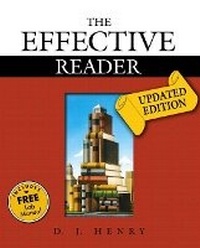
Effective Reader, The, Updated Edition (with MyReadingLab)
Published on 7. September 2007
Book
Mixed media product
978-0-321-45692-2 (ISBN)
Description
The Effective Reader integrates reading skills with the reading process (SQ3R) to produce more effective readers and help students discover the power and pleasure of reading. Providing step-by-step reading instruction, a wide range of practice and test materials, and a rich selection of readings from textbooks and other sources, the author combines solid skill instruction with an abundance of guided practice to develop the quintessential abilities students need to become effective readers and critical thinkers.
More details
Language
English
Place of publication
New Jersey
United States
Publishing group
Pearson Education (US)
Target group
Professional and scholarly
Dimensions
Height: 235 mm
Width: 191 mm
Weight
1451 gr
ISBN-13
978-0-321-45692-2 (9780321456922)
Copyright in bibliographic data and cover images is held by Nielsen Book Services Limited or by the publishers or by their respective licensors: all rights reserved.
Schweitzer Classification
Other editions
New editions
D. J. Henry
The Effective Reader
Book
10/2007
2nd Edition
Pearson
€50.94
Article exhausted; check for reprint
Content
Preface.
Introduction.
I. BECOMING AN EFFECTIVE READER.
1. A Reading System for Effective Readers.
Prior Knowledge
The Reading Process
Before Reading: Survey and Question
*Get Ready to Read
During Reading: Read and Recite
After Reading: Review.
*Stop and Think.
Textbook Skills: Asking Questions and Reciting Answers Before, During, and After Reading.
Chapter Review.
Applications.
Review Tests.
Mastery Tests.
2. Vocabulary Skills.
*Get Ready to Read About Vocabulary Skills.
Words Are Building Blocks.
Context Clues: A SAGE Approach.
Synonyms.
Antonyms.
General Context.
Examples.
Textbook Skills: Using a Glossary.
Word Parts.
Roots.
Prefixes.
Suffixes.
Textbook Skills: Visual Vocabulary .
Chapter Review.
Applications.
Review Tests.
*Stop and Think.
Mastery Tests.
3. Stated Main Ideas.
*Get Ready to Read About Stated Main Ideas.
The Traits of a Main Idea
Identifying the Topic of a Paragraph.
Identifying a Topic Sentence.
The Flow of Ideas and Placement of Topic Sentences.
Topic Sentence at the Beginning of a Paragraph.
Topic Sentence Within a Paragraph.
Topic Sentence at the End of a Paragraph.
Topic Sentence at the Beginning and the End of a Paragraph.
The Central Idea and the Thesis Statement.
Textbook Skills: Topics, Main Ideas, and Central Ideas in Textbooks.
Chapter Review.
Applications.
Review Tests.
*Stop and Think.
Mastery Tests.
4. Supporting Details.
*Get Ready to Read About Supporting Details.
Questions for Locating Supporting Details.
Major and Minor Details.
Creating a Summary from Annotations.
Textbook Skills: Chapter-end Questions in a Textbook.
Chapter Review.
Applications.
Review Tests.
*Stop and Think.
Mastery Tests.
5. Outlines and Concept Maps.
*Get Ready to Read About Outlines and Concept Maps.
Outlines.
Concept Maps
Textbook Skills: The Table of Contents
Chapter Review.
Applications.
Review Tests.
*Stop and Think.
Mastery Tests.
6. Transitions and Thought Patterns.
*Get Ready to Read About Transitions and Thought Patterns.
Transition Words: Relationships Within a Sentence.
Thought Patterns: Relationships Between Sentences.
The Time Order Pattern.
The Space Order Pattern.
The Listing Pattern.
The Classification Pattern.
Textbook Skills: Thought Patterns in Textbooks.
Chapter Review.
Applications.
Review Tests.
*Step and Think.
Mastery Tests.
7. More Thought Patterns.
*Get Ready to Read About More Thought Patterns.
The Comparison-and-Contrast Pattern.
Comparison
Contrast .
Comparison and Contrast .
The Cause-and-Effect Pattern.
The Generalization-and-Example Pattern.
The Definition Pattern.
Textbook Skills: Thought Patterns and Textbooks.
Chapter Review.
Applications.
Review Tests.
*Stop and Think.
Mastery Tests.
8. Implied Main Ideas and Implied Central Ideas.
*Get Ready to Read About Implied Main Ideas and Implied Central Ideas.
What Is an Implied Main Idea?.
Using Supporting Details and Thought Patterns to Find Implied Main Ideas.
Finding the Implied Main Ideas of Paragraphs.
Creating a Summary from the Supporting Details.
The Implied Central Idea.
Textbook Skills: Graphics as Details That Imply a Main Idea.
A Final Note about Experience and Perspective.
Chapter Review.
Applications.
Review Tests.
Mastery Tests.
9. Fact and Opinion.
*Get Ready to Read About Fact and Opinion.
What Is the Difference Between Fact and Opinion?.
Ask Questions to Identify Facts.
Note Biased Words to Identify Opinions.
Note Qualifiers to Identify Opinions.
Think Carefully About Supposed "Facts".
Read Critically: Evaluate Details as Fact or Opinion in Context.
Evaluate the Context of the Passage.
Evaluate the Context of the Author.
Evaluate the Context of the Source.
Textbook Skills: Fact and Opinion in Textbook Passages.
Chapter Review.
Applications.
Review Tests.
*Stop and Think.
Mastery Tests.
10. Tone and Purpose.
*Get Ready to Read About Tone and Purpose.
What Are Tone and Purpose?.
Understand How Tone Is Established.
Identify Subjective and Objective Tone Words.
Discover the General Purpose in the Main Idea.
Figure Out the Primary Purpose.
Recognize Irony Used for Special Effects.
Textbook Skills: Author's Tone and Purpose .
Chapter Review.
Applications.
Review Tests.
*Stop and Think.
Mastery Tests.
11. Inferences.
*Get Ready to Read About Inferences.
Inferences: Educated Guesses.
What Is a Valid Inference?.
Making VALID Inferences and Avoiding Invalid Conclusions.
Step 1: Verify and Value the Facts.
Step 2: Assess Prior Knowledge.
Step 3: Learn from the Text.
Step 4. Investigate for Bias.
Step 5: Detect Contradictions.
Inferences in Creative Expression.
Textbook Skills: Inferences and Visual Aids.
Chapter Review.
Applications.
Review Tests.
*Stop and Think.
Mastery Tests.
12. The Basics of Argument.
*Get Ready to Read About the Basics of Argument.
What Is an Argument?.
Step 1. Identify the Author's Claim and Supports.
Step 2. Decide Whether the Supports Are Relevant.
Step 3. Decide Whether the Supports Are Adequate.
Step 4: Check the Argument for Bias.
Textbook Skills: The Logic of Argument.
Chapter Review.
Applications.
Review Tests.
*Stop and Think.
Mastery Tests.
13. Advanced Argument: Persuasive Techniques.
*Get Ready to Read About Advanced Argument.
Biased Arguments.
What Is a Fallacy in Logical Thought?
What Is Propaganda?
Irrelevant Arguments: Fallacies.
Personal Attack.
Straw Man.
Begging the Question.
Irrelevant Arguments: Propaganda Techniques.
Name-Calling.
Testimonials.
Plain Folks.
Bandwagon.
Inadequate Arguments: Fallacies.
Either-Or.
False Comparison.
False Cause.
Inadequate Arguments: Propaganda Techniques.
Card Stacking.
Transfer.
Glittering Generalities.
Textbook Skills: Examining Biased Arguments.
Chapter Review.
Applications.
Review Tests.
*Stop and Think.
Mastery Tests.
II. ADDITIONAL READINGS.
The Connection Between Reading and Writing.
Step 1: Prewrite.
Step 2: Organize Your Ideas.
Step 3: Write.
Step 4: Edit and Revise.
Annotating a Text.
Writing a Summary.
1. One Person's Path to Literacy, Richard Wanderman.
2. Native American Sports Mascots.
3. Messages from a Welfare Mom, Ramona Parish.
4. Darkness at Noon, Harold Krents.
5. Curbing College Drinking Starts with a Change in Attitude, Sara Fritz.
6. Time to Look and Listen, Magdoline Asfahani.
7. The Day Language Came into My Life, Helen Keller.
8. My Best Friend, Joe, Gersh Kuntzman.
9. A World Safe for Babies, Ellen Goodman.
10. Managing Your Time, Edwin Bliss.
III. COMBINED-SKILLS TESTS.
IV. READING ENRICHMENT.
A Reading Graphics in Textbooks.
Lab Manual.
A Reading System for Effective Readers.
1. Prior Knowledge.
2. The Reading Process: Before Reading.
3. The Reading Process: During Reading.
4. The Reading Process: After Reading.
5. Textbook Skills.
Vocabulary Skills.
6. Context Clues.
7. Roots.
8. Prefixes.
9. Suffixes.
10. Textbook Skills.
Stated Main Ideas.
11. Identifying Topics and Main Ideas.
12. Topics, Main Ideas, and Supporting Details.
13. Placement of Topic Sentences.
14. Topic, Central Idea, and Details.
15. Textbook Skills.
Supporting Details.
16. Questions for Locating Details.
17. Supporting Details.
18. Major and Minor Details.
19. Creating a Summary from Annotations.
20. Textbook Skills.
Outlines and Concept Maps.
21. Outlining.
22. Formal Outlines.
23. Concept Maps.
24. More Concept Maps.
25. Textbook Skills.
Transitions and Thought Patterns.
26. Time Order Patterns.
27. The Space Order Pattern.
28. The Listing Pattern
29. The Classification Pattern.
30. Textbook Skills.
More Thought Patterns.
31. The Comparison-and-Contrast Pattern.
32. The Cause-and-Effect Pattern.
33. The Generalization-and-Example Pattern.
34. The Definition Pattern.
35. Textbook Skills.
Implied Main Ideas and Implied Central Ideas.
36. Implied Main Ideas.
37. Implied Main Ideas in Analogies.
38. Implied Main Ideas in Literature.
39. Implied Central Ideas.
40. Textbook Skills.
Fact and Opinion.
41. Fact and Opinion.
42. Biased Words and Qualifiers.
43. Reading Critically in Context.
44. Fact and Opinion in a Newspaper Article.
45. Textbook Skills.
Tone and Purpose.
46. Subjective and Objective Tone.
47. Author's Purpose.
48. Tone and Purpose in Nonfiction.
49. Verbal and Situational Irony.
50. Textbook Skills.
Inferences.
51. Inferences: Educated Guesses.
52. Valid Inferences.
53. Making VALID Inferences and Avoiding Invalid Conclusions.
54. Inferences in Creative Expression.
55. Textbook Skills.
The Basics of Argument.
56. Claim and Support.
57. Relevant and Adequate Support.
58. Argument in a Periodical Article.
59. Bias in Political Cartoons.
60. Textbook Skills.
Advanced Argument.
61. Irrelevant Arguments: Fallacies.
62. Irrelevant Arguments: Propaganda Techniques.
63. Inadequate Arguments: Fallacies.
64. Inadequate Arguments: Propaganda Techniques.
65. Textbook Skills.
Practice Tests.
66. Practice Tests for the Florida College Basic Skills Exit Reading Test.
67. Practice Tests for the Texas Higher Education Assessment Test.
68. Practice Tests for The Effective Reader.
Text Credits.
Photo Credits .
Index.
Introduction.
I. BECOMING AN EFFECTIVE READER.
1. A Reading System for Effective Readers.
Prior Knowledge
The Reading Process
Before Reading: Survey and Question
*Get Ready to Read
During Reading: Read and Recite
After Reading: Review.
*Stop and Think.
Textbook Skills: Asking Questions and Reciting Answers Before, During, and After Reading.
Chapter Review.
Applications.
Review Tests.
Mastery Tests.
2. Vocabulary Skills.
*Get Ready to Read About Vocabulary Skills.
Words Are Building Blocks.
Context Clues: A SAGE Approach.
Synonyms.
Antonyms.
General Context.
Examples.
Textbook Skills: Using a Glossary.
Word Parts.
Roots.
Prefixes.
Suffixes.
Textbook Skills: Visual Vocabulary .
Chapter Review.
Applications.
Review Tests.
*Stop and Think.
Mastery Tests.
3. Stated Main Ideas.
*Get Ready to Read About Stated Main Ideas.
The Traits of a Main Idea
Identifying the Topic of a Paragraph.
Identifying a Topic Sentence.
The Flow of Ideas and Placement of Topic Sentences.
Topic Sentence at the Beginning of a Paragraph.
Topic Sentence Within a Paragraph.
Topic Sentence at the End of a Paragraph.
Topic Sentence at the Beginning and the End of a Paragraph.
The Central Idea and the Thesis Statement.
Textbook Skills: Topics, Main Ideas, and Central Ideas in Textbooks.
Chapter Review.
Applications.
Review Tests.
*Stop and Think.
Mastery Tests.
4. Supporting Details.
*Get Ready to Read About Supporting Details.
Questions for Locating Supporting Details.
Major and Minor Details.
Creating a Summary from Annotations.
Textbook Skills: Chapter-end Questions in a Textbook.
Chapter Review.
Applications.
Review Tests.
*Stop and Think.
Mastery Tests.
5. Outlines and Concept Maps.
*Get Ready to Read About Outlines and Concept Maps.
Outlines.
Concept Maps
Textbook Skills: The Table of Contents
Chapter Review.
Applications.
Review Tests.
*Stop and Think.
Mastery Tests.
6. Transitions and Thought Patterns.
*Get Ready to Read About Transitions and Thought Patterns.
Transition Words: Relationships Within a Sentence.
Thought Patterns: Relationships Between Sentences.
The Time Order Pattern.
The Space Order Pattern.
The Listing Pattern.
The Classification Pattern.
Textbook Skills: Thought Patterns in Textbooks.
Chapter Review.
Applications.
Review Tests.
*Step and Think.
Mastery Tests.
7. More Thought Patterns.
*Get Ready to Read About More Thought Patterns.
The Comparison-and-Contrast Pattern.
Comparison
Contrast .
Comparison and Contrast .
The Cause-and-Effect Pattern.
The Generalization-and-Example Pattern.
The Definition Pattern.
Textbook Skills: Thought Patterns and Textbooks.
Chapter Review.
Applications.
Review Tests.
*Stop and Think.
Mastery Tests.
8. Implied Main Ideas and Implied Central Ideas.
*Get Ready to Read About Implied Main Ideas and Implied Central Ideas.
What Is an Implied Main Idea?.
Using Supporting Details and Thought Patterns to Find Implied Main Ideas.
Finding the Implied Main Ideas of Paragraphs.
Creating a Summary from the Supporting Details.
The Implied Central Idea.
Textbook Skills: Graphics as Details That Imply a Main Idea.
A Final Note about Experience and Perspective.
Chapter Review.
Applications.
Review Tests.
Mastery Tests.
9. Fact and Opinion.
*Get Ready to Read About Fact and Opinion.
What Is the Difference Between Fact and Opinion?.
Ask Questions to Identify Facts.
Note Biased Words to Identify Opinions.
Note Qualifiers to Identify Opinions.
Think Carefully About Supposed "Facts".
Read Critically: Evaluate Details as Fact or Opinion in Context.
Evaluate the Context of the Passage.
Evaluate the Context of the Author.
Evaluate the Context of the Source.
Textbook Skills: Fact and Opinion in Textbook Passages.
Chapter Review.
Applications.
Review Tests.
*Stop and Think.
Mastery Tests.
10. Tone and Purpose.
*Get Ready to Read About Tone and Purpose.
What Are Tone and Purpose?.
Understand How Tone Is Established.
Identify Subjective and Objective Tone Words.
Discover the General Purpose in the Main Idea.
Figure Out the Primary Purpose.
Recognize Irony Used for Special Effects.
Textbook Skills: Author's Tone and Purpose .
Chapter Review.
Applications.
Review Tests.
*Stop and Think.
Mastery Tests.
11. Inferences.
*Get Ready to Read About Inferences.
Inferences: Educated Guesses.
What Is a Valid Inference?.
Making VALID Inferences and Avoiding Invalid Conclusions.
Step 1: Verify and Value the Facts.
Step 2: Assess Prior Knowledge.
Step 3: Learn from the Text.
Step 4. Investigate for Bias.
Step 5: Detect Contradictions.
Inferences in Creative Expression.
Textbook Skills: Inferences and Visual Aids.
Chapter Review.
Applications.
Review Tests.
*Stop and Think.
Mastery Tests.
12. The Basics of Argument.
*Get Ready to Read About the Basics of Argument.
What Is an Argument?.
Step 1. Identify the Author's Claim and Supports.
Step 2. Decide Whether the Supports Are Relevant.
Step 3. Decide Whether the Supports Are Adequate.
Step 4: Check the Argument for Bias.
Textbook Skills: The Logic of Argument.
Chapter Review.
Applications.
Review Tests.
*Stop and Think.
Mastery Tests.
13. Advanced Argument: Persuasive Techniques.
*Get Ready to Read About Advanced Argument.
Biased Arguments.
What Is a Fallacy in Logical Thought?
What Is Propaganda?
Irrelevant Arguments: Fallacies.
Personal Attack.
Straw Man.
Begging the Question.
Irrelevant Arguments: Propaganda Techniques.
Name-Calling.
Testimonials.
Plain Folks.
Bandwagon.
Inadequate Arguments: Fallacies.
Either-Or.
False Comparison.
False Cause.
Inadequate Arguments: Propaganda Techniques.
Card Stacking.
Transfer.
Glittering Generalities.
Textbook Skills: Examining Biased Arguments.
Chapter Review.
Applications.
Review Tests.
*Stop and Think.
Mastery Tests.
II. ADDITIONAL READINGS.
The Connection Between Reading and Writing.
Step 1: Prewrite.
Step 2: Organize Your Ideas.
Step 3: Write.
Step 4: Edit and Revise.
Annotating a Text.
Writing a Summary.
1. One Person's Path to Literacy, Richard Wanderman.
2. Native American Sports Mascots.
3. Messages from a Welfare Mom, Ramona Parish.
4. Darkness at Noon, Harold Krents.
5. Curbing College Drinking Starts with a Change in Attitude, Sara Fritz.
6. Time to Look and Listen, Magdoline Asfahani.
7. The Day Language Came into My Life, Helen Keller.
8. My Best Friend, Joe, Gersh Kuntzman.
9. A World Safe for Babies, Ellen Goodman.
10. Managing Your Time, Edwin Bliss.
III. COMBINED-SKILLS TESTS.
IV. READING ENRICHMENT.
A Reading Graphics in Textbooks.
Lab Manual.
A Reading System for Effective Readers.
1. Prior Knowledge.
2. The Reading Process: Before Reading.
3. The Reading Process: During Reading.
4. The Reading Process: After Reading.
5. Textbook Skills.
Vocabulary Skills.
6. Context Clues.
7. Roots.
8. Prefixes.
9. Suffixes.
10. Textbook Skills.
Stated Main Ideas.
11. Identifying Topics and Main Ideas.
12. Topics, Main Ideas, and Supporting Details.
13. Placement of Topic Sentences.
14. Topic, Central Idea, and Details.
15. Textbook Skills.
Supporting Details.
16. Questions for Locating Details.
17. Supporting Details.
18. Major and Minor Details.
19. Creating a Summary from Annotations.
20. Textbook Skills.
Outlines and Concept Maps.
21. Outlining.
22. Formal Outlines.
23. Concept Maps.
24. More Concept Maps.
25. Textbook Skills.
Transitions and Thought Patterns.
26. Time Order Patterns.
27. The Space Order Pattern.
28. The Listing Pattern
29. The Classification Pattern.
30. Textbook Skills.
More Thought Patterns.
31. The Comparison-and-Contrast Pattern.
32. The Cause-and-Effect Pattern.
33. The Generalization-and-Example Pattern.
34. The Definition Pattern.
35. Textbook Skills.
Implied Main Ideas and Implied Central Ideas.
36. Implied Main Ideas.
37. Implied Main Ideas in Analogies.
38. Implied Main Ideas in Literature.
39. Implied Central Ideas.
40. Textbook Skills.
Fact and Opinion.
41. Fact and Opinion.
42. Biased Words and Qualifiers.
43. Reading Critically in Context.
44. Fact and Opinion in a Newspaper Article.
45. Textbook Skills.
Tone and Purpose.
46. Subjective and Objective Tone.
47. Author's Purpose.
48. Tone and Purpose in Nonfiction.
49. Verbal and Situational Irony.
50. Textbook Skills.
Inferences.
51. Inferences: Educated Guesses.
52. Valid Inferences.
53. Making VALID Inferences and Avoiding Invalid Conclusions.
54. Inferences in Creative Expression.
55. Textbook Skills.
The Basics of Argument.
56. Claim and Support.
57. Relevant and Adequate Support.
58. Argument in a Periodical Article.
59. Bias in Political Cartoons.
60. Textbook Skills.
Advanced Argument.
61. Irrelevant Arguments: Fallacies.
62. Irrelevant Arguments: Propaganda Techniques.
63. Inadequate Arguments: Fallacies.
64. Inadequate Arguments: Propaganda Techniques.
65. Textbook Skills.
Practice Tests.
66. Practice Tests for the Florida College Basic Skills Exit Reading Test.
67. Practice Tests for the Texas Higher Education Assessment Test.
68. Practice Tests for The Effective Reader.
Text Credits.
Photo Credits .
Index.