

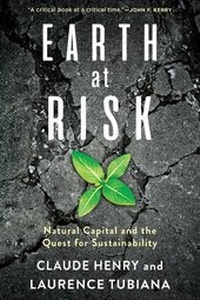
Earth at Risk
Natural Capital and the Quest for Sustainability
Published on 19. December 2017
Book
Hardback
376 pages
978-0-231-16252-4 (ISBN)
Description
We are squandering our planet's natural capital-its biodiversity, water and soil, and energy sources-at a blistering pace. Major changes must be made to steer our planet and people away from our current, doomed course. Though technology has been one of the drivers of the current trend of unsustainable development, it is also one of the essential tools for remedying it. Earth at Risk maps out the necessary transition to sustainability, detailing the innovations in technology, along with law, science, institutional design, and economics, that can and must be put to use to avert environmental catastrophe. Claude Henry and Laurence Tubiana begin with a measure of the costs of ecological damage-the erosion of biodiversity; air, water, and soil pollution; and the wide-reaching effects of climate change-and then consider the solutions that are either now available or close on the horizon that may lead to a more sustainable global trajectory. What market-based tools can be used to promote clean growth? How can renewable energy help us decrease our use of fossil fuels? Is international agreement on climate goals possible?
Henry and Tubiana tackle a range of urgent questions, emphasizing possibilities for-and obstacles to-implementation and action. Building on the experience of the most significant climate negotiation of the decade, they show what a world organized along the principles of sustainability could look like.
Henry and Tubiana tackle a range of urgent questions, emphasizing possibilities for-and obstacles to-implementation and action. Building on the experience of the most significant climate negotiation of the decade, they show what a world organized along the principles of sustainability could look like.
Reviews / Votes
The authors are ideally situated to understand the ins and outs of the climate crisis, and in this book they deliver an insightful overview, one that will be useful to any student of our dilemma. -- Bill McKibben, author of The End of Nature In Earth at Risk, Claude Henry and Laurence Tubiana do more than explain why action is urgently needed to conserve the world's natural capital. They also explain why some previous efforts failed, why others succeeded, and how, drawing from the lessons of both kinds of experience, the world can achieve sustainable development in the future. -- Scott Barrett, Columbia UniversityMore details
Language
English
Place of publication
New York
United States
Target group
Professional and scholarly
Product notice
Trade binding
Dimensions
Height: 229 mm
Width: 152 mm
Weight
454 gr
ISBN-13
978-0-231-16252-4 (9780231162524)
Copyright in bibliographic data and cover images is held by Nielsen Book Services Limited or by the publishers or by their respective licensors: all rights reserved.
Schweitzer Classification
Other editions
Additional editions

E-Book
07/2018
1st Edition
Columbia University Press
from
€38.88
Available for download
Persons
Claude Henry, a physicist turned economist, is a professor of sustainable development at Sciences Po Paris and at Columbia University. He is also currently president of the Scientific Council of the Institute of Sustainable Development and International Relations. Laurence Tubiana is the founder and director of the Institute of Sustainable Development and International Relations and professor and director of the Sustainable Development Center at Sciences Po Paris. She was the special representative of the French minister of foreign affairs for the 2015 Paris Climate Conference (COP-21) and French ambassador for climate negotiations.
Content
Acknowledgments
Introduction
1. Erosion of Biological Diversity
2. The Ubiquitous Waste and Growing Scarcity of Water and Soil
3. Energy: As Little as Possible
4. Perspectives on Climate Change
5. Enlisting the Scientific Method
6. Sustainability at the Intersection of Science and Nature
7. Scientific Uncertainty, Fabricated Uncertainty, and the Vulnerability of Regulation
8. Producing and Disseminating Sustainability-Enhancing Innovations
9. Economic Instruments for Sustainable Development
10. Global Governance of Sustainable Development
11. The Geopolitics of Environment
12. The New Multipolarity of Sustainable Development
Conclusion
Notes
References
Index
Introduction
1. Erosion of Biological Diversity
2. The Ubiquitous Waste and Growing Scarcity of Water and Soil
3. Energy: As Little as Possible
4. Perspectives on Climate Change
5. Enlisting the Scientific Method
6. Sustainability at the Intersection of Science and Nature
7. Scientific Uncertainty, Fabricated Uncertainty, and the Vulnerability of Regulation
8. Producing and Disseminating Sustainability-Enhancing Innovations
9. Economic Instruments for Sustainable Development
10. Global Governance of Sustainable Development
11. The Geopolitics of Environment
12. The New Multipolarity of Sustainable Development
Conclusion
Notes
References
Index