

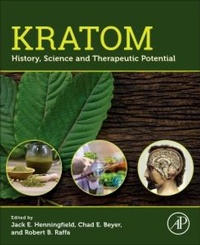
Kratom
History, Science and Therapeutic Potential
Published on 29. September 2025
Book
Paperback/Softback
262 pages
978-0-443-27412-1 (ISBN)
Description
Kratom: History, Science and Therapeutic Potential is the first book to address the unregulated, widespread availability of kratom, with its weak opioid and stimulant effects, coupled with limited awareness of it by healthcare professionals. Kratom has great therapeutic utility and medicinal potential, but more study, caution, and possible regulation is needed. It discusses geographical sourcing, historical uses, current worldwide uses, and potential for treatment of other medical conditions. Most exciting for healthcare professionals will be the implications of this substance's potential for treatment of diseases like depression, ADHD, PTSD, and substance-use disorder, particularly opioid use disorder (OUD).
Moreover, kratom and its active alkaloid mitragynine are getting remarkable attention at federal and local governments as more than eight million Americans consume this product annually. Yet, the paucity of information for researchers and clinicians is troublesome.
Moreover, kratom and its active alkaloid mitragynine are getting remarkable attention at federal and local governments as more than eight million Americans consume this product annually. Yet, the paucity of information for researchers and clinicians is troublesome.
More details
Language
English
Place of publication
San Diego
United States
Publishing group
Elsevier Science Publishing Co Inc
Target group
Professional and scholarly
Product notice
Paperback (trade)
Unsewn / adhesive bound
Dimensions
Height: 234 mm
Width: 190 mm
Thickness: 14 mm
Weight
576 gr
ISBN-13
978-0-443-27412-1 (9780443274121)
Copyright in bibliographic data and cover images is held by Nielsen Book Services Limited or by the publishers or by their respective licensors: all rights reserved.
Schweitzer Classification
Other editions
Additional editions
E-Book
09/2025
Elsevier
€153.99
Available for download
Persons
Jack E. Henningfield, PhD, is Vice President, Research, Health Policy, and Abuse Liability at Pinney Associates, and Adjunct Professor, Behavioral Biology, Department of Psychiatry and Behavioral Sciences, at the Johns Hopkins University School of Medicine. His research and contributions to drug regulation and public policy have contributed to the development of medicines and other approaches for behavioral and CNS disorders and improved public health. He focuses on abuse liability and Controlled Substances Act (CSA) scheduling within the CSA Eight Factor Analysis of CNS-active substances. At NIDA, he led abuse potential assessments and developed drug scheduling recommendations in the Intramural Research Program in collaboration with FDA and DEA. He has contributed to comments to FDA on drug regulation and policy, and has written numerous books and monographs, and more than 500 published papers and reports for various governmental agencies and other organizations. His efforts have earned him a multitude of awards.
Chad E. Beyer, PhD, MBA is CEO of Kures, Inc, a clinical-stage company focused on addiction. With more than 25 years of experience, Dr. Beyer is a drug hunter with a successful record of discovering and developing disease-modifying medications. He was formerly CEO and SVP of R&D at Promentis Pharmaceuticals and the Head of Neurochemistry at Wyeth Pharmaceuticals. Dr. Beyer has led numerous preclinical and clinical teams, participated in the submission of 33 INDs, and contributed to the commercialization of two blockbuster medications: Effexor (R) and Pristiq (R). Dr. Beyer holds a Ph.D. in Pharmacology from LSU Medical Center and an MBA from the Rutgers Business School and has served on the Board of Directors of various companies. Notably, Dr. Beyer has authored more than 70 manuscripts, co-edited the book entitled "Next Generation Antidepressants,? co-founded the journal "Technology Transfer & Entrepreneurship,? and is an Entrepreneur in Residence at Lafayette College.
Dr. Raffa is Adjunct Professor at the University of Arizona College of Pharmacy, and Professor Emeritus at Temple University School of Pharmacy, with master's degrees in Biomedical Engineering and Toxicology, and a doctorate in Pharmacology. He was a Research Fellow on the Scientific Ladder and Team Co-Leader for analgesics drug discovery in the CNS Group at Johnson & Johnson. He cofounded CaRafe Drug Innovation and Enalare Therapeutics, serving as the CSO of Neumentum Inc., and Advantx Pharmaceuticals, companies dedicated to developing non-opioid analgesics and treatment of overdoses. He is the co-holder of several patents, some on tramadol plus acetaminophen. He has published over 400 papers and pharmacological books. He is Associate Editor-in-Chief of the Journal of Pain Research, and past president of the Mid-Atlantic Pharmacology Society of ASPET. He lectures and consults worldwide on pain pathways, analgesics, and novel sigma receptor/chaperone compounds, and a novel (BK channel) respiratory stimulant.
Chad E. Beyer, PhD, MBA is CEO of Kures, Inc, a clinical-stage company focused on addiction. With more than 25 years of experience, Dr. Beyer is a drug hunter with a successful record of discovering and developing disease-modifying medications. He was formerly CEO and SVP of R&D at Promentis Pharmaceuticals and the Head of Neurochemistry at Wyeth Pharmaceuticals. Dr. Beyer has led numerous preclinical and clinical teams, participated in the submission of 33 INDs, and contributed to the commercialization of two blockbuster medications: Effexor (R) and Pristiq (R). Dr. Beyer holds a Ph.D. in Pharmacology from LSU Medical Center and an MBA from the Rutgers Business School and has served on the Board of Directors of various companies. Notably, Dr. Beyer has authored more than 70 manuscripts, co-edited the book entitled "Next Generation Antidepressants,? co-founded the journal "Technology Transfer & Entrepreneurship,? and is an Entrepreneur in Residence at Lafayette College.
Dr. Raffa is Adjunct Professor at the University of Arizona College of Pharmacy, and Professor Emeritus at Temple University School of Pharmacy, with master's degrees in Biomedical Engineering and Toxicology, and a doctorate in Pharmacology. He was a Research Fellow on the Scientific Ladder and Team Co-Leader for analgesics drug discovery in the CNS Group at Johnson & Johnson. He cofounded CaRafe Drug Innovation and Enalare Therapeutics, serving as the CSO of Neumentum Inc., and Advantx Pharmaceuticals, companies dedicated to developing non-opioid analgesics and treatment of overdoses. He is the co-holder of several patents, some on tramadol plus acetaminophen. He has published over 400 papers and pharmacological books. He is Associate Editor-in-Chief of the Journal of Pain Research, and past president of the Mid-Atlantic Pharmacology Society of ASPET. He lectures and consults worldwide on pain pathways, analgesics, and novel sigma receptor/chaperone compounds, and a novel (BK channel) respiratory stimulant.
Content
Section 1: Background
1. Botany, geographical distribution, and phytochemistry of Mitragyna speciosa (Korth.) and related species
Satya Swathi Nadakuduti, Mengzi Zhang, Larissa C. Laforest and Brian Pearson
2. The scientific evolution of kratom: a historical overview
Thiruventhan Karunakaran, Yathindra Marimuthu, Balasingam Vicknasingam and Marek C. Chawarski
3. Recent patterns and reasons for use
Marc T. Swogger, Kirsten E. Smith, Tianna Torrice and Oliver Grundmann
Section 2: Basic science
4. Chemistry and metabolites: ADME
Manoj Gundeti, Christopher R. Mccurdy and Abhisheak Sharma
Section 3: Current therapeutic uses
5. Kratom-related physical dependence and addiction
Kirsten E. Smith, Darshan Singh and Oliver Grundmann
6. Current therapeutic uses
Norsyifa Harun, Siti Rafidah Yusof and Farah Wahida Suhaimi
Section 4: Pharmaceutical drug development of kratom-derived products
7. Regulation and policy regarding kratom-derived dietary supplements and direct-to-consumer sales
Robert Durkin, Oliver Grundmann and Kirsten E. Smith
8. Patentability and exclusivity of kratom based natural products
Robert Paradiso
Section 5: Concerns
9. Kratom drug-drug (and other) interactions
Robert B. Raffa and Jeanette Mathews
10. Susceptible populations
Robert B. Raffa and Jeanette Mathews
Section 6: Commentaries/Perspectives
11. Kratom purity and quality control issues: an in-depth analysis
Frank Breve
12. Kratom entrepreneurship | exploiting the commercial potential of kratom and its active alkaloids
Chad E. Beyer
13. Equity investment into kratom, mitragynine, and related products
Zachariah Mcintosh-Pearce
14. Medical marijuana as a template for understanding kratom
Soren Shade
1. Botany, geographical distribution, and phytochemistry of Mitragyna speciosa (Korth.) and related species
Satya Swathi Nadakuduti, Mengzi Zhang, Larissa C. Laforest and Brian Pearson
2. The scientific evolution of kratom: a historical overview
Thiruventhan Karunakaran, Yathindra Marimuthu, Balasingam Vicknasingam and Marek C. Chawarski
3. Recent patterns and reasons for use
Marc T. Swogger, Kirsten E. Smith, Tianna Torrice and Oliver Grundmann
Section 2: Basic science
4. Chemistry and metabolites: ADME
Manoj Gundeti, Christopher R. Mccurdy and Abhisheak Sharma
Section 3: Current therapeutic uses
5. Kratom-related physical dependence and addiction
Kirsten E. Smith, Darshan Singh and Oliver Grundmann
6. Current therapeutic uses
Norsyifa Harun, Siti Rafidah Yusof and Farah Wahida Suhaimi
Section 4: Pharmaceutical drug development of kratom-derived products
7. Regulation and policy regarding kratom-derived dietary supplements and direct-to-consumer sales
Robert Durkin, Oliver Grundmann and Kirsten E. Smith
8. Patentability and exclusivity of kratom based natural products
Robert Paradiso
Section 5: Concerns
9. Kratom drug-drug (and other) interactions
Robert B. Raffa and Jeanette Mathews
10. Susceptible populations
Robert B. Raffa and Jeanette Mathews
Section 6: Commentaries/Perspectives
11. Kratom purity and quality control issues: an in-depth analysis
Frank Breve
12. Kratom entrepreneurship | exploiting the commercial potential of kratom and its active alkaloids
Chad E. Beyer
13. Equity investment into kratom, mitragynine, and related products
Zachariah Mcintosh-Pearce
14. Medical marijuana as a template for understanding kratom
Soren Shade