

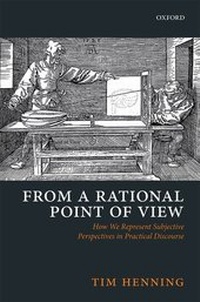
From a Rational Point of View
How We Represent Subjective Perspectives in Practical Discourse
Published on 5. June 2018
Book
Hardback
252 pages
978-0-19-879703-6 (ISBN)
Description
When discussing normative reasons, oughts, requirements of rationality, motivating reasons, and so on, we often have to use verbs like "believe" and "want" to capture a relevant subject's perspective. According to the received view about sentences involving these verbs, what they do is describe the subject's mental states. Many puzzles concerning normative discourse have to do with the role that mental states consequently appear to play in normative discourse.
Tim Henning uses tools from semantics and the philosophy of language to develop an alternative account of sentences involving these verbs. According to this view, which is called parentheticalism, we very commonly use these verbs in a parenthetical sense. These verbs themselves express backgrounded side-remarks on the contents they embed, and these latter, embedded contents constitute the at-issue contents. This means that instead of speaking about the subject's mental states, we often use sentences involving "believe" and "want" to speak about the world from her point of view. Henning makes this notion precise, and uses it to solve various puzzles concerning normative discourse. The final result is a new, unified understanding of normative discourse, which gets by without postulating conceptual breaks between objective and subjective normative reasons, or normative reasons and rationality, or indeed between the reasons we ascribe to an agent and the reasons she herself can be expected to cite. Instead of being connected to either subjective mental states or objective facts, all of these normative statuses are can be adequately articulated by citing worldly considerations from a subject's point of view.
Tim Henning uses tools from semantics and the philosophy of language to develop an alternative account of sentences involving these verbs. According to this view, which is called parentheticalism, we very commonly use these verbs in a parenthetical sense. These verbs themselves express backgrounded side-remarks on the contents they embed, and these latter, embedded contents constitute the at-issue contents. This means that instead of speaking about the subject's mental states, we often use sentences involving "believe" and "want" to speak about the world from her point of view. Henning makes this notion precise, and uses it to solve various puzzles concerning normative discourse. The final result is a new, unified understanding of normative discourse, which gets by without postulating conceptual breaks between objective and subjective normative reasons, or normative reasons and rationality, or indeed between the reasons we ascribe to an agent and the reasons she herself can be expected to cite. Instead of being connected to either subjective mental states or objective facts, all of these normative statuses are can be adequately articulated by citing worldly considerations from a subject's point of view.
More details
Language
English
Place of publication
Oxford
United Kingdom
Target group
College/higher education
Dimensions
Height: 237 mm
Width: 164 mm
Thickness: 21 mm
Weight
542 gr
ISBN-13
978-0-19-879703-6 (9780198797036)
Copyright in bibliographic data and cover images is held by Nielsen Book Services Limited or by the publishers or by their respective licensors: all rights reserved.
Schweitzer Classification
Other editions
Additional editions
Tim Henning
From a Rational Point of View
How We Represent Subjective Perspectives in Practical Discourse
E-Book
05/2018
1st Edition
OUP eBook
€52.49
Available for download
Tim Henning
From a Rational Point of View
How We Represent Subjective Perspectives in Practical Discourse
E-Book
05/2018
1st Edition
OUP eBook
€52.49
Available for download
Person
Tim Henning is Professor of Practical Philosophy at the University of Stuttgart. His research interests include normative ethics, metanormativity, philosophy of language, and Kant. He has published several articles and books in German and English. His books include a monograph on personal autonomy and personal history, entitled Person sein und Geschichten erzaehlen, and an introduction to Kant's ethics (in German). His articles have appeared in journals such as Philosophical Review, Ethics, Philosophy and Phenomenological Research and Philosophical Quarterly.
Content
Introduction
1: Parentheticalism about "believe"
2: Parentheticalism about "want"
3: Parentheticalism and Normative Reasons
4: Parentheticalism, Normative Reasons, and Error Cases
5: Parentheticalism and Requirements of Rationality
6: Parentheticalism and Action Explanation
7: Parentheticalism and (Ir)rational Agency
Epilogue
1: Parentheticalism about "believe"
2: Parentheticalism about "want"
3: Parentheticalism and Normative Reasons
4: Parentheticalism, Normative Reasons, and Error Cases
5: Parentheticalism and Requirements of Rationality
6: Parentheticalism and Action Explanation
7: Parentheticalism and (Ir)rational Agency
Epilogue