

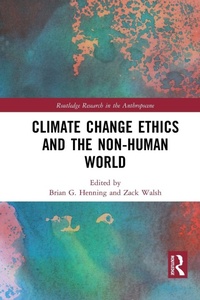
Climate Change Ethics and the Non-Human World
1st Edition
Published on 13. December 2021
Book
Paperback/Softback
226 pages
978-1-032-23829-6 (ISBN)
Description
This book examines from different perspectives the moral significance of non-human members of the biotic community and their omission from climate ethics literature.
The complexity of life in an age of rapid climate change demands the development of moral frameworks that recognize and respect the dignity and agency of both human and non-human organisms. Despite decades of careful work in non-anthropocentric approaches to environmental ethics, recent anthologies on climate ethics have largely omitted non-anthropocentric approaches. This multidisciplinary volume of international scholars tackles this lacuna by presenting novel work on non-anthropocentric approaches to climate ethics. Written in an accessible style, the text incorporates sentiocentric, biocentric, and ecocentric perspectives on climate change.
With diverse perspectives from both leading and emerging scholars of environmental ethics, geography, religious studies, conservation ecology, and environmental studies, this book will offer a valuable reading for students and scholars of these fields.
The complexity of life in an age of rapid climate change demands the development of moral frameworks that recognize and respect the dignity and agency of both human and non-human organisms. Despite decades of careful work in non-anthropocentric approaches to environmental ethics, recent anthologies on climate ethics have largely omitted non-anthropocentric approaches. This multidisciplinary volume of international scholars tackles this lacuna by presenting novel work on non-anthropocentric approaches to climate ethics. Written in an accessible style, the text incorporates sentiocentric, biocentric, and ecocentric perspectives on climate change.
With diverse perspectives from both leading and emerging scholars of environmental ethics, geography, religious studies, conservation ecology, and environmental studies, this book will offer a valuable reading for students and scholars of these fields.
More details
Series
Language
English
Place of publication
London
United Kingdom
Publishing group
Taylor & Francis Ltd
Target group
College/higher education
Postgraduate and Undergraduate
Illustrations
1 s/w Abbildung
1 Illustrations, black and white
Dimensions
Height: 234 mm
Width: 156 mm
Thickness: 12 mm
Weight
354 gr
ISBN-13
978-1-032-23829-6 (9781032238296)
Copyright in bibliographic data and cover images is held by Nielsen Book Services Limited or by the publishers or by their respective licensors: all rights reserved.
Schweitzer Classification
Other editions
Additional editions
Brian G. Henning | Zack Walsh
Climate Change Ethics and the Non-Human World
Book
02/2020
1st Edition
Routledge
€192.21
Shipment within 15-20 days
Brian G. Henning | Zack Walsh
Climate Change Ethics and the Non-Human World
E-Book
02/2020
1st Edition
Routledge
€59.49
Available for download
Brian G. Henning | Zack Walsh
Climate Change Ethics and the Non-Human World
E-Book
02/2020
1st Edition
Routledge
€59.49
Available for download
Persons
Brian G. Henning is a professor of philosophy and environmental studies at Gonzaga University. He is founding Co-Chair of the climate action group 350 Spokane. His research includes more than 35 articles and nine books, including Riders in the Storm: Ethics in an Age of Climate Change and the award-winning book The Ethics of Creativity.
Zack Walsh is Research Associate at the Institute for Advanced Sustainability Studies (IASS) in Potsdam, Germany. He co-leads the A Mindset for the Anthropocene (AMA) project, which is a transdisciplinary research project and emerging network of change agents integrating personal and socio-ecological transformations to sustainability.
Zack Walsh is Research Associate at the Institute for Advanced Sustainability Studies (IASS) in Potsdam, Germany. He co-leads the A Mindset for the Anthropocene (AMA) project, which is a transdisciplinary research project and emerging network of change agents integrating personal and socio-ecological transformations to sustainability.
Content
Foreword Introduction 1. Climate Change and the Loss of Nonhuman Welfare 2. Anthropocentrism and the Anthropocene: Restoration and Geoengineering as Negative Paradigms of Epistemological Domination 3. Climate Ethics Bridging Animal Ethics to Overcome Climate Inaction: An Approach from Strategic Visual Communication 4. Suffering, Sentientism, and Sustainability: An Analysis of a Non-Anthropocentric Moral Framework for Climate Ethics 5. Biocentrism, Climate Change, and the Spatial and Temporal Scope of Ethics 6. Evaluating Climate Change with the Language of the Forms of Life 7. Thinking Through the Anthropocene: Educating for a Planetary Community 8. Conflicting Advice: Resolving Conflicting Moral Recommendations in Climate and Environmental Ethics 9. An Eco-centric Proposal for Setting a Price on Greenhouse Gas Emissions 10. Being Human: An Ecocentric Approach to Climate Ethics 11. Atmospheres of Object-Oriented Ontology 12. Monsters, Metamorphoses, and The Horror of Ethics in the "Pelagioscene" 13. Gut Check: Imagining a Posthuman "Climate" 14. Wonderland Earth in the Anthropocene Epoch