

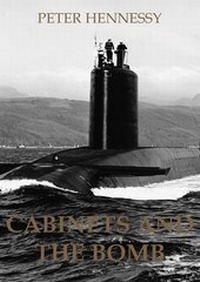
Cabinets and the Bomb
Published on 1. November 2007
Book
Paperback/Softback
368 pages
978-0-19-726422-5 (ISBN)
Description
The nuclear weapons question runs through post-1940 British history like an irradiated thread. It represents part of the hidden history of twentieth-century Britain, given the high level of technical secrecy and political sensitivity in which the bomb was - and is - embedded.
This volume publishes previously classified Cabinet papers and related archives, dealing with the first theoretical scientific breakthrough in 1940, through the A-bomb and H-bomb procurements, to the Polaris missile upgrading decisions of the 1970s. The story is brought up to date in Peter Hennessy's narrative, which covers developments up to the spring of 2007.
The fascination of the book lies in its uncovering the very private internal themes, debates and justifications for Britain's being a nuclear weapons power exchanged between ministers, civil servants, diplomats, scientists, military and intelligence officers. There is a strong element of now-it-can-be-told in the book, which will appeal not just to professional historians but also to undergraduates and A-Level students who are partaking in the current mini-boom on the study of the Cold War. Cabinets and the Bomb is also a contribution to wider public understanding in the context of the present debate about Trident upgrade (though it is a book of explanation, not advocacy).
This volume publishes previously classified Cabinet papers and related archives, dealing with the first theoretical scientific breakthrough in 1940, through the A-bomb and H-bomb procurements, to the Polaris missile upgrading decisions of the 1970s. The story is brought up to date in Peter Hennessy's narrative, which covers developments up to the spring of 2007.
The fascination of the book lies in its uncovering the very private internal themes, debates and justifications for Britain's being a nuclear weapons power exchanged between ministers, civil servants, diplomats, scientists, military and intelligence officers. There is a strong element of now-it-can-be-told in the book, which will appeal not just to professional historians but also to undergraduates and A-Level students who are partaking in the current mini-boom on the study of the Cold War. Cabinets and the Bomb is also a contribution to wider public understanding in the context of the present debate about Trident upgrade (though it is a book of explanation, not advocacy).
Reviews / Votes
The declassified papers offer an extraordinary perspective on things that were long secret...This is a rich collection that deserves extended study. * Milan Rai, Peace News * a remarkable documentary record * Oliver Kamm, The Times Online * ...fascinating...Cabinets and the Bomb will appeal to the public as well as to professional historians and researchers and students and others studying the history of the Cold War. * Frank Barnaby, Oxford Research Group *More details
Series
Language
English
Place of publication
Oxford
United Kingdom
Target group
College/higher education
Professional and scholarly
Illustrations
numerous halftones
Dimensions
Height: 296 mm
Width: 210 mm
Thickness: 20 mm
Weight
1364 gr
ISBN-13
978-0-19-726422-5 (9780197264225)
Copyright in bibliographic data and cover images is held by Nielsen Book Services Limited or by the publishers or by their respective licensors: all rights reserved.
Schweitzer Classification
Person
Content
Introduction
Part I
The Nuclear Certificate
Chronology
Part II
Fission, 1940-1953
Fusion, 1954-1958
Delivery, 1958-1963
Polaris Politics, 1963-1967
Moscow Criterion, 1967-1977
Polaris to Trident, 1978-2005
Upgrade, 2005-2007
Conclusion
Epilogue
Part I
The Nuclear Certificate
Chronology
Part II
Fission, 1940-1953
Fusion, 1954-1958
Delivery, 1958-1963
Polaris Politics, 1963-1967
Moscow Criterion, 1967-1977
Polaris to Trident, 1978-2005
Upgrade, 2005-2007
Conclusion
Epilogue