

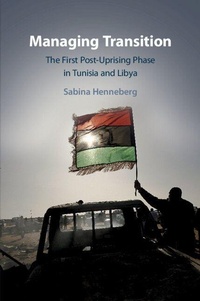
Managing Transition
The First Post-Uprising Phase in Tunisia and Libya
Published on 2. March 2023
Book
Paperback/Softback
284 pages
978-1-108-81606-9 (ISBN)
Description
Examining the factors that shaped the first interim governments of Tunisia and Libya, which formed in the immediate aftermath of the 2011 uprisings that brought down their governments, Managing Transition analyses each interim government to enhance our understanding of how political transition occurred within two North African countries. Tracing the importance of the key decisions made during these transition periods, Sabina Henneberg demonstrates the importance of these decisions taken during the short phase between authoritarian collapse and first post-uprising elections, including decisions around leadership, institutional reform, transitional justice, and the electoral processes themselves. By documenting, in close detail, the important events of the 2011 Arab Uprisings, and the months that followed, this study shows that while pre-existing structures strongly influence the design and behaviour of first interim governments, actors' choices are equally important in shaping both immediate and longer-term phases of transition.
Reviews / Votes
'Managing Transition provides an exceptional and comprehensive chronicle of the micro-practices and difficult dilemmas faced by interim governments in Tunisia and Libya following the Arab Uprisings in 2011. It is a compelling analysis of decision-makers' struggles with simultaneously enacting change and preserving continuity as the two nations undergo transition from authoritarian rule - Sabina Henneberg ultimately calls into question whether it is even possible to define the parameters of a 'successful' transition.' Edwige Fortier, Research Associate, Department of Development Studies, SOAS 'Sabina Henneberg elucidates the structural factors which incentivize first transitional governments to adopt populist, globalist, and usually dysfunctional policies. She shows how in Tunisia historical precedent and coalition building laid the groundwork for a constitutional transition, while in Libya, feckless leadership set the groundwork for appeasement and state implosion.' Jason Pack, Non-Resident Fellow at the Middle East Institute and Founder of Libya-Analysis LLCMore details
Language
English
Place of publication
Cambridge
United Kingdom
Target group
Professional and scholarly
College/higher education
Product notice
Paperback (trade)
Illustrations
Worked examples or Exercises
Dimensions
Height: 229 mm
Width: 152 mm
Thickness: 15 mm
Weight
381 gr
ISBN-13
978-1-108-81606-9 (9781108816069)
Copyright in bibliographic data and cover images is held by Nielsen Book Services Limited or by the publishers or by their respective licensors: all rights reserved.
Schweitzer Classification
Other editions
Additional editions

Book
12/2020
Cambridge University Press
€95.50
Shipment within 15-20 days

E-Book
12/2020
Cambridge University Press
€78.99
Available for download
Person
Sabina Henneberg is a Visiting Scholar for the African Studies Program at Johns Hopkins University School of Advanced International Studies, where her research has focused on political transition in North Africa. She is the author of articles in journals including the Journal of North African Studies, British Journal of Middle Eastern Studies, Journal of International Affairs, Foreign Affairs and Foreign Policy. She is currently the Tunisia Country Specialist with Amnesty International USA.
Content
1. Introduction; 2. The Tunisian provisional administration; 3. Impacts of the TPA; 4. The Libyan National Transition Council; 5: Impacts of the NTC; 6. Impacts of the TPA and NTC in later years; 7. Conclusions.