

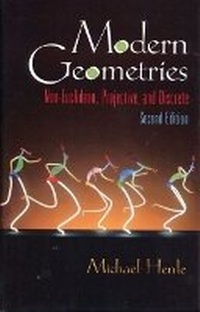
Modern Geometries
Non-Euclidean, Projective, and Discrete Geometry
2nd Edition
Published on 20. April 2001
Book
Hardback
400 pages
978-0-13-032313-2 (ISBN)
Description
For sophomore/senior-level courses in Geometry.
Engaging and accessible, this text describes geometry as it is understood and used by contemporary mathematicians and theoretical scientists. Basically a non-Euclidean geometry book, it provides a brief, but solid, introduction to modern geometry using analytic methods. It relates geometry to familiar ideas from analytic geometry, staying firmly in the Cartesian plane and building on skills already known and extensively practiced there. It uses the principle geometric concept of congruence or geometric transformation--introducing and using the Erlanger Program explicitly throughout.
Engaging and accessible, this text describes geometry as it is understood and used by contemporary mathematicians and theoretical scientists. Basically a non-Euclidean geometry book, it provides a brief, but solid, introduction to modern geometry using analytic methods. It relates geometry to familiar ideas from analytic geometry, staying firmly in the Cartesian plane and building on skills already known and extensively practiced there. It uses the principle geometric concept of congruence or geometric transformation--introducing and using the Erlanger Program explicitly throughout.
More details
Other editions
Previous edition

Book
09/1996
Pearson
€32.23
Article exhausted; check for reprint
Content
Dependency Chart.
Introduction.
I. BACKGROUND.
1. Some History.
2. Complex Numbers.
3. Geometric Transformations.
4. The Erlanger Program.
II. PLANE GEOMETRY.
5. Moebius Geometry.
6. Steiner Circles.
7. Hyperbolic Geometry.
8. Cycles.
9. Hyperbolic Length.
10. Area.
11. Elliptic Geometry.
12. Absolute Geometry.
III. PROJECTIVE GEOMETRY.
13. The Real Projective Plane.
14. Projective Transformations.
15. Multidimensional Projective Geometry.
16. Universal Projective Geometry.
IV. SOLID GEOMETRY.
17. Quaternions.
18. Euclidean and Pseudo-Euclidean Solid Geometry.
19. Hyperbolic and Elliptic Solid Geometry.
V. DISCRETE GEOMETRY.
20. Matroids.
21. Reflections.
22. Discrete Symmetry.
23. Non-Euclidean Symmetry.
VI. AXIOM SYSTEMS.
24. Hilbert's Axioms.
25. Bachmann's Axioms.
26. Metric Absolute Geometry.
VII. CONCLUSION.
27. The Cultural Impact of Non-Euclidean Geometry.
28. The Geometric Idea of Space.
Bibliography.
Index.
Introduction.
I. BACKGROUND.
1. Some History.
2. Complex Numbers.
3. Geometric Transformations.
4. The Erlanger Program.
II. PLANE GEOMETRY.
5. Moebius Geometry.
6. Steiner Circles.
7. Hyperbolic Geometry.
8. Cycles.
9. Hyperbolic Length.
10. Area.
11. Elliptic Geometry.
12. Absolute Geometry.
III. PROJECTIVE GEOMETRY.
13. The Real Projective Plane.
14. Projective Transformations.
15. Multidimensional Projective Geometry.
16. Universal Projective Geometry.
IV. SOLID GEOMETRY.
17. Quaternions.
18. Euclidean and Pseudo-Euclidean Solid Geometry.
19. Hyperbolic and Elliptic Solid Geometry.
V. DISCRETE GEOMETRY.
20. Matroids.
21. Reflections.
22. Discrete Symmetry.
23. Non-Euclidean Symmetry.
VI. AXIOM SYSTEMS.
24. Hilbert's Axioms.
25. Bachmann's Axioms.
26. Metric Absolute Geometry.
VII. CONCLUSION.
27. The Cultural Impact of Non-Euclidean Geometry.
28. The Geometric Idea of Space.
Bibliography.
Index.