

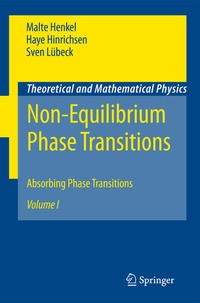
Non-Equilibrium Phase Transitions
Description
1 discusses a particular kind of non-equilibrium phase transitions, namely those between an active, ?- tuating state and absorbing states. Volume 2 (to be written by one of us (MH) with M. Pleimling) will be devoted to ageing phenomena.
Reviews / Votes
From the reviews:
"The monograph concentrates on nonequilibrium phase transitions from fluctuating (ordered) states into so-called absorbing states, which can never be left by the system once reached. . Extended appendices (plus solutions of excercises and answers to problems) on specific models . make the book useful not only to scientists and lecturers, but also to advanced graduate students." (Piotr Garbaczewski, Zentralblatt MATH, Vol. 1165, 2009)
"This research monograph . provides a highly desirable and topical pedagogical introduction as well as a timely overview of recent advances in theoretical investigations of continuous non-equilibrium phase transition from active states to inactive absorbing states. . This text is likely to become a standard reference in the field, and should be an indispensable source of information for both beginning and already seasoned researchers interested in non-equilibrium statistical physics, the theory of stochastic processes, andfundamental properties of reaction-diffusion systems . ." (Uwe C. Täuber, Mathematical Reviews, Issue 2012 h)
More details
Other editions
Additional editions
Persons
Content
1 Introduction. 2 Survey of Equilibrium Critical Phenomena. 3 Directed percolation. 4 Scaling Properties of Absorbing Phase Transitions 4.1 Scaling in the Steady State. 5 Universality classes different from directed percolation. Appendices: A Equilibrium Models A.1 Potts model A.2 Clock model A.3 Turban model A.4 Baxter-Wu model A.5 Blume-Capel model A.6 XY model A.7 O(n) model A.8 Double exchange model A.9 Frustrated spin models A.10 Hilhorst-van Leeuven model B Scaling Laws C Diagonalisation of Time-Evolution Operators D Langevin Equations and Path Integrals E Mean-Field Approximations E.1 Simple mean-field/site approximation E.2 Pair-approximation E.3 The 'hop-away' mean-field approximation F On Finite-Size Scaling Techniques F.1 Sequences of finite-size estimates F.2 Sequence extrapolation G Numerical Methods G.1 Simulational techniques G.2 Computation of response functions. Solutions. Frequently Used Symbols. Abbreviations. References. Index.