

Unwrapping Goethe's Weimar
Essays in Cultural Studies and Local Knowledge
Published on 1. December 1999
Book
Hardback
208 pages
978-1-57113-194-2 (ISBN)
Description
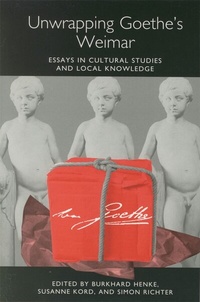
A comprehensive reconsideration of the myth of Goethe's Weimar, occasioned by the 1999 celebrations of Goethe's 250th birthday.
The 1999 celebrations of Goethe's two hundred and fiftieth birthday and the city's designation as Culture City of Europe give rise to this comprehensive look at the myth of Goethe's Weimar and the ways it has been packaged. Some of the most prominent North American Germanists have delved into archives and forgotten texts to reveal a troubled locus of culture, commodification, and ideological projection. Goethe's presence in Weimar receives new currency inexplorations of consumer culture and the fashioning of bourgois taste; women artists and the market; portrait busts and their display practices; Anna Amalia and musical collaboration; masquerades and cross-dressing; Goechhausen and the Weimar Grotesque; Goethe's views on soldiering and acting; propaganda and human rights.
The 1999 celebrations of Goethe's two hundred and fiftieth birthday and the city's designation as Culture City of Europe give rise to this comprehensive look at the myth of Goethe's Weimar and the ways it has been packaged. Some of the most prominent North American Germanists have delved into archives and forgotten texts to reveal a troubled locus of culture, commodification, and ideological projection. Goethe's presence in Weimar receives new currency inexplorations of consumer culture and the fashioning of bourgois taste; women artists and the market; portrait busts and their display practices; Anna Amalia and musical collaboration; masquerades and cross-dressing; Goechhausen and the Weimar Grotesque; Goethe's views on soldiering and acting; propaganda and human rights.
Reviews / Votes
The volume abounds in new insights and discoveries about the culture and activities of Weimar courtly and bourgeois high-society (for example music practices, the Weimar theater, masked balls, the commercial production of plaster busts with which to adorn the home, the very influential local fashion magazine, etc.) and illuminates the participation of numerous lesser-known figures in the creation of what came to be known as Classical Weimar.--Thomas P. Saine, editor, GOETHE YEARBOOK 'The book offers an interesting and extensive amount of material which will stimulate considerable further research.' MONATSHEFTE '[A] lively and entertaining collection of essays.' GERMANIC NOTES AND REVIEWS 'The collection offers a myriad of Cultural Studies approaches and demonstrates their importance for the re-examination of historical periods. ... A central contribution to German eighteenth-century studies.' GERMAN STUDIES REVIEW 'Unpacks the dense signifying network of a familiar cultural constellation to reval a plethora of exciting insights. * GOETHE *More details
Series
Language
English
Place of publication
Columbia, MD
United States
Publishing group
Boydell & Brewer Ltd
Target group
Professional and scholarly
Product notice
Cloth over boards
Dimensions
Height: 229 mm
Width: 152 mm
Weight
1 gr
ISBN-13
978-1-57113-194-2 (9781571131942)
Copyright in bibliographic data and cover images is held by Nielsen Book Services Limited or by the publishers or by their respective licensors: all rights reserved.
Schweitzer Classification
Persons
SUSANNE KORD is Professor of German at University College London and has published widely on crime and antisemitism, ethics in horror films, women and violent crime, and many other books and essays on film (especially genre and Hollywood movies), women's literary history and reception, and eighteenth- and nineteenth-century literature and culture. She has received 6 major awards for her writing. In the interest of making some of women's unknown literature available to modern readers, she has edited four collections of plays by women and translated three dramas into English. Her major works include Murderesses in German Writing, 1720-1860 (Cambridge UP, 2013), Lovable Crooks and Loathsome Jews: Antisemitism in German and Austrian Crime Writing Before the World Wars (McFarland, 2018). Her latest book is a short exploration of Drew Goddard's meta-horror film The Cabin in the Woods (2012), forthcoming with Liverpool University Press in 2022. ELISABETH KRIMMER is Professor of German at the University of California, Davis.
Content
Introduction: Like a Box of Chocolates... - Simon Richter
Goethe. Advertising, Marketing, and Merchandising the Classical - Burkhard Henke
Weimar Classicism and the Origins of Consumer Culture - Daniel Purdy
Floating Heads: Weimar Portrait Busts - Catriona MacLeod
Music in Weimar cicra 1780: Decentering Text, Decentering Goethe - Annie Janiero Randall
War and Dramaturgy: Goethe's Command of the Weimar Theater - Karin Schutjer
From Werther to Amazons: Cross-Dressing and Male-Male Desire - Susan Gustafson
Sartorial Transgressions: Re-Dressing Class and Gender Hierarchies in Masquerades and Travesties - Elisabeth Krimmer
Women Writers and the Authorization of Literary Practice - Linda Dietrick
The Hunchback of Weimar: Louise von Goechhausen and the Weimar Grotesque -
Creation and Constipation: Don Carlos and Schiller's Blocke Passage to Weimar - Stephanie Hammer
Skeletons in Goethe's Closet: Human Rights, Protest, and the Myth of Political Liberality -
The Weimar Myth: From City of the Arts to the Global Village - Gert Theile
Goethe. Advertising, Marketing, and Merchandising the Classical - Burkhard Henke
Weimar Classicism and the Origins of Consumer Culture - Daniel Purdy
Floating Heads: Weimar Portrait Busts - Catriona MacLeod
Music in Weimar cicra 1780: Decentering Text, Decentering Goethe - Annie Janiero Randall
War and Dramaturgy: Goethe's Command of the Weimar Theater - Karin Schutjer
From Werther to Amazons: Cross-Dressing and Male-Male Desire - Susan Gustafson
Sartorial Transgressions: Re-Dressing Class and Gender Hierarchies in Masquerades and Travesties - Elisabeth Krimmer
Women Writers and the Authorization of Literary Practice - Linda Dietrick
The Hunchback of Weimar: Louise von Goechhausen and the Weimar Grotesque -
Creation and Constipation: Don Carlos and Schiller's Blocke Passage to Weimar - Stephanie Hammer
Skeletons in Goethe's Closet: Human Rights, Protest, and the Myth of Political Liberality -
The Weimar Myth: From City of the Arts to the Global Village - Gert Theile