

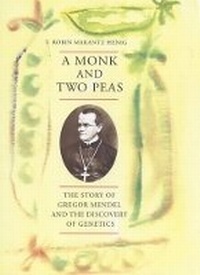
A Monk and Two Peas
The Story of Gregor Mendel and the Discovery of Genetics
Published on 25. May 2000
Book
Hardback
256 pages
978-0-297-64365-4 (ISBN)
Description
The story of the monk who experimented with peas in his monastery has all the highs and lows of great fiction. Mendel was a man of nervous constitution (whenever he had to visit the sick and dying he was so overcome physically that he had to take to bed) who was determined to work out how traits are inherited. He spent seven years in the monastery garden experimenting on over 300,000 strains of plants. Determined to discover how species change, adapt and arise anew but essentially remain the same from generation to generation, he worked out that traits are inherited independently, that they come in pairs, one from each parent. Mendel presented a paper outlining his findings in 1865, just 6 years after Darwin's The Origins of Species came out. While Darwin's work provoked agitated debate, Mendel continued to labour away in silence in his garden and his work was completely ignored. Mendel sent his paper to fellow scientist Carl von Nageli who told Mendel that his work was incomplete and unconvincing. He encouraged Mendel to create hybrids from hawkweed which Naegeli knew was incredibly difficult to achieve as he had himself spent years working on them.
Was he furious that a younger man had struck on something far more original than he could ever produce? Did he deliberately divert the monk After Mendel's death all his papers were burnt in a bonfire in the monastery. Was this routine housekeeping or the result of a fit of jealousy by a monk who succeeded him as abbot? Finally, in 1900, 35 years after it first appeared, Mendel's paper was found by the Cambridge scientist William Bateson. It became immediately apparent that Mendel was onto something extremely significant. Had Darwin known about his work many of the debates about the details of natural selection might have been resolved. This is a captivating book about a remarkable and neglected man who played an enormous role in our understanding of the mechanisms of life itself.
Was he furious that a younger man had struck on something far more original than he could ever produce? Did he deliberately divert the monk After Mendel's death all his papers were burnt in a bonfire in the monastery. Was this routine housekeeping or the result of a fit of jealousy by a monk who succeeded him as abbot? Finally, in 1900, 35 years after it first appeared, Mendel's paper was found by the Cambridge scientist William Bateson. It became immediately apparent that Mendel was onto something extremely significant. Had Darwin known about his work many of the debates about the details of natural selection might have been resolved. This is a captivating book about a remarkable and neglected man who played an enormous role in our understanding of the mechanisms of life itself.
More details
Language
English
Place of publication
London
United Kingdom
Publishing group
Orion Publishing Co
Product notice
sewn/stitched
Illustrations
illustrations
Dimensions
Height: 216 mm
Width: 138 mm
Weight
443 gr
ISBN-13
978-0-297-64365-4 (9780297643654)
Copyright in bibliographic data and cover images is held by Nielsen Book Services Limited or by the publishers or by their respective licensors: all rights reserved.
Schweitzer Classification
Person
Robin Marantz Henig is the author of six books, most recently A Dancing Matrix: How Science Confronts Emerging Viruses (Knopf, 1993) for which she was named Author of the Year by the American Society of Journalists and Authors. She writes regularly for USA Today, The New York Times and the Washington Post.