

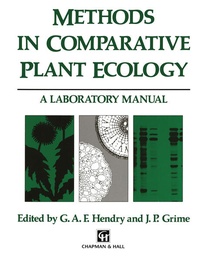
Methods in Comparative Plant Ecology
A laboratory manual
Published on 30. October 2012
Book
Paperback/Softback
XVIII, 252 pages
978-94-010-4655-8 (ISBN)
Description
Methods in Comparative Plant Ecology: A laboratory manual is a sister book to the widely acclaimed Comparative Plant Ecology by Grime, Hodgson and Hunt. It contains details on some 90 critical concise diagnostic techniques by over 40 expert contributors. In one volume it provides an authoritative bench-top guide to diagnostic techniques in experimental plant ecology.
Reviews / Votes
This book is ring bound which allows the volume to lie open on the laboratory bench. And make no mistake, it will lie open on many laboratory benches! Every plant ecology laboratory will want to have at least one copy. - Journal of EcologyIt will be of value not only to the experienced researcher but also to the novice starting a project...extremely useful - New Phytologists
There is much here of interest to teachers of A level and undergraduate biology and environmental science students. - The Biologist
The manual has been well written and edited...very useful to beginning graduate students who are looking for suitable techniques...You do not have to be an adherent of the comparative plant ecology school to find this book a useful addition to your bookshelf... - Ecology
More details
Edition
Softcover reprint of the original 1st ed. 1993
Language
English
Place of publication
Dordrecht
Netherlands
Target group
Professional and scholarly
Research
Illustrations
XVIII, 252 p.
Dimensions
Height: 246 mm
Width: 189 mm
Thickness: 16 mm
Weight
540 gr
ISBN-13
978-94-010-4655-8 (9789401046558)
DOI
10.1007/978-94-011-1494-3
Schweitzer Classification
Other editions
Additional editions
E-Book
12/2012
Springer
€149.79
Available for download
Book
01/1993
Chapman and Hall
€160.49
Shipment within 10-20 days
Content
1 Introduction.- 1.1 The need for comparative laboratory studies.- 1.2 How to use the manual.- 1.3 Abbreviations.- 2 General procedures and methodologies.- 2.1 Seed collecting, cleaning and long-term storage.- 2.2 Seed viability and germination.- 2.3 The ISP aerial environment: lighting, day length, temperature and humidity.- 2.4 ISP germination and rooting environments; sand, compost and solution culture.- 2.5 Harvesting, recording weight, area and length.- 2.6 Photographic recording.- 2.7 The ISP standard regime.- 3 Methods of comparative study.- Anatomy.- 3.1 Aerenchyma, intercellular gas space and aeration.- 3.2 Functional plant anatomy.- DNA.- 3.3 Chromosome number.- 3.4 Nuclear DNA amount.- Environmental impacts.- 3.5 Anoxia tolerance in germinating seeds, rhizomes, stolons and tubers.- 3.6 Response to defoliation.- 3.7 Desiccation tolerance.- 3.8 Drought tolerance.- 3.9 Effect of high temperatures on protein synthesis.- 3.10 Herbicide selectivity.- 3.11 Plant responses to low temperatures.- 3.12 Ozone sensitivity.- 3.13 Sulphur dioxide pollution.- 3.14 Sunfleck utilization.- 3.15 Ultra-violet (UV-B) radiation.- Growth.- 3.16 Adventitious rooting of cuttings.- 3.17 Carbon budget.- 3.18 Day length responses.- 3.19 Establishment in a vertical light gradient.- 3.20 Foraging for light.- 3.21 Foraging for mineral nutrients.- 3.22 Fresh weight/dry weight and related ratios.- 3.23 Constant temperature and shade.- 3.24 Fluctuating temperature and drought.- 3.25 Mean relative growth rate.- 3.26 Response to carbon dioxide enrichment.- 3.27 Variation in RGR underlying carbon economy.- Leaves.- 3.28 Decomposition.- 3.29 Defence chemistry.- 3.30 Longevity.- 3.31 Palatability.- 3.32 Tearability.- Metabolism.- 3.33 Calculation of specific activities of enzymes.- 3.34 Carbon isotope discrimination and water use efficiency.- 3.35 Nitrate reductase activity.- 3.36 Acid phosphatases.- 3.37 Photosynthesis and chlorophyll fluorescence: simultaneous measurements.- 3.38 Photosynthesis and respiration: use of O2electrodes.- 3.39 Respiration: the alternative pathway.- 3.40 Respiration: cytochrome c oxidase activity.- 3.41 Storage carbohydrates.- 3.42 Stress indicators: chlorophylls and carotenoids.- 3.43 Stress indicators: electrolyte leakage.- 3.44 Stress indicators: lipid peroxidation.- Mineral nutrients.- 3.45 Chemical analysis.- 3.46 Uptake and yield.- Roots.- 3.47 Architectural analyses.- 3.48 Mycorrhizal infection: assessment and quantification.- 3.49 Penetration and response to drought.- Seeds.- 3.50 Buoyancy in air.- 3.51 Defence chemistry (cyanide).- 3.52 Defence chemistry (phenols).- 3.53 Dormancy breaking.- 3.54 Germination at alternating temperatures.- 3.55 Germination at a range of constant temperatures.- 3.56 Germination and the high irradiance reaction.- 3.57 Germination and soil water potential.- 3.58 Mineral nutrient content.- 3.59 Morphology and colour.- 3.60 Organic reserves.- 3.61 Persistence in soil.- 3.62 Size.- Shoots.- 3.63 Architecture and vigour.- Toxicity.- 3.64 Aluminium.- 3.65 Cadmium sensitivity and constitutive resistance.- 3.66 Iron.- 3.67 Sulphide.- 3.68 Variability in seed storage proteins.- 4 Quantitative synthesis.- 5 Epilogue: the future development of comparative methodologies.- The problem.- The search for an answer.- Species index.