

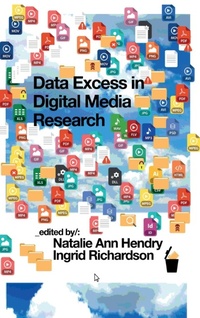
Data Excess in Digital Media Research
Published on 8. November 2024
Book
Hardback
176 pages
978-1-80455-945-1 (ISBN)
Description
Data excess - particularly in digital media research - is inevitable. It emerges as the 'debris' and 'leftovers' from planning, fieldwork and writing; the words cut from drafts and copied to untouched and forgotten files; digital metadata automatically recorded to databases; the data archived but never analysed or published. What do or can we do with this excess from our research?
Thinking beyond academic constraints and the constant push towards the next new fundable thing, Data Excess in Digital Media Research explicitly engages with data that has been left behind, ignored, obscured or even 'written out' of research publications. Positioning 'excess' as a conceptual, methodological, ethical and pragmatic challenge and opportunity, the authors in this edited collection examine what can happen when media researchers return to their surplus archives and develop new knowledge from what would otherwise be under-explored excess.
Provoking an ethical reconsideration of what we do, or do not do, with excess data, this is a call to action for researchers and scholars to rethink how they conduct their research as the consequences of datafication grow ever more central to both our academic endeavours and our lives.
Thinking beyond academic constraints and the constant push towards the next new fundable thing, Data Excess in Digital Media Research explicitly engages with data that has been left behind, ignored, obscured or even 'written out' of research publications. Positioning 'excess' as a conceptual, methodological, ethical and pragmatic challenge and opportunity, the authors in this edited collection examine what can happen when media researchers return to their surplus archives and develop new knowledge from what would otherwise be under-explored excess.
Provoking an ethical reconsideration of what we do, or do not do, with excess data, this is a call to action for researchers and scholars to rethink how they conduct their research as the consequences of datafication grow ever more central to both our academic endeavours and our lives.
More details
Language
English
Place of publication
Bingley
United Kingdom
Target group
Professional and scholarly
Product notice
Laminated cover
Dimensions
Height: 229 mm
Width: 152 mm
Thickness: 11 mm
Weight
408 gr
ISBN-13
978-1-80455-945-1 (9781804559451)
Copyright in bibliographic data and cover images is held by Nielsen Book Services Limited or by the publishers or by their respective licensors: all rights reserved.
Schweitzer Classification
Other editions
Additional editions
Natalie Ann Hendry | Ingrid Richardson
Data Excess in Digital Media Research
E-Book
11/2024
1st Edition
Emerald Publishing Limited
€167.99
Available for download
Persons
Natalie Ann Hendry is Senior Lecturer in youth wellbeing in the Faculty of Education, University of Melbourne, Australia. Natalie's research investigates the relationships between education, health and media in young adults' lives.
Ingrid Richardson is Professor of Digital Media at RMIT University, Australia. She has published on a wide range of topics, including technoscience, virtual and augmented reality, games and mobile media, social media and participatory network cultures and the phenomenology of media practices.
Ingrid Richardson is Professor of Digital Media at RMIT University, Australia. She has published on a wide range of topics, including technoscience, virtual and augmented reality, games and mobile media, social media and participatory network cultures and the phenomenology of media practices.
Content
Chapter 1. Introduction: Digital data, research ethos and haunting; Natalie Ann Hendry and Ingrid Richardson
Chapter 2. Reframing data excess; Rowan Wilken
Chapter 3. Unanticipated excess: Inescapable moments and uneasy feelings; Ben Lyall, Josie Reade, and Claire Moran
Chapter 4. The digital mess of a digital ethnography; Clare Southerton
Chapter 5. 'Digital hoarding' and embracing data excess in digital cultures research; Natalie Ann Hendry
Chapter 6. The epistemic culture of data minimalism: Conducting an ethnography of travel influencers; Christian S. Ritter
Chapter 7. Embodied excess: Interpreting haptic mobile media practices; Jess Hardley and Ingrid Richardson
Chapter 8. Re-engaging with excess data: Newbie researchers, Tumblr, and the evolving research event; Navid Sabet
Chapter 9. Museums, smart cities and big data: How can we transform data excess into data intelligence?; Natalia Grincheva
Chapter 10. Evaluation, digital data and excess(es) in health interventions; Benjamin Hanckel
Chapter 2. Reframing data excess; Rowan Wilken
Chapter 3. Unanticipated excess: Inescapable moments and uneasy feelings; Ben Lyall, Josie Reade, and Claire Moran
Chapter 4. The digital mess of a digital ethnography; Clare Southerton
Chapter 5. 'Digital hoarding' and embracing data excess in digital cultures research; Natalie Ann Hendry
Chapter 6. The epistemic culture of data minimalism: Conducting an ethnography of travel influencers; Christian S. Ritter
Chapter 7. Embodied excess: Interpreting haptic mobile media practices; Jess Hardley and Ingrid Richardson
Chapter 8. Re-engaging with excess data: Newbie researchers, Tumblr, and the evolving research event; Navid Sabet
Chapter 9. Museums, smart cities and big data: How can we transform data excess into data intelligence?; Natalia Grincheva
Chapter 10. Evaluation, digital data and excess(es) in health interventions; Benjamin Hanckel