

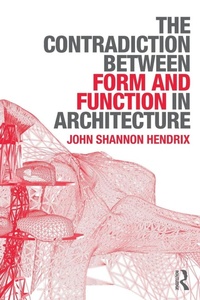
The Contradiction Between Form and Function in Architecture
1st Edition
Published on 31. January 2013
Book
Paperback/Softback
224 pages
978-0-415-63914-9 (ISBN)
Description
Continuing the themes that have been addressed in The Humanities in Architectural Design and The Cultural Role of Architecture, this book illustrates the important role that a contradiction between form and function plays in compositional strategies in architecture. The contradiction between form and function is seen as a device for poetic expression, for the expression of ideas, in architecture.
Here the role of the terms "form" and "function" are analyzed throughout the history of architecture and architectural theory, from Vitruvius to the present, with particular emphasis on twentieth-century functionalism. Historical examples are given from Ancient, Classical, Islamic, Christian, Byzantine, Gothic, Renaissance, Mannerist, and Neoclassical architecture, and from movements in the twentieth century to the present.
In addition philosophical issues such as lineamenti, Vorstellung, differance, dream construction, deep structure and surface structure, topology theory, self-generation, and immanence are explored in relation to the compositions and writings of architects throughout history.
This book contributes to the project of re-establishing architecture as a humanistic discipline, to re-establish an emphasis on the expression of ideas, and on the ethical role of architecture to engage the intellect of the observer and to represent human identity.
Here the role of the terms "form" and "function" are analyzed throughout the history of architecture and architectural theory, from Vitruvius to the present, with particular emphasis on twentieth-century functionalism. Historical examples are given from Ancient, Classical, Islamic, Christian, Byzantine, Gothic, Renaissance, Mannerist, and Neoclassical architecture, and from movements in the twentieth century to the present.
In addition philosophical issues such as lineamenti, Vorstellung, differance, dream construction, deep structure and surface structure, topology theory, self-generation, and immanence are explored in relation to the compositions and writings of architects throughout history.
This book contributes to the project of re-establishing architecture as a humanistic discipline, to re-establish an emphasis on the expression of ideas, and on the ethical role of architecture to engage the intellect of the observer and to represent human identity.
More details
Language
English
Place of publication
London
United Kingdom
Publishing group
Taylor & Francis Ltd
Target group
College/higher education
Professional and scholarly
Illustrations
40 s/w Photographien bzw. Rasterbilder
40 Halftones, black and white
Dimensions
Height: 234 mm
Width: 156 mm
Thickness: 13 mm
Weight
360 gr
ISBN-13
978-0-415-63914-9 (9780415639149)
Copyright in bibliographic data and cover images is held by Nielsen Book Services Limited or by the publishers or by their respective licensors: all rights reserved.
Schweitzer Classification
Other editions
Additional editions
John Shannon Hendrix
The Contradiction Between Form and Function in Architecture
E-Book
02/2013
Routledge
€77.99
Available for download
John Shannon Hendrix
The Contradiction Between Form and Function in Architecture
E-Book
02/2013
Routledge
€77.99
Available for download
John Shannon Hendrix
The Contradiction Between Form and Function in Architecture
Book
01/2013
1st Edition
Routledge
€237.70
Shipment within 15-20 days
Person
John Shannon Hendrix is Professor of Architectural History at the University of Lincoln, UK, and Adjunct Professor at Roger Williams University and at Rhode Island School of Design, USA.
Content
Introduction 1. Ancient and Classical: Egypt, Greece, and Rome 2. Medieval: Byzantine, Islamic, Gothic 3. Renaissance and Baroque: Architectural Theory and Form 4. Enlightenment and Idealism 5. Modernism: Structural Rationalism to Structural Linguistics 6. Postmodernism: Complexity and Contradiction 7. Bioconstructivism: Topological Theory