

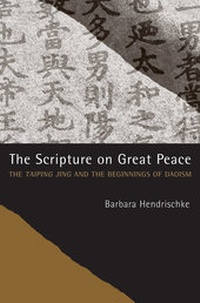
The Scripture on Great Peace
The Taiping jing and the Beginnings of Daoism
1st Edition
Will be published approx. on 10. January 2007
Book
Hardback
420 pages
978-0-520-24788-8 (ISBN)
Description
This first Western-language translation of one of the great books of the Daoist religious tradition, the "Taiping jing', or "Scripture on Great Peace," documents early Chinese medieval thought and lays the groundwork for a more complete understanding of Daoism's origins. Barbara Hendrischke, a leading expert on the Taiping jing in the West, has spent twenty-five years on this magisterial translation, which includes notes that contextualize the scripture's political and religious significance. Virtually unknown to scholars until the 1970s, the "Taiping jing" raises the hope for salvation in a practical manner by instructing men and women how to appease heaven and satisfy earth and thereby reverse the fate that thousands of years of human wrongdoing has brought about. The scripture stems from the beginnings of the Daoist religious movement, when ideas contained in the ancient Laoziwere spread with missionary fervor among the population at large.
"The Taiping jing" demonstrates how early Chinese medieval thought arose from the breakdown of the old imperial order and replaced it with a vision of a new, more diverse and fair society that would integrate outsiders - in particular women and people of a non-Chinese background.
"The Taiping jing" demonstrates how early Chinese medieval thought arose from the breakdown of the old imperial order and replaced it with a vision of a new, more diverse and fair society that would integrate outsiders - in particular women and people of a non-Chinese background.
Reviews / Votes
"No Western scholar has given the Taiping jing the thorough, painstaking attention that Hendrischke has given it. For the last quarter-century, she has unquestionably been the West's leading expert on the subject. Hendrischke is not only the prime authority on the history and nature of the text itself, but also the prime authority on virtually all related historical materials and issues. Hendrischke draws on this vast knowledge throughout the book. Her arguments are remarkably compelling, the translations are unfailingly precise and expertly nuanced, and there are wonderful tidbits of enlightening new data with fascinating new implications on every page." - Russell Kirkland, author of Taoism: The Enduring Tradition"More details
Series
Edition
First Edition
Language
English
Place of publication
Berkerley
United States
Target group
Professional and scholarly
Product notice
Cloth over boards
Dimensions
Height: 229 mm
Width: 152 mm
Thickness: 30 mm
Weight
726 gr
ISBN-13
978-0-520-24788-8 (9780520247888)
Copyright in bibliographic data and cover images is held by Nielsen Book Services Limited or by the publishers or by their respective licensors: all rights reserved.
Schweitzer Classification
Other editions
Additional editions
Book
03/2015
1st Edition
University of California Press
€42.16
Shipment within 10-20 days
E-Book
01/2007
1st Edition
Naval Institute Press
€39.49
Available for download
Person
Barbara Hendrischke is Senior Research Fellow in the School of Modern Languages at the University of New South Wales. She is author of Wen-tzu - Ein Beitrag zur Problematik und zum Verstandnis eines taoistischen Textes and Taiping jing: The Origin and Transmission of the 'Scripture on General Welfare' - The history of an unofficial text.
Content
Preface Conventions Introduction Translation Section 41. How to Distinguish between Poor and Rich Section 42. One Man and Two Women Section 43. How to Promote the Good and Halt the Wicked Section 44. How to Preserve the Three Essentials Section 45. The Three Needs and the Method of [Dealing with] Auspicious and Ominous Events Section 46. You Must Not Serve the Dead More Than the Living Section 47. How to Verify the Trustworthiness of Texts and Writings Section 48. An Explanation of the Reception and Transmission [of Evil] in Five Situations Section 50. An Explanation of the Master's Declaration Section 51. The True Contract Section 52. How to Word Hard to Do Good Section 53. How to Distinguish between Root and Branches Section 54. How to Enjoy Giving Life Wins Favor with Heaven Section 55. How to Classify Old Texts and Give a Title to the Book Section 56. How the Nine Groups of Men Disperse Calamities Inherited from Former Kings Section 57. How to Examine What is True and What is False Dao Section 58. On the Four Ways of Conduct and on [the Relationship between] Root and Branches Section 59. Big and Small Reproaches Section 60. How Books Illustrate [Rule by] Punishment and [by] Virtue Section 61. On Digging Up Soil and Publishing Books Section 62. Dao is Priceless and Overcomes Yi and Di Barbarians Section 63. Officials, Sons, and Disciples of Outstanding Goodness Find Ways for Their Lord, Father, and Master to Become Transcendent Section 64. How to Subdue Others by Means of Dao and Not by Means of Severity Section 65. Threefold Cooperation and Interaction Section 66. On the Need to Study What Is True Appendix: The Composition of the TPJ Bibliography Index