

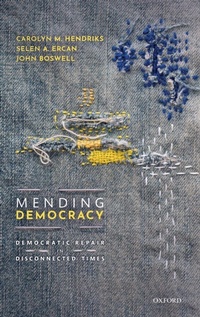
Mending Democracy
Democratic Repair in Disconnected Times
Published on 20. October 2020
Book
Hardback
208 pages
978-0-19-884305-4 (ISBN)
Description
The fabric of democracy is threadbare in many contemporary societies. Connections that are vital to the functioning and integrity of our democratic systems are wearing thin. Citizens are increasingly disconnected - from their elected representatives, from one another in the public sphere, and from complex processes of public policy. In such disconnected times, how can we strengthen and renew our democracies?
This book develops the idea of democratic mending as a way of advancing a more connective approach to democratic reform. It is informed by three rich empirical cases of connectivity in practice, as well as cutting-edge debates in deliberative democracy. The empirical cases uncover empowering and transformative modes of political engagement that are vital for democratic renewal. The diverse actors in this book are not withdrawing, resisting or seeking autonomy from conventional institutions of representative democracy but actively experimenting with ways to improve and engage with them. Through their everyday practices of democratic mending they undertake crucial systemic repair work and strengthen the integrity of our democratic fabric in ways that are yet to be fully acknowledged by scholars and practitioners of democratic reform.
This book develops the idea of democratic mending as a way of advancing a more connective approach to democratic reform. It is informed by three rich empirical cases of connectivity in practice, as well as cutting-edge debates in deliberative democracy. The empirical cases uncover empowering and transformative modes of political engagement that are vital for democratic renewal. The diverse actors in this book are not withdrawing, resisting or seeking autonomy from conventional institutions of representative democracy but actively experimenting with ways to improve and engage with them. Through their everyday practices of democratic mending they undertake crucial systemic repair work and strengthen the integrity of our democratic fabric in ways that are yet to be fully acknowledged by scholars and practitioners of democratic reform.
Reviews / Votes
Fraying and fragile, the fabric of democracy is generally viewed as being increasingly threadbare. In this context Mending Democracy offers an account of political life that is as refreshing as it is sophisticated. From kitchens to cafes and from knitting-clubs to workplace corridors, the focus on everyday life reveals a set of creative practices that pose new questions and - more importantly - new opportunities for those thinking about the future of democracy. Mending Democracy is undoubtedly one of the most important books published on this topic in recent decades. * Professor Matthew Flinders, Founding Director of the Sir Bernard Crick Centre and Professor of Politics at the University of Sheffield, and President of the Political Studies Association of the UK *More details
Language
English
Place of publication
Oxford
United Kingdom
Target group
Professional and scholarly
Dimensions
Height: 240 mm
Width: 161 mm
Thickness: 15 mm
Weight
470 gr
ISBN-13
978-0-19-884305-4 (9780198843054)
Copyright in bibliographic data and cover images is held by Nielsen Book Services Limited or by the publishers or by their respective licensors: all rights reserved.
Schweitzer Classification
Other editions
Additional editions
Carolyn M. Hendriks | Selen A. Ercan | John Boswell
Mending Democracy
Democratic Repair in Disconnected Times
E-Book
10/2020
1st Edition
OUP eBook
€59.99
Available for download
Carolyn M. Hendriks | Selen A. Ercan | John Boswell
Mending Democracy
Democratic Repair in Disconnected Times
E-Book
10/2020
1st Edition
OUP eBook
€59.99
Available for download
Persons
Carolyn M. Hendriks is a Professor at the Crawford School of Public Policy at the Australian National University. Her work examines democratic aspects of contemporary governance, including participation, deliberation, inclusion and representation. Carolyn has undertaken numerous empirical research projects in Australia, Germany and the Netherlands on the role of interests, power, networks, markets and elites in participatory modes of governing. She has published widely on different aspects of public engagement in public policy and politics including two books, over 30 scholarly journal articles, and numerous book chapters. Carolyn is an appointed individual member of the global network Democracy R&D. She also sits on the new Democracy Foundation's Research Committee, and on the editorial boards of several international journals, including the European Journal of Political Research, Policy and Society and the Journal of Deliberative Democracy.
Selen A. Ercan is an Associate Professor at the Centre for Deliberative Democracy and Global Governance at the University of Canberra. Her work sits at the intersection of normative democratic theory and empirical political research, and examines a wide range of topics including the politics of inclusion and exclusion in multicultural societies, public deliberation in the face of value conflicts and polarised public debates, and the potential of new forms of political participation and protest movements in reviving democratic practice. Selen's publications on these topics have appeared in various journals including International Political Science Review, Policy and Politics, Democratic Theory, Social Movement Studies, and Critical Policy Studies.
John Boswell is an Associate Professor in Politics at the University of Southampton. His work on deliberative democracy and democratic renewal draws on other key interests in policy studies and interpretive methods and theory. He has published conceptual and empirical work on these themes in journals such as Political Studies, Perspectives on Politics, Policy Sciences, and the European Journal of Political Research.
Selen A. Ercan is an Associate Professor at the Centre for Deliberative Democracy and Global Governance at the University of Canberra. Her work sits at the intersection of normative democratic theory and empirical political research, and examines a wide range of topics including the politics of inclusion and exclusion in multicultural societies, public deliberation in the face of value conflicts and polarised public debates, and the potential of new forms of political participation and protest movements in reviving democratic practice. Selen's publications on these topics have appeared in various journals including International Political Science Review, Policy and Politics, Democratic Theory, Social Movement Studies, and Critical Policy Studies.
John Boswell is an Associate Professor in Politics at the University of Southampton. His work on deliberative democracy and democratic renewal draws on other key interests in policy studies and interpretive methods and theory. He has published conceptual and empirical work on these themes in journals such as Political Studies, Perspectives on Politics, Policy Sciences, and the European Journal of Political Research.
Author
ProfessorAssociate Professor, Crawford School of Public Policy, Australian National University
Associate ProfessorAssociate Professor, Centre for Deliberative Democracy and Global Governance at the University of Canberra
University of SouthamptonUniversity of Southampton, Associate Professor in Politics
Content
1: Repairing Democracy's Disconnects
2: Conceptualising Connectivity in Deliberative Democracy
3: Connecting Elected Representatives with their Constituents: The Case of Indi
4: Connecting Publics in a Fractured Public Sphere: The Case of Knitting Nannas Against Gas
5: Connecting Citizens and Administrative Policy-Making: The Case of British Healthcare Agencies
6: Connective Practices: The Everyday Work of Democratic Mending
7: Towards a Connective Turn in Deliberative Democracy
8: Advancing a Connective Approach to Democratic Reform
2: Conceptualising Connectivity in Deliberative Democracy
3: Connecting Elected Representatives with their Constituents: The Case of Indi
4: Connecting Publics in a Fractured Public Sphere: The Case of Knitting Nannas Against Gas
5: Connecting Citizens and Administrative Policy-Making: The Case of British Healthcare Agencies
6: Connective Practices: The Everyday Work of Democratic Mending
7: Towards a Connective Turn in Deliberative Democracy
8: Advancing a Connective Approach to Democratic Reform