

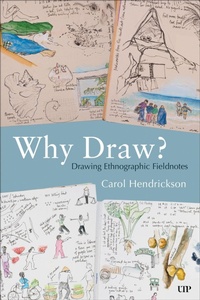
Why Draw?
Drawing Ethnographic Fieldnotes
Published on 8. July 2025
Book
Hardback
232 pages
978-1-4875-5658-7 (ISBN)
Description
In Why Draw?, Carol Hendrickson explores the potential of drawing within the context of ethnographic fieldwork. The book aims to inspire readers to immerse themselves in the generative process of thinking while seeing while drawing.
To foster visual thinking and encourage experimentation, Hendrickson discusses a range of case studies that show the possibilities of drawing in the field and thinking through the resulting drawings. Richly illustrated, the book focuses on current theoretical and methodological considerations in the social sciences, including semiotic issues of representation and indexicality, embodiment and the senses, affect, collaboration, and temporality. Chapters are supplemented with exercises, practical advice, and short interludes that provide inspiration.
At its heart, Why Draw? asks readers to create visual notes in new and different ways; contemplate a range of contemporary issues through the act of drawing; and explore the potential of drawing to act as a bridge between fieldwork and finished works destined for public presentation.
To foster visual thinking and encourage experimentation, Hendrickson discusses a range of case studies that show the possibilities of drawing in the field and thinking through the resulting drawings. Richly illustrated, the book focuses on current theoretical and methodological considerations in the social sciences, including semiotic issues of representation and indexicality, embodiment and the senses, affect, collaboration, and temporality. Chapters are supplemented with exercises, practical advice, and short interludes that provide inspiration.
At its heart, Why Draw? asks readers to create visual notes in new and different ways; contemplate a range of contemporary issues through the act of drawing; and explore the potential of drawing to act as a bridge between fieldwork and finished works destined for public presentation.
Reviews / Votes
"Carol Hendrickson's writing style is supple and engaging, compelling the interested reader to continue on; her voice is strong and honest. The book is wonderfully rich in ethnographic drawings as examples, including; not just the author's works, but those of many other researchers, which shows readers that there are many ways to express visual marks while doing ethnographic work." -- Andrew Causey, Columbia College Chicago, author of <em>Drawn to See</em> "Why Draw? is an extremely original and valuable contribution to the field of ethnographic methods. Its primary contribution is to provide guidance on the use of graphic recording methods, while also encouraging reflection on their usefulness and value in the context of ethnography. It is highly enjoyable to read without failing to pose challenging questions and stimulating exercises." -- Karina Kuschnir, Federal University of Rio de JaneiroMore details
Language
English
Place of publication
Toronto
Canada
Target group
College/higher education
Professional and scholarly
Product notice
sewn/stitched
Cloth over boards
Illustrations
53 illustrations
Dimensions
Height: 230 mm
Width: 154 mm
Thickness: 22 mm
Weight
517 gr
ISBN-13
978-1-4875-5658-7 (9781487556587)
Copyright in bibliographic data and cover images is held by Nielsen Book Services Limited or by the publishers or by their respective licensors: all rights reserved.
Schweitzer Classification
Person
Carol Hendrickson was professor of anthropology at Marlboro College and is now professor emerita at Emerson College.
Content
1. Introduction
What to Take: Materials for Drawing in the Field
2. Representing the World: Iconicity
A Drawing Event
3. Being There: Indexicality
Visual Practices in Place
4. Embodiment, Movement, and the Senses
The Artist's Body
5. The Force of Visual Fieldnotes: Affect
The Notebook as Lyrical Museum
6. Drawing Near: Company, Conversation, and Collaboration
Explorations in Visual Fieldwork Methods
7. About Time: Temporalities and Sequences
Artists' Books, Bookworks, and Book-Objects
8. Conclusion
Bibliography
Index
What to Take: Materials for Drawing in the Field
2. Representing the World: Iconicity
A Drawing Event
3. Being There: Indexicality
Visual Practices in Place
4. Embodiment, Movement, and the Senses
The Artist's Body
5. The Force of Visual Fieldnotes: Affect
The Notebook as Lyrical Museum
6. Drawing Near: Company, Conversation, and Collaboration
Explorations in Visual Fieldwork Methods
7. About Time: Temporalities and Sequences
Artists' Books, Bookworks, and Book-Objects
8. Conclusion
Bibliography
Index