

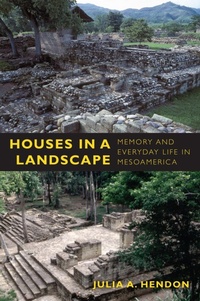
Houses in a Landscape
Memory and Everyday Life in Mesoamerica
Published on 22. April 2010
Book
Hardback
312 pages
978-0-8223-4693-7 (ISBN)
Description
In Houses in a Landscape, Julia A. Hendon examines the connections between social identity and social memory using archaeological research on indigenous societies that existed more than one thousand years ago in what is now Honduras. While these societies left behind monumental buildings, the remains of their dead, remnants of their daily life, intricate works of art, and fine examples of craftsmanship such as pottery and stone tools, they left only a small body of written records. Despite this paucity of written information, Hendon contends that an archaeological study of memory in such societies is possible and worthwhile. It is possible because memory is not just a faculty of the individual mind operating in isolation, but a social process embedded in the materiality of human existence. Intimately bound up in the relations people develop with one another and with the world around them through what they do, where and how they do it, and with whom or what, memory leaves material traces.Hendon conducted research on three contemporaneous Native American civilizations that flourished from the seventh century through the eleventh CE: the Maya kingdom of Copan, the hilltop center of Cerro Palenque, and the dispersed settlement of the Cuyumapa valley. She analyzes domestic life in these societies, from cooking to crafting, as well as public and private ritual events including the ballgame. Combining her findings with a rich body of theory from anthropology, history, and geography, she explores how objects-the things people build, make, use, exchange, and discard-help people remember. In so doing, she demonstrates how everyday life becomes part of the social processes of remembering and forgetting, and how "memory communities" assert connections between the past and the present.
Reviews / Votes
"[Hendon's] nuanced analysis is brilliantly crafted, culturally intimate, and immensely provocative. Hendon's playing field spans a range of objects, features, and monuments that elicit newfound insights into the seeming intangibles of memory in Maya thought and culture. Ultimately, the author delivers the promise and prospect for interpreting community memory, daily life, and the dynamics of intergroup relations via the thoughtful, introspective consideration of objects recovered from cultural landscapes in archaeology. Highly recommended." - R. G. Mendoza, Choice "I encourage scholars of the Maya and construction of memory to read Hendon's attractive and well-presented volume. . . . Overall, Houses in a Landscape is likely to fuel scholarly debate and inspire archaeological projects to test its conclusions for many years to come." - Stephen L. Whittington, Journal of the Royal Anthropological Association "A brilliant work, Houses in a Landscape sets a new standard for the social archaeology of the Maya and related cultures. It is theoretically sophisticated, meticulously researched, and beautifully written, and it extends the existing literature on memory and archaeology in significant ways. "-Robert W. Preucel, author of Archaeological Semiotics "This is an invigorating, original, and intellectually rewarding book, notable for the breadth and critical rigor of Julia A. Hendon's theoretical discussions, and the originality of her insights to ancient Honduran societies. It will be of interest not only to archaeologists but also to social theorists more broadly."-Wendy Ashmore, coeditor of Household and Community in the Mesoamerican Past "[Hendon's] nuanced analysis is brilliantly crafted, culturally intimate, and immensely provocative. Hendon's playing field spans a range of objects, features, and monuments that elicit newfound insights into the seeming intangibles of memory in Maya thought and culture. Ultimately, the author delivers the promise and prospect for interpreting community memory, daily life, and the dynamics of intergroup relations via the thoughtful, introspective consideration of objects recovered from cultural landscapes in archaeology. Highly recommended." - R. G. Mendoza (Choice) "I encourage scholars of the Maya and construction of memory to read Hendon's attractive and well-presented volume. . . . Overall, Houses in a Landscape is likely to fuel scholarly debate and inspire archaeological projects to test its conclusions for many years to come." - Stephen L. Whittington (Journal of the Royal Anthropological Institute)More details
Series
Language
English
Place of publication
North Carolina
United States
Target group
College/higher education
Professional and scholarly
Product notice
Cloth over boards
Illustrations
48 photos, 8 tables, 7 maps
Dimensions
Height: 239 mm
Width: 160 mm
Thickness: 23 mm
Weight
612 gr
ISBN-13
978-0-8223-4693-7 (9780822346937)
Copyright in bibliographic data and cover images is held by Nielsen Book Services Limited or by the publishers or by their respective licensors: all rights reserved.
Schweitzer Classification
Other editions
Additional editions
E-Book
04/2010
1st Edition
De Gruyter
€208.99
Available for download
Person
Julia A. Hendon is Associate Professor of Anthropology at Gettysburg College. She is the co-editor of Mesoamerican Archaeology: Theory and Practice.
Content
Illustrations ix
Tables xi
Acknowledgments xiii
Introduction: Thinking About Memory 1
1. Communities of Practice in Honduras in the Seventh Century through the Eleventh 33
2. The Enchantment and Humility of Objects 63
3. The Semiotic House: Everyday Life and Domestic Space 91
4. Embodied Forms of Knowing 123
5. Relational Identities and Material Domains 149
6. Special Events at Home 181
7. Ballcourts and Houses: Shared Patterns of Monumentality and Domesticity 203
Conclusion: Communities of Memory and Local Histories 227
Notes 239
Bibliography 243
Index 283
Tables xi
Acknowledgments xiii
Introduction: Thinking About Memory 1
1. Communities of Practice in Honduras in the Seventh Century through the Eleventh 33
2. The Enchantment and Humility of Objects 63
3. The Semiotic House: Everyday Life and Domestic Space 91
4. Embodied Forms of Knowing 123
5. Relational Identities and Material Domains 149
6. Special Events at Home 181
7. Ballcourts and Houses: Shared Patterns of Monumentality and Domesticity 203
Conclusion: Communities of Memory and Local Histories 227
Notes 239
Bibliography 243
Index 283