

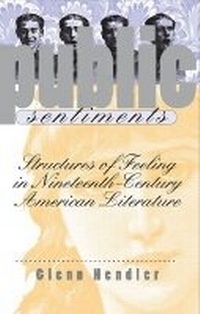
Public Sentiments
Structures of Feeling in Nineteenth-Century American Literature
Published on 30. April 2001
Book
Hardback
288 pages
978-0-8078-2606-5 (ISBN)
Description
In this book, Glenn Hendler explores what he calls the ""logic of sympathy"" in novels by Walt Whitman, Louisa May Alcott, T. S. Arthur, Martin Delany, Horatio Alger, Fanny Fern, Nathaniel Parker Willis, Henry James, Mark Twain, and William Dean Howells. For these nineteenth-century writers, he argues, sympathetic identification was not strictly an individual, feminizing, and private feeling but the quintessentially public sentiment--a transformative emotion with the power to shape social institutions and political movements.
Uniting current scholarship on gender in nineteenth-century American culture with historical and theoretical debates on the definition of the public sphere in the period, Hendler shows how novels taught diverse readers to ""feel right,"" to experience their identities as male or female, black or white, middle or working class, through a sentimental, emotionally based structure of feeling. He links novels with such wide-ranging cultural and political discourses as the temperance movement, feminism, and black nationalism. Public Sentiments demonstrates that, whether published for commercial reasons or for higher moral and aesthetic purposes, the nineteenth-century American novel was conceived of as a public instrument designed to play in a sentimental key.
|Shows how novels by Walt Whitman, Louisa May Alcott, T. S. Arthur, Martin Delany, Horatio Alger, Fanny Fern, Nathaniel Parker Willis, Henry James, Mark Twain, and William Dean Howells taught readers to experience their identities as male or female, black or white, middle or working class, through a sentimental, emotionally based structure of feeling.
Uniting current scholarship on gender in nineteenth-century American culture with historical and theoretical debates on the definition of the public sphere in the period, Hendler shows how novels taught diverse readers to ""feel right,"" to experience their identities as male or female, black or white, middle or working class, through a sentimental, emotionally based structure of feeling. He links novels with such wide-ranging cultural and political discourses as the temperance movement, feminism, and black nationalism. Public Sentiments demonstrates that, whether published for commercial reasons or for higher moral and aesthetic purposes, the nineteenth-century American novel was conceived of as a public instrument designed to play in a sentimental key.
|Shows how novels by Walt Whitman, Louisa May Alcott, T. S. Arthur, Martin Delany, Horatio Alger, Fanny Fern, Nathaniel Parker Willis, Henry James, Mark Twain, and William Dean Howells taught readers to experience their identities as male or female, black or white, middle or working class, through a sentimental, emotionally based structure of feeling.
Reviews / Votes
"In this full-scale account of male sentiment and the limits of female sympathy, Hendler analyzes with imagination and wit how we can gauge the nineteenthcentury significance of sentimentality. It is a remarkably lucid, forceful book." - Dale M. Bauer, University of Kentucky"More details
Language
English
Place of publication
Chapel Hill
United States
Target group
College/higher education
Professional and scholarly
Dimensions
Height: 235 mm
Width: 156 mm
ISBN-13
978-0-8078-2606-5 (9780807826065)
Copyright in bibliographic data and cover images is held by Nielsen Book Services Limited or by the publishers or by their respective licensors: all rights reserved.
Schweitzer Classification
Person
Glenn Hendler, assistant professor of English at the University of Notre Dame, is coeditor of Sentimental Men: Masculinity and the Politics of Affect in American Culture.