

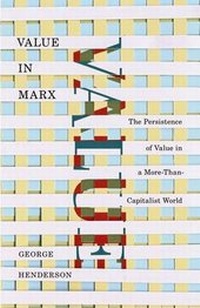
Value in Marx
The Persistence of Value in a More-Than-Capitalist World
Published on 20. March 2013
Book
Hardback
208 pages
978-0-8166-8095-5 (ISBN)
Description
Long prone to dogmatic disagreement, the question of value in Marx's thought-what value is, the purpose it serves, its application to real-world capitalism-requires renewal if Marx's work is to remain vibrant. In Value in Marx, George Henderson offers a lucid rereading of Marx that strips value of its turgid theoretical reduction and reframes it as an investigation into the tensions between social relations and forms as they are rather than as what they could otherwise become.
Drawing on Marx's Capital and Grundrisse, Henderson shows how these volumes do not harbor a single theory of value that equates value to capital. Instead, these books experimentally compose and recompose value for a world that is more than capitalist. At stake is how Marx conceives of human freedom, of balanced social arrangements, and of control over the things people produce. Henderson finds that the limits on social becoming, including the tendency toward alienated existence, haunt Marx even as he looks beyond the critique of capital to an emancipated society to come.
Can these limits be confronted in a creative, even joyful, way? Can they become aspects of what we desire, rather than being silenced and denied? As long as we persist in interpreting value broadly, following it as an active and not a shut-down, predetermined feature of Marx's texts, Henderson ultimately views Marx as responding positively to these challenges and employing value as a powerful tool of the political imaginary.
Drawing on Marx's Capital and Grundrisse, Henderson shows how these volumes do not harbor a single theory of value that equates value to capital. Instead, these books experimentally compose and recompose value for a world that is more than capitalist. At stake is how Marx conceives of human freedom, of balanced social arrangements, and of control over the things people produce. Henderson finds that the limits on social becoming, including the tendency toward alienated existence, haunt Marx even as he looks beyond the critique of capital to an emancipated society to come.
Can these limits be confronted in a creative, even joyful, way? Can they become aspects of what we desire, rather than being silenced and denied? As long as we persist in interpreting value broadly, following it as an active and not a shut-down, predetermined feature of Marx's texts, Henderson ultimately views Marx as responding positively to these challenges and employing value as a powerful tool of the political imaginary.
More details
Language
English
Place of publication
Minnesota
United States
Dimensions
Height: 216 mm
Width: 140 mm
Thickness: 25 mm
ISBN-13
978-0-8166-8095-5 (9780816680955)
Copyright in bibliographic data and cover images is held by Nielsen Book Services Limited or by the publishers or by their respective licensors: all rights reserved.
Schweitzer Classification
Person
George Henderson is associate professor of geography at the University of Minnesota. He is the author of California and the Fictions of Capital and coeditor of Geographic Thought: A Praxis Perspective.
Content
Contents
Acknowledgments
Introduction: Did Marx Have a Theory of Value?
Part I
1. The Value-Capital Couplet and How to Break It
2. The Politics of Capitalist "Totality" in a More-Than-Capitalist World
Part II
3. The End of Value (As We Know It)
4. From Necessity to Freedom and Back Again: Abjected Labor and the Taint of Value
Part III
5. The Value Hypothesis: Three Scenes for a Political Imaginary of Value
Notes
Bibliography
Index
Acknowledgments
Introduction: Did Marx Have a Theory of Value?
Part I
1. The Value-Capital Couplet and How to Break It
2. The Politics of Capitalist "Totality" in a More-Than-Capitalist World
Part II
3. The End of Value (As We Know It)
4. From Necessity to Freedom and Back Again: Abjected Labor and the Taint of Value
Part III
5. The Value Hypothesis: Three Scenes for a Political Imaginary of Value
Notes
Bibliography
Index