

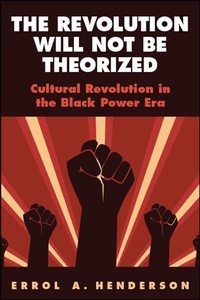
The Revolution Will Not Be Theorized
Cultural Revolution in the Black Power Era
Published on 1. August 2019
Book
Hardback
514 pages
978-1-4384-7543-1 (ISBN)
Description
Studies the revolutionary theory of the Black Power Movement in the 1960s through ?70s, placing it within the broader social theory of black revolution in the United States since the nineteenth century.
The study of the impact of Black Power Movement (BPM) activists and organizations in the 1960s through ?70s has largely been confined to their role as proponents of social change; but they were also theorists of the change they sought. In The Revolution Will Not Be Theorized Errol A. Henderson explains this theoretical contribution and places it within a broader social theory of black revolution in the United States dating back to nineteenth-century black intellectuals. These include black nationalists, feminists, and anti-imperialists; activists and artists of the Harlem Renaissance; and early Cold War-era black revolutionists. The book first elaborates W. E. B. Du Bois's thesis of the "General Strike" during the Civil War, Alain Locke's thesis relating black culture to political and economic change, Harold Cruse's work on black cultural revolution, and Malcolm X's advocacy of black cultural and political revolution in the United States. Henderson then critically examines BPM revolutionists' theorizing regarding cultural and political revolution and the relationship between them in order to realize their revolutionary objectives. Focused more on importing theory from third world contexts that were dramatically different from the United States, BPM revolutionists largely ignored the theoretical template for black revolution most salient to their case, which undermined their ability to theorize a successful black revolution in the United States.
This book is freely available in an open access edition thanks to TOME (Toward an Open Monograph Ecosystem)-a collaboration of the Association of American Universities, the Association of University Presses, and the Association of Research Libraries-and the generous support of Pennsylvania State University.
The study of the impact of Black Power Movement (BPM) activists and organizations in the 1960s through ?70s has largely been confined to their role as proponents of social change; but they were also theorists of the change they sought. In The Revolution Will Not Be Theorized Errol A. Henderson explains this theoretical contribution and places it within a broader social theory of black revolution in the United States dating back to nineteenth-century black intellectuals. These include black nationalists, feminists, and anti-imperialists; activists and artists of the Harlem Renaissance; and early Cold War-era black revolutionists. The book first elaborates W. E. B. Du Bois's thesis of the "General Strike" during the Civil War, Alain Locke's thesis relating black culture to political and economic change, Harold Cruse's work on black cultural revolution, and Malcolm X's advocacy of black cultural and political revolution in the United States. Henderson then critically examines BPM revolutionists' theorizing regarding cultural and political revolution and the relationship between them in order to realize their revolutionary objectives. Focused more on importing theory from third world contexts that were dramatically different from the United States, BPM revolutionists largely ignored the theoretical template for black revolution most salient to their case, which undermined their ability to theorize a successful black revolution in the United States.
This book is freely available in an open access edition thanks to TOME (Toward an Open Monograph Ecosystem)-a collaboration of the Association of American Universities, the Association of University Presses, and the Association of Research Libraries-and the generous support of Pennsylvania State University.
Reviews / Votes
"Errol A. Henderson's masterful and powerful book lays bare the complex dynamics of the revolutionary black nationalist tradition in the US empire. It is the best treatment we have of the theoretical contributions of Malcolm X, Harold Cruse, Grace Boggs, and others that attempt to connect revolutionary efforts to black cultural institutions. His fascinating reflections on reverse civilizationism are worth the book! And Henderson's magisterial work helps bring back revolutionary theory and praxis in our grim neofascist times!" - Cornel West"This book is not only one of the most intellectually ambitious works but also the most comprehensive examination of revolutionary theory in the Black Power Era. A monumental accomplishment. Bravo!" - Komozi Woodard, author of A Nation within a Nation: Amiri Baraka (LeRoi Jones) and Black Power Politics
More details
Series
Language
English
Place of publication
Albany, NY
United States
Target group
Professional and scholarly
US School Grade: College Graduate Student and over
Product notice
Laminated cover
Dimensions
Height: 231 mm
Width: 160 mm
Thickness: 26 mm
Weight
839 gr
ISBN-13
978-1-4384-7543-1 (9781438475431)
DOI
10.1353/book.67098
Copyright in bibliographic data and cover images is held by Nielsen Book Services Limited or by the publishers or by their respective licensors: all rights reserved.
Schweitzer Classification
Other editions
Additional editions
E-Book
07/2019
1st Edition
SUNY Press
€0.00
Available for download
Person
Errol A. Henderson is Associate Professor of Political Science at Pennsylvania State University. He is the author of several books, including African Realism? International Relations Theory and Africa's Wars in the Postcolonial Era.
Content
Acknowledgments
Introduction: The Revolution Will Not Be Theorized
1. Malcolm X and the Revolutionary Turn in the Civil Rights Movement
2. Black Nationalism: Civilizationism and Reverse Civilizationism
3. The General Strike and the Slave Revolution of the U.S. Civil War
4. Cultural Revolution and Cultural Evolution
5. Theorizing Cultural Revolution in the Black Power Era
6. RAM, Us, the Black Panther Party
7. Republic of New Africa, League of Revolutionary Black Workers
8. CAP, Shrine of the Black Madonna/Pan-African Orthodox Christian Church
Conclusion: Black Revolutionary Theory in the BPM
Notes
References
Index
Introduction: The Revolution Will Not Be Theorized
1. Malcolm X and the Revolutionary Turn in the Civil Rights Movement
2. Black Nationalism: Civilizationism and Reverse Civilizationism
3. The General Strike and the Slave Revolution of the U.S. Civil War
4. Cultural Revolution and Cultural Evolution
5. Theorizing Cultural Revolution in the Black Power Era
6. RAM, Us, the Black Panther Party
7. Republic of New Africa, League of Revolutionary Black Workers
8. CAP, Shrine of the Black Madonna/Pan-African Orthodox Christian Church
Conclusion: Black Revolutionary Theory in the BPM
Notes
References
Index