

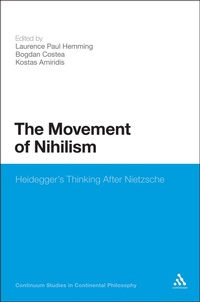
The Movement of Nihilism
Heidegger's Thinking After Nietzsche
Published on 5. May 2011
Book
Hardback
208 pages
978-1-4411-6809-2 (ISBN)
Description
When Nietzsche announced the advent of nihilism in 1887/88, he argued that he was sketching the history of the next two centuries. For some time now, he wrote, our whole European culture has been moving as toward catastrophe : restlessly, violently, headlong, like a river that want to reach the end, that no longer reflects, that is afraid to reflect. Can we gain a ground for reflection upon our own condition? Can we heed Nietzsche's warning? Can we respond to the challenge? In this book, eleven newly commissioned essays from leading scholars offer an attempt to grasp Nietzsche's prescience through Heidegger's critique of it; attempting to think through the philosophical consequences of the last century in reading the signs of our own condition. The book also provides and fascinating and unique discussion of some of the lesser-known texts of the later Heidegger.
Reviews / Votes
I would recommend this collection of essays... for a number of strategies for where to begin a thinking of nihilism from out of the Nietzschean/Heideggerian context. Although this context may speak to many concerns, one of the more interesting is the direction towards which the collection is directed, which is a re-thinking of the political. It might well be that Heidegger, perhaps best known for his indefensible political action, will still yet offer some future for the philosophical thinking of the political. -- Notre Dame Philosophical ReviewMore details
Series
Language
English
Place of publication
New York
United States
Target group
College/higher education
Product notice
Laminated cover
Dimensions
Height: 234 mm
Width: 156 mm
Thickness: 13 mm
Weight
471 gr
ISBN-13
978-1-4411-6809-2 (9781441168092)
Copyright in bibliographic data and cover images is held by Nielsen Book Services Limited or by the publishers or by their respective licensors: all rights reserved.
Schweitzer Classification
Persons
Laurence Paul Hemming is Senior Research Fellow in the Institute for Advanced Studies of the Faculty of Arts and Social Sciences of Lancaster University, UK. Kostas Amiridis is a Lecturer in the Department of Organization, Work and Technology at Lancaster University, UK. Bogdan Costea is Senior Lecturer in the Department of Organization, Work and Technology at Lancaster University, UK.
Content
1. Introduction, Laurence Paul Hemming (Lancaster University, UK); 2. The Movement of Nihilism as Self-Assertion: Heidegger, Junger and Blumenberg, Kostas Amiridis and Bogdan Costea (both Lancaster University, UK); 3. Nihilism, Tragedy and Politics, Michael Dillon (Lancaster University, UK); 4. The Gods of the Polis, Laurence Hemming. 5. Nihilism versus the desire for a single communal faith: Heidegger's unique mobilisation of a key theme of German Kulturkritik, Thomas Rohkramer (Lancaster University, UK); 6. Questioning Politics, or Beyond Power, Miguel de Beistegui (Warwick University, UK); 7. Early Christianity and Heidegger's 'Movement of Nihilism', Hal Broadbent (Heythrop College, University of London, UK); 8. Through Nietzsche to an Understanding of Nihilism, Ullrich Haase (Manchester Metropolitan University, UK); 9. Nietzsche and Heidegger: within or beyond Christianity, Joanna Hodge (Manchester Metropolitan University, UK); 10. The Turning of Place: Nihilism, Politics, and the Death of God, Jeff Malpas (University of Tasmania, Australia); 11. What Gives Here? Phronesis and die Gotter: A close reading of 70-71 of Martin Heidegger's Besinnung, Susan Frank Parsons (editor of the journal, Studies in Christian Ethics); 12. "Mythos heisst: das sagende wort" / "der Herr will in der Finsternis wohnen": Rhetoric, Religion and Philosophy in Heidegger's and Grassi's reading of the Phaedrus, Johan Siebers (University of Central Lancashire, UK); 13. Technology as Nihilism and the Possibility of Political Action, Mark Sinclair (Manchester Metropolitan University); Bibliography; Index.