

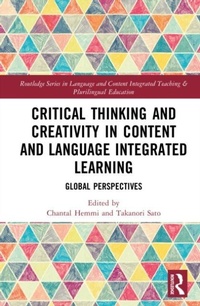
Critical Thinking and Creativity in Content and Language Integrated Learning
Global Perspectives
1st Edition
Will be published approx. on 6. October 2026
Book
Hardback
296 pages
978-1-032-66441-5 (ISBN)
Description
This volume addresses the theory and practice of Critical Thinking and Creativity (CT&C) in the context of Content and Language Integrated Learning (CLIL) by presenting how it is applied to cultivate these two important elements, CT&C, in education in different parts of the world.
The chapters present original research on CT&C from a variety of countries including Argentina, Italy, Japan, Spain, Taiwan and USA, and covers different educational levels such as primary, secondary and university. Providing varying perspectives on theory and practice, this book focuses on the challenge of embedding CT and integrating CT&C in our practice through the processes and end-products of a dual-focused education. The book consists of three parts: critical thinking in CLIL, creativity in CLIL, and critical thinking and creativity in CLIL. The chapters consist of empirical research and theoretical perspectives, and explores CLIL's potential to foster students' CT&C.
This volume offers a good balance of internationally recognised and up-and-coming researchers. The book will be of interest to researchers and graduate school students in the fields of TESOL, Applied Linguistics and Education, as well as initial training students aiming to become teachers of subjects or language, and CLIL.
The chapters present original research on CT&C from a variety of countries including Argentina, Italy, Japan, Spain, Taiwan and USA, and covers different educational levels such as primary, secondary and university. Providing varying perspectives on theory and practice, this book focuses on the challenge of embedding CT and integrating CT&C in our practice through the processes and end-products of a dual-focused education. The book consists of three parts: critical thinking in CLIL, creativity in CLIL, and critical thinking and creativity in CLIL. The chapters consist of empirical research and theoretical perspectives, and explores CLIL's potential to foster students' CT&C.
This volume offers a good balance of internationally recognised and up-and-coming researchers. The book will be of interest to researchers and graduate school students in the fields of TESOL, Applied Linguistics and Education, as well as initial training students aiming to become teachers of subjects or language, and CLIL.
More details
Series
Language
English
Place of publication
London
United Kingdom
Publishing group
Taylor & Francis Ltd
Target group
College/higher education
Postgraduate
Illustrations
7 s/w Zeichnungen, 44 s/w Tabellen, 46 s/w Abbildungen, 39 s/w Photographien bzw. Rasterbilder
44 Tables, black and white; 7 Line drawings, black and white; 39 Halftones, black and white; 46 Illustrations, black and white
Dimensions
Height: 234 mm
Width: 156 mm
ISBN-13
978-1-032-66441-5 (9781032664415)
Copyright in bibliographic data and cover images is held by Nielsen Book Services Limited or by the publishers or by their respective licensors: all rights reserved.
Schweitzer Classification
Persons
Chantal Hemmi is full Professor and Director of Liberal Arts Education Center for English (LARECE), Tokyo Woman's Christian University (TWCU), and a Visiting Fellow at Sophia Linguistic Institute for International Communication (SOLIFIC) in Japan.
Takanori Sato is Associate Professor at the Center for Language Education and Research (CLER), Sophia University, Japan. He is a full member of SOLIFIC.
Takanori Sato is Associate Professor at the Center for Language Education and Research (CLER), Sophia University, Japan. He is a full member of SOLIFIC.
Content
1. CLIL as an active agent in critical thinking and creativity Chantal Hemmi and Takanori Sato 2. Co-construction of knowledge through critical evaluation and elaboration in CLIL group-work activities
Emi Fukasawa, Hiroko Aikawa, and Chantal Hemmi
3. CLIL Students' Language Complexity and Critical Thinking: A Comparative Study between Students in Different Bilingual Modalities and Socioeconomic Areas
Marta Gonzalez-Romero and Ana Llinares
4. Assessment of Critical Thinking in CLIL: Assessment Criteria for Critical Thinking in Research-based Argumentative Essays
Takanori Sato
5. Students' Development of Critical Thinking through Project-based Learning in a Bilingual Education Context
Rosa Sanchez-Garcia and Victor Pavon-Vazquez
6. Positioning Creativity, Accuracy and Precision Within STEM CLIL Learning-Spaces
Y.L. Teresa Ting
7. Fostering critical thinking and creativity with the Cognitive Discourse Functions of evaluate and explore in secondary CLIL science
Pilar Gerns, Louisa Mortimore, and Tom Morton
8. Developing critical thinking and creativity in emerging English language learners through CLIL
Chia-Ling Kao and Yuen Yi Lo
9. Scaffolding Deeper Thinking in CLIL Classrooms: CLIL Teachers' Views on Creative and Critical Thinking Development
Juan de Dios Martinez Agudo
10. The Promise of Design Thinking: Enhancing Creativity in CLIL Settings
Leonor Maria Martinez Serrano
11. Actualising student creation of the end product through COIL
Chantal Hemmi and Enika D Banerjee
12. Fostering Creativity in a CLIL Didactic Sequence on "Food Chains"
Gabriela N. Tavella and Dandan Chen
13. Critical Thinking and Creativity: Moving Forward into the Future
Takanori Sato and Chantal Hemmi
Emi Fukasawa, Hiroko Aikawa, and Chantal Hemmi
3. CLIL Students' Language Complexity and Critical Thinking: A Comparative Study between Students in Different Bilingual Modalities and Socioeconomic Areas
Marta Gonzalez-Romero and Ana Llinares
4. Assessment of Critical Thinking in CLIL: Assessment Criteria for Critical Thinking in Research-based Argumentative Essays
Takanori Sato
5. Students' Development of Critical Thinking through Project-based Learning in a Bilingual Education Context
Rosa Sanchez-Garcia and Victor Pavon-Vazquez
6. Positioning Creativity, Accuracy and Precision Within STEM CLIL Learning-Spaces
Y.L. Teresa Ting
7. Fostering critical thinking and creativity with the Cognitive Discourse Functions of evaluate and explore in secondary CLIL science
Pilar Gerns, Louisa Mortimore, and Tom Morton
8. Developing critical thinking and creativity in emerging English language learners through CLIL
Chia-Ling Kao and Yuen Yi Lo
9. Scaffolding Deeper Thinking in CLIL Classrooms: CLIL Teachers' Views on Creative and Critical Thinking Development
Juan de Dios Martinez Agudo
10. The Promise of Design Thinking: Enhancing Creativity in CLIL Settings
Leonor Maria Martinez Serrano
11. Actualising student creation of the end product through COIL
Chantal Hemmi and Enika D Banerjee
12. Fostering Creativity in a CLIL Didactic Sequence on "Food Chains"
Gabriela N. Tavella and Dandan Chen
13. Critical Thinking and Creativity: Moving Forward into the Future
Takanori Sato and Chantal Hemmi