

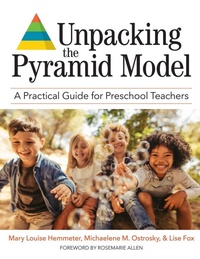
Unpacking the Pyramid Model
A Practical Guide for Preschool Teachers
Published on 30. November 2020
Book
Paperback/Softback
208 pages
978-1-68125-390-9 (ISBN)
Description
For more than a decade, the widely used Pyramid Model for Promoting Social Emotional Competence in Infants and Young Children has been helping early educators use research-based practices to boost social-emotional development. Now thereaEUR (TM)s a practical guide that makes it easier than ever to implement this highly effective framework in preschool classrooms.Created by the Pyramid Model developers and experts with extensive training experience, this is the first book to provide a comprehensive, step-by-step overview of the Pyramid Model for children ages 2-5. Early childhood educators will get a complete overview of the framework, plus in-depth guidance, evidence-based strategies, and helpful checklists for implementing all tiers of the Pyramid Model: universal, targeted, and individualized.
Ideal for use in teacher trainings, preservice methods courses, and individual professional development, Unpacking the Pyramid Model will give current and future educators the foundational skills they need to promote positive behavior and build all young childrenaEUR (TM)s social-emotional competence.
Learn how to use the Pyramid Model to:
Construct a positive classroom environment that supports access and engagement for all students
Develop predictable schedules and routines that maximize participation and learning
Clearly define and teach behavior expectations and rules
Deliver intentional, explicit instruction in social-emotional competence
Support smooth and streamlined transitions that prevent challenging behavior
Create a culture of friendship and actively teach children friendship skills
Teach children about emotions and help them develop a aEURoefeeling vocabularyaEUR?
Give children the skills they need to solve interpersonal problems appropriately
Provide individualized support for children with persistent challenging behavior
Ideal for use in teacher trainings, preservice methods courses, and individual professional development, Unpacking the Pyramid Model will give current and future educators the foundational skills they need to promote positive behavior and build all young childrenaEUR (TM)s social-emotional competence.
Learn how to use the Pyramid Model to:
Construct a positive classroom environment that supports access and engagement for all students
Develop predictable schedules and routines that maximize participation and learning
Clearly define and teach behavior expectations and rules
Deliver intentional, explicit instruction in social-emotional competence
Support smooth and streamlined transitions that prevent challenging behavior
Create a culture of friendship and actively teach children friendship skills
Teach children about emotions and help them develop a aEURoefeeling vocabularyaEUR?
Give children the skills they need to solve interpersonal problems appropriately
Provide individualized support for children with persistent challenging behavior
Reviews / Votes
Unpacking the Pyramid Model is a clear and comprehensive roadmap for implementing the Pyramid Model. Hemmeter, Ostrosky, and Fox and an all-star cast have distilled a wide array of research-based Pyramid practices into a guide that will be helpful for brand-new teachers and veteran early educators alike. Every teacher of young children should have this book and learn from the experts."-Judith Carta, Ph.D., Senior Scientist and Professor, Juniper Gardens Children's Project, University of Kansas
"We've been waiting for this book and now it's here! Unpacking the Pyramid Model is an invaluable resource for anyone in the field of early care and education. It's evidence-based. It's feasible. And the authors have struck an inspirational tone. Students and practicing teachers will want to try out these strategies in their own classrooms. I'm excited to recommend this book."
-Susan Sandall, Ph.D., Professor Emeritus, University of Washington
More details
Language
English
Place of publication
Baltimore
United States
Target group
Professional and scholarly
Dimensions
Height: 295 mm
Width: 210 mm
Thickness: 15 mm
Weight
980 gr
ISBN-13
978-1-68125-390-9 (9781681253909)
Copyright in bibliographic data and cover images is held by Nielsen Book Services Limited or by the publishers or by their respective licensors: all rights reserved.
Schweitzer Classification
Persons
Mary Louise Hemmeter, Ph.D., is Professor in the Department of Special Education at Vanderbilt University. Her research focuses on effective instruction, social-emotional development, challenging behavior, and on coaching teachers.
She has been a principal investigator (PI) or co-PI on numerous projects funded by the U.S. Departments of Education and Health and Human Services. Through her work on the National Center on Social Emotional Foundations for Early Learning and Institute of Education Sciences (IES)-funded research projects, she was involved in the development of the Pyramid Model for Supporting Social Emotional Competence in Young Children and practice-based coaching, a model for supporting teachers in implementing effective practices.
She is currently the PI on on an IES-funded development project on programwide supports for implementing the Pyramid Model, a co-PI on an IES developmental project on implementing the Pyramid Model in infant-toddler settings, and a co-PI on an IES efficacy study examining approaches to supporting teachers in implementing embedded instructions.
She was a coeditor of the Journal of Early Intervention and President of the Council for Exceptional Children's Division for Early Childhood (DEC). She received the Mary McEvoy Service to the Field Award from the Division for Early Childhood.
Dr Michaelene M. Ostrosky is the Head of the Department of Special Education at the University of Illinois at Urbana-Champaign. Her educational background and research focuses on early childhood special education with a particular interest in social emotional competence; social interaction and peer relationships; challenging behavior; and communication delays and disabilities. As a former teacher of young children with disabilities, Professor Ostrosky is committed to making research accessible to practitioners and family members through her writing and presentations.
Dr Lise Fox is a professor in the Department of Child and Family Studies of the University of South Florida in Tampa, Florida and the Co-Director of Florida Center for Inclusive Communities: A University Center for Excellence in Developmental Disabilities. Lise was the Principal Investigator of the Technical Assistance Center for Social Emotional Intervention funded by the Office of Special Education Programs. Dr. Fox is engaged in research and training efforts related to the implementation of the Pyramid Model in early education and care classrooms, program-wide models of implementation, and positive behavior support. She received the Mary E. McEvoy Service to the Field Award from the Division for Early Childhood.
She has been a principal investigator (PI) or co-PI on numerous projects funded by the U.S. Departments of Education and Health and Human Services. Through her work on the National Center on Social Emotional Foundations for Early Learning and Institute of Education Sciences (IES)-funded research projects, she was involved in the development of the Pyramid Model for Supporting Social Emotional Competence in Young Children and practice-based coaching, a model for supporting teachers in implementing effective practices.
She is currently the PI on on an IES-funded development project on programwide supports for implementing the Pyramid Model, a co-PI on an IES developmental project on implementing the Pyramid Model in infant-toddler settings, and a co-PI on an IES efficacy study examining approaches to supporting teachers in implementing embedded instructions.
She was a coeditor of the Journal of Early Intervention and President of the Council for Exceptional Children's Division for Early Childhood (DEC). She received the Mary McEvoy Service to the Field Award from the Division for Early Childhood.
Dr Michaelene M. Ostrosky is the Head of the Department of Special Education at the University of Illinois at Urbana-Champaign. Her educational background and research focuses on early childhood special education with a particular interest in social emotional competence; social interaction and peer relationships; challenging behavior; and communication delays and disabilities. As a former teacher of young children with disabilities, Professor Ostrosky is committed to making research accessible to practitioners and family members through her writing and presentations.
Dr Lise Fox is a professor in the Department of Child and Family Studies of the University of South Florida in Tampa, Florida and the Co-Director of Florida Center for Inclusive Communities: A University Center for Excellence in Developmental Disabilities. Lise was the Principal Investigator of the Technical Assistance Center for Social Emotional Intervention funded by the Office of Special Education Programs. Dr. Fox is engaged in research and training efforts related to the implementation of the Pyramid Model in early education and care classrooms, program-wide models of implementation, and positive behavior support. She received the Mary E. McEvoy Service to the Field Award from the Division for Early Childhood.
Content
About the Downloads
About the Editors
About the Contributors
Acknowledgements
Introduction
1 ? Overview of the Pyramid Model -Lise Fox, Mary Louise Hemmeter, Michaelene M. Ostrosky, & Robert M. Corso
2 ? Creating Connections with Children -Kathleen Artman-Meeker, Amy Hunter, & Tweety Yates
3 ? Promoting Positive Child Outcomes through Family Partnerships -Jaclyn D. Joseph, Meghan von der Embse, & Alana G. Schnitz
4 ? Recognizing the Value of Positive Relationships with Colleagues -Kiersten A. Kinder, Amanda C. Quesenberry, & Gregory A. Cheatham
5 ? Classroom Environments -Jessica K. Hardy, Rosa Milagros Santos, & Sharon L. Doubet
6 ? Schedules and Routines -Edward Bovey, Ellie Bold, Abby Hodges, & Phillip Strain
7 ? Designing and Implementing Transitions in Early Childhood Classrooms -Jessica K. Hardy, Mary Louise Hemmeter, Lise Fox, & Michaelene M. Ostrosky
8 ? Designing the Physical, Social, and Temporal Environments to Teach Expectations and Rules -Denise Perez Binder, Rochelle Lentini, & Elizabeth A. Steed
9 ? Promoting ChildrenaEUR (TM)s Engagement -Ronald Roybal, Edward Bovey, Ellie Bold, Abby Hodges, & Phillip Strain
10 ? Effective Teaching Strategies for Facilitating Social Emotional Competence for all Children -Erin E. Barton, Angel Fettig, Elizabeth Pokorski, & Shawna Harbin
11 ? Using Positive Descriptive Feedback to Improve ChildrenaEUR (TM)s Behavior -Maureen A. Conroy & Kevin S. Sutherland
12 ? Creating a Culture of Friendship: Friendship Skills and Strategies for Teaching Them -Lori E. Meyer, Molly E. Milam, & Michaelene M. Ostrosky
13 ? Teaching Children to Problem Solve -Adrienne Golden, Abby L. Taylor, Jarrah Korba, & Mary Louise Hemmeter
14 ? Supporting Emotional Literacy -Gail E. Joseph, Tweety Yates, & Michaelene M. Ostrosky
15 ? Problem Solving Challenging Behavior -Kathleen Artman-Meeker, Erin E. Barton, Phillip Strain, & Mary Louise Hemmeter
16 ? Implementing Individualized Behavior Support for Children with Persistent Challenging Behavior -Lise Fox, Glen Dunlap, & Jolenea Ferro
17 ? Implementing Pyramid Model Practices to Make a Difference for Children -Patricia Snyder, Crystal Bishop, Darbianne Shannon, & Tara McLaughlin
About the Editors
About the Contributors
Acknowledgements
Introduction
1 ? Overview of the Pyramid Model -Lise Fox, Mary Louise Hemmeter, Michaelene M. Ostrosky, & Robert M. Corso
2 ? Creating Connections with Children -Kathleen Artman-Meeker, Amy Hunter, & Tweety Yates
3 ? Promoting Positive Child Outcomes through Family Partnerships -Jaclyn D. Joseph, Meghan von der Embse, & Alana G. Schnitz
4 ? Recognizing the Value of Positive Relationships with Colleagues -Kiersten A. Kinder, Amanda C. Quesenberry, & Gregory A. Cheatham
5 ? Classroom Environments -Jessica K. Hardy, Rosa Milagros Santos, & Sharon L. Doubet
6 ? Schedules and Routines -Edward Bovey, Ellie Bold, Abby Hodges, & Phillip Strain
7 ? Designing and Implementing Transitions in Early Childhood Classrooms -Jessica K. Hardy, Mary Louise Hemmeter, Lise Fox, & Michaelene M. Ostrosky
8 ? Designing the Physical, Social, and Temporal Environments to Teach Expectations and Rules -Denise Perez Binder, Rochelle Lentini, & Elizabeth A. Steed
9 ? Promoting ChildrenaEUR (TM)s Engagement -Ronald Roybal, Edward Bovey, Ellie Bold, Abby Hodges, & Phillip Strain
10 ? Effective Teaching Strategies for Facilitating Social Emotional Competence for all Children -Erin E. Barton, Angel Fettig, Elizabeth Pokorski, & Shawna Harbin
11 ? Using Positive Descriptive Feedback to Improve ChildrenaEUR (TM)s Behavior -Maureen A. Conroy & Kevin S. Sutherland
12 ? Creating a Culture of Friendship: Friendship Skills and Strategies for Teaching Them -Lori E. Meyer, Molly E. Milam, & Michaelene M. Ostrosky
13 ? Teaching Children to Problem Solve -Adrienne Golden, Abby L. Taylor, Jarrah Korba, & Mary Louise Hemmeter
14 ? Supporting Emotional Literacy -Gail E. Joseph, Tweety Yates, & Michaelene M. Ostrosky
15 ? Problem Solving Challenging Behavior -Kathleen Artman-Meeker, Erin E. Barton, Phillip Strain, & Mary Louise Hemmeter
16 ? Implementing Individualized Behavior Support for Children with Persistent Challenging Behavior -Lise Fox, Glen Dunlap, & Jolenea Ferro
17 ? Implementing Pyramid Model Practices to Make a Difference for Children -Patricia Snyder, Crystal Bishop, Darbianne Shannon, & Tara McLaughlin