

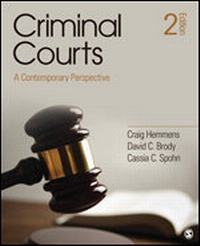
Criminal Courts
A Contemporary Perspective
2nd Edition
Published on 12. February 2013
Book
Paperback/Softback
536 pages
978-1-4522-5722-8 (ISBN)
Description
Written by three leaders in the field, this text explores all conventional topics (court structure, courtroom actors, and the trial and appeal process) as well as others seldom covered. The text first reviews the judicial function, the role and purpose of law, sources of law, the various types of law, and the American court system structure and operations, both state and federal. The participants in the system are discussed next, followed by the pre-trial, trial, and post-trial processes. A wealth of pedagogical tools adds valuable related content, ranging from the points of view of court process participants to comparative information to hotly debated topics.
More details
Edition
2nd Revised edition
Language
English
Place of publication
Thousand Oaks
United States
Target group
College/higher education
Edition type
Revised edition
Dimensions
Height: 232 mm
Width: 187 mm
Weight
880 gr
ISBN-13
978-1-4522-5722-8 (9781452257228)
Copyright in bibliographic data and cover images is held by Nielsen Book Services Limited or by the publishers or by their respective licensors: all rights reserved.
Schweitzer Classification
Other editions
New editions
Book
02/2016
3rd Edition
SAGE Publications Inc
€147.07
Article is exhausted; no reprint
Previous edition
Book
12/2009
1st Edition
SAGE Publications Inc
€104.18
Article exhausted; check for reprint
Persons
Craig Hemmens is a professor in the Department of Criminal Justice and Criminology at Washington State University. He holds a JD from North Carolina Central University School of Law and a PhD in criminal justice from Sam Houston State University. Professor Hemmens has published 20 books and more than 200 articles, many dealing with legal issues in criminal justice. He currently serves as editor of the Criminal Law Bulletin and previously served as the editor of the Journal of Criminal Justice Education and as president of the Academy of Criminal Justice Sciences. His current research interests include criminal law and procedure.
David C. Brody is a professor in the Department of Criminal Justice and Criminology at Washington State University. He received a JD from the University of Arizona College of Law and a PhD in criminal justice from the State University of New York at Albany. He is the author of casebooks on criminal law and criminal procedure, as well as scholarly articles that have been published in such journals as the American Criminal Law Review, Crime and Delinquency, Justice System Journal, and Judicature. His current research focuses on the selection and evaluation of judges, jury reform, and the interaction between law, politics, and criminal justice policy.
Cassia Spohn is School Director and Foundation Professor of Criminal Justice at Arizona State University. She is the author of several books, including The Color of Justice: Race, Ethnicity, and Crime in America (with Sam Walker and Miriam DeLone) and How Do Judges Decide? The Search for Fairness and Equity in Sentencing. She has published a number of articles examining prosecutors' charging decisions in sexual assault cases and exploring the effect of race/ethnicity on charging and sentencing decisions. Her current research interests include the effect of race and gender on court processing decisions, victim characteristics and case outcomes in sexual assault cases, judicial decision making, sentencing of drug offenders, and the deterrent effect of imprisonment. In 1999, she was awarded the University of Nebraska Outstanding Research and Creative Activity Award.
David C. Brody is a professor in the Department of Criminal Justice and Criminology at Washington State University. He received a JD from the University of Arizona College of Law and a PhD in criminal justice from the State University of New York at Albany. He is the author of casebooks on criminal law and criminal procedure, as well as scholarly articles that have been published in such journals as the American Criminal Law Review, Crime and Delinquency, Justice System Journal, and Judicature. His current research focuses on the selection and evaluation of judges, jury reform, and the interaction between law, politics, and criminal justice policy.
Cassia Spohn is School Director and Foundation Professor of Criminal Justice at Arizona State University. She is the author of several books, including The Color of Justice: Race, Ethnicity, and Crime in America (with Sam Walker and Miriam DeLone) and How Do Judges Decide? The Search for Fairness and Equity in Sentencing. She has published a number of articles examining prosecutors' charging decisions in sexual assault cases and exploring the effect of race/ethnicity on charging and sentencing decisions. Her current research interests include the effect of race and gender on court processing decisions, victim characteristics and case outcomes in sexual assault cases, judicial decision making, sentencing of drug offenders, and the deterrent effect of imprisonment. In 1999, she was awarded the University of Nebraska Outstanding Research and Creative Activity Award.
Content
SECTION I: THE PURPOSE AND STRUCTURE OF AMERICAN COURTS
Chapter 1: Introduction: Law and the Judicial Function
Chapter 2: Sources of Law
Chapter 3: Types of Law
Chapter 4: Court Organization and Structure
SECTION II: COURTROOM ACTORS AND THE COURTROOM WORKGROUP
Chapter 5: The Prosecutor
Chapter 6: The Defense Attorney
Chapter 7: Judges
Chapter 8: Criminal Defendants and Crime Victims
Chapter 9: The Jury
SECTION III: COURT PROCESSES
Chapter 10: Pretrial Procedures
Chapter 11: The Criminal Trial
Chapter 12: Sentencing
Chapter 13: The Appeals Process
Chapter 14: Specialized Courts
Chapter 1: Introduction: Law and the Judicial Function
Chapter 2: Sources of Law
Chapter 3: Types of Law
Chapter 4: Court Organization and Structure
SECTION II: COURTROOM ACTORS AND THE COURTROOM WORKGROUP
Chapter 5: The Prosecutor
Chapter 6: The Defense Attorney
Chapter 7: Judges
Chapter 8: Criminal Defendants and Crime Victims
Chapter 9: The Jury
SECTION III: COURT PROCESSES
Chapter 10: Pretrial Procedures
Chapter 11: The Criminal Trial
Chapter 12: Sentencing
Chapter 13: The Appeals Process
Chapter 14: Specialized Courts