

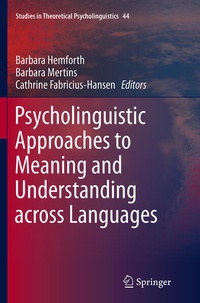
Psycholinguistic Approaches to Meaning and Understanding across Languages
Description
Reviews / Votes
"Although experimental work is becoming an increasingly influential methodology in semantic and pragmatic research, much of the evidence grounding this research is still drawn from a very small pool of languages. This intriguing book is exemplary in showcasing the benefits of combining experimental work with a comparativist approach. A variety of fundamental topics (ranging from anaphoric resolution, aspectual coercion, and coordination, to discourse coherence, ellipsis, and quotation) in 9 languages are represented, studied with a variety of experimental techniques. An excellent addition to the library of any researcher in semantics or pragmatics." (Jonathan Ginzburg, UFR d'Études anglophones, Université Paris-Diderot , France)
More details
Other editions
Additional editions
Content
Foreword.- Chapter 1: Introduction: Meaning across Languages.- Chapter 2: Understanding Coordinate Clauses: A Cross-Linguistic Experimental Approach.- Chapter 3: Pairing Form and Meaning in English and Norwegian: Conjoined VPs or Conjoined Clauses?.- Chapter 4: Cross-linguistic Variation in the Processing of Aspect.- Chapter 5: Referring Expressions in Speech Reports.- Chapter 6: The Role of Grammaticality Judgments Within an Integral Approach to Brazilian Portuguese Bare Nominals.- Chapter 7: Information Structure and Pronoun Resolution in German and French: Evidence from the Visual-world Paradigm.- Chapter 8: Conversational Implicatures in Anaphora Resolution: Alternative Constructions and Referring Expressions.- Chapter 9: From Verbs to Discourse: A Novel Account of Implicit Causality.