

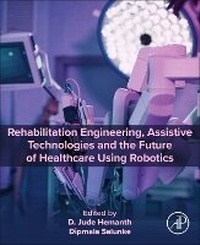
Rehabilitation Engineering, Assistive Technologies and the Future of Healthcare Using Robotics
Published on 13. June 2025
Book
Paperback/Softback
256 pages
978-0-443-31624-1 (ISBN)
Description
Rehabilitation Engineering, Assistive Technologies and the Future of Healthcare Using Robotics??? presents the most recent developments in assistive technologies, rehabilitative engineering, and robotics, offering in-depth analysis of cutting-edge instruments and frameworks that have the power to transform rehabilitation and general well-being. The book provides insights into how the integration of assistive technology and robots can enhance healthcare delivery while also addressing global challenges related to healthcare accessibility, rehabilitation, the integration of advanced technologies, opportunities, and problems in assistive technologies. Sections are complemented by case studies from different countries.
More details
Language
English
Place of publication
San Diego
United States
Publishing group
Elsevier Science Publishing Co Inc
Target group
Professional and scholarly
Product notice
Paperback (trade)
Unsewn / adhesive bound
Dimensions
Height: 236 mm
Width: 191 mm
Thickness: 13 mm
Weight
476 gr
ISBN-13
978-0-443-31624-1 (9780443316241)
Copyright in bibliographic data and cover images is held by Nielsen Book Services Limited or by the publishers or by their respective licensors: all rights reserved.
Schweitzer Classification
Other editions
Additional editions
M. E. Hemanth B. E. | Dipmala Salunke
Rehabilitation Engineering, Assistive Technologies and the Future of Healthcare Using Robotics
E-Book
06/2025
Elsevier
€167.99
Available for download
Persons
Dr. D. Jude Hemanth is currently working as a professor in Department of ECE, Karunya University, Coimbatore, India. He also holds the position of "Visiting Professor? in Faculty of Electrical Engineering and Information Technology, University of Oradea, Romania. He also serves as the "Research Scientist? of Computational Intelligence and Information Systems (CI2S) Lab, Argentina; LAPISCO research lab, Brazil; RIADI Lab, Tunisia; Research Centre for Applied Intelligence, University of Craiova, Romania and e-health and telemedicine group, University of Valladolid, Spain.
Dr. Hemanth received his B.E degree in ECE from Bharathiar University in 2002, M.E degree in communication systems from Anna University in 2006 and Ph.D. from Karunya University in 2013. He has published 37 edited books with reputed publishers such as Elsevier, Springer and IET. His research areas include Computational Intelligence and Image processing. He has authored more than 200 research papers in reputed SCIE indexed International Journals and Scopus indexed International Conferences. Dr. Dipmala Salunke serves as an Associate Professor in the Department of Information Technology at JSPM's Rajarshi Shahu College of Engineering in Tathwawade, Pune, India. With over 17 years of teaching experience, she has completed her research in AI and healthcare. Dr. Salunke is the author of books on Machine Learning, Artificial Intelligence, and Software Architecture for computer/IT students. She has also served as a reviewer and session chair for numerous international conferences and journals. Dr. Salunke has delivered expert sessions on Machine Learning and Python programming and has published many research papers in reputable journals and conferences. Additionally, she holds professional certifications in Machine Learning and Deep Learning. Her research interests encompass Artificial Intelligence, Machine Learning, Deep Learning, and Medical Image Processing.
Dr. Hemanth received his B.E degree in ECE from Bharathiar University in 2002, M.E degree in communication systems from Anna University in 2006 and Ph.D. from Karunya University in 2013. He has published 37 edited books with reputed publishers such as Elsevier, Springer and IET. His research areas include Computational Intelligence and Image processing. He has authored more than 200 research papers in reputed SCIE indexed International Journals and Scopus indexed International Conferences. Dr. Dipmala Salunke serves as an Associate Professor in the Department of Information Technology at JSPM's Rajarshi Shahu College of Engineering in Tathwawade, Pune, India. With over 17 years of teaching experience, she has completed her research in AI and healthcare. Dr. Salunke is the author of books on Machine Learning, Artificial Intelligence, and Software Architecture for computer/IT students. She has also served as a reviewer and session chair for numerous international conferences and journals. Dr. Salunke has delivered expert sessions on Machine Learning and Python programming and has published many research papers in reputable journals and conferences. Additionally, she holds professional certifications in Machine Learning and Deep Learning. Her research interests encompass Artificial Intelligence, Machine Learning, Deep Learning, and Medical Image Processing.
Content
Transformative role of artificial intelligence in healthcare robotics
Robotic assistive technologies for patients with motor disabilities: An overview
A telerehabilitation framework for robot-aided therapies and digital twin-based training system
Significance and impact of robotics in healthcare using optimized techniques
Flex sensors in healthcare communication: Accessibility and interaction
Optimizing design and analysis of walking assistance exoskeleton
Revolutionizing rehabilitation robotics in physiotherapy
Integrated stacked LSTM methodology for Parkinson's disease identification and exoskeleton rehabilitation using the Daphnet dataset
AIoT-powered proactive elderly healthcare: Wearable monitoring
The rise of Robotics and AI in healthcare: Concerns and Implications
Exploring ethical and social dimensions of healthcare robotics in patient centered care
Robotic assistive technologies for patients with motor disabilities: An overview
A telerehabilitation framework for robot-aided therapies and digital twin-based training system
Significance and impact of robotics in healthcare using optimized techniques
Flex sensors in healthcare communication: Accessibility and interaction
Optimizing design and analysis of walking assistance exoskeleton
Revolutionizing rehabilitation robotics in physiotherapy
Integrated stacked LSTM methodology for Parkinson's disease identification and exoskeleton rehabilitation using the Daphnet dataset
AIoT-powered proactive elderly healthcare: Wearable monitoring
The rise of Robotics and AI in healthcare: Concerns and Implications
Exploring ethical and social dimensions of healthcare robotics in patient centered care