

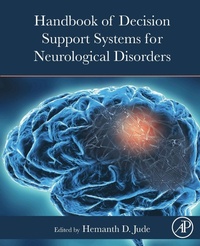
Handbook of Decision Support Systems for Neurological Disorders
Published on 7. April 2021
Book
Paperback/Softback
320 pages
978-0-12-822271-3 (ISBN)
Description
Handbook of Decision Support Systems for Neurological Disorders provides readers with complete coverage of advanced computer-aided diagnosis systems for neurological disorders. While computer-aided decision support systems for different medical imaging modalities are available, this is the first book to solely concentrate on decision support systems for neurological disorders. Due to the increase in the prevalence of diseases such as Alzheimer, Parkinson's and Dementia, this book will have significant importance in the medical field. Topics discussed include recent computational approaches, different types of neurological disorders, deep convolution neural networks, generative adversarial networks, auto encoders, recurrent neural networks, and modified/hybrid artificial neural networks.
More details
Language
English
Place of publication
San Diego
United States
Publishing group
Elsevier Science Publishing Co Inc
Target group
Professional and scholarly
Product notice
Paperback (trade)
Dimensions
Height: 231 mm
Width: 190 mm
Thickness: 16 mm
Weight
676 gr
ISBN-13
978-0-12-822271-3 (9780128222713)
Copyright in bibliographic data and cover images is held by Nielsen Book Services Limited or by the publishers or by their respective licensors: all rights reserved.
Schweitzer Classification
Other editions
Additional editions
M. E. Hemanth B. E.
Handbook of Decision Support Systems for Neurological Disorders
E-Book
03/2021
Academic Press
€148.00
Available for download
Person
Dr. D. Jude Hemanth is currently working as a professor in Department of ECE, Karunya University, Coimbatore, India. He also holds the position of "Visiting Professor? in Faculty of Electrical Engineering and Information Technology, University of Oradea, Romania. He also serves as the "Research Scientist? of Computational Intelligence and Information Systems (CI2S) Lab, Argentina; LAPISCO research lab, Brazil; RIADI Lab, Tunisia; Research Centre for Applied Intelligence, University of Craiova, Romania and e-health and telemedicine group, University of Valladolid, Spain.
Dr. Hemanth received his B.E degree in ECE from Bharathiar University in 2002, M.E degree in communication systems from Anna University in 2006 and Ph.D. from Karunya University in 2013. He has published 37 edited books with reputed publishers such as Elsevier, Springer and IET. His research areas include Computational Intelligence and Image processing. He has authored more than 200 research papers in reputed SCIE indexed International Journals and Scopus indexed International Conferences.
Dr. Hemanth received his B.E degree in ECE from Bharathiar University in 2002, M.E degree in communication systems from Anna University in 2006 and Ph.D. from Karunya University in 2013. He has published 37 edited books with reputed publishers such as Elsevier, Springer and IET. His research areas include Computational Intelligence and Image processing. He has authored more than 200 research papers in reputed SCIE indexed International Journals and Scopus indexed International Conferences.
Content
1.A review of deep learning-based disease detection in Alzheimer's patients
2. Brain tissue segmentation to detect schizophrenia in gray matter using MR images
3. Detection of small tumors of the brain using medical imaging
4. Fuzzy logic-based hybrid knowledge systems for the detection and diagnosis of childhood autism
5. Artificial intelligence for risk prediction of Alzheimer's disease: a new promise for community health screening in the
older aged
6. Cost-effective assistive device for motor neuron disease
7. EEG signal-based human emotion detection using an artificial neural network
8. Multiview decision tree-based segmentation of tumors in MR brain medical images
9. Multiclass SVM coupled with optimization techniques for
segmentation and classification of medical images
10. Brain tissues segmentation in magnetic resonance imaging for the diagnosis of brain disorders using a convolutional neural network
11. Fine motor skills and cognitive development using virtual reality-based games in children
12. A CAD software application as a decision support system for ischemic stroke detection in the posterior fossa
13. Optimization-based multilevel threshold image segmentation for identifying ischemic stroke lesion in brain MR images
14. A study of machine learning algorithms used for detecting cognitive disorders associated with dyslexia
15. A Critical Analysis and Review of Assistive Technology: Advancements, Laws, and Impact on Improving the Rehabilitation of Dysarthric Patients
16. A comparative study on the application of machine learning
algorithms for neurodegenerative disease prediction
2. Brain tissue segmentation to detect schizophrenia in gray matter using MR images
3. Detection of small tumors of the brain using medical imaging
4. Fuzzy logic-based hybrid knowledge systems for the detection and diagnosis of childhood autism
5. Artificial intelligence for risk prediction of Alzheimer's disease: a new promise for community health screening in the
older aged
6. Cost-effective assistive device for motor neuron disease
7. EEG signal-based human emotion detection using an artificial neural network
8. Multiview decision tree-based segmentation of tumors in MR brain medical images
9. Multiclass SVM coupled with optimization techniques for
segmentation and classification of medical images
10. Brain tissues segmentation in magnetic resonance imaging for the diagnosis of brain disorders using a convolutional neural network
11. Fine motor skills and cognitive development using virtual reality-based games in children
12. A CAD software application as a decision support system for ischemic stroke detection in the posterior fossa
13. Optimization-based multilevel threshold image segmentation for identifying ischemic stroke lesion in brain MR images
14. A study of machine learning algorithms used for detecting cognitive disorders associated with dyslexia
15. A Critical Analysis and Review of Assistive Technology: Advancements, Laws, and Impact on Improving the Rehabilitation of Dysarthric Patients
16. A comparative study on the application of machine learning
algorithms for neurodegenerative disease prediction