

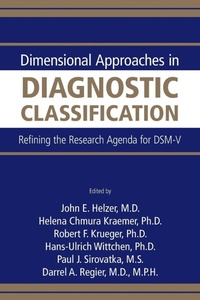
Dimensional Approaches in Diagnostic Classification
Refining the Research Agenda for DSM-V
Published on 13. June 2008
Book
Paperback/Softback
164 pages
978-0-89042-343-1 (ISBN)
Description
Since its initial publication more than 50 years ago, the
DSM has systematized the complex intellectual and clinical process of
diagnosing mentally ill persons through the use of categories and
classification. The manuals have provided a consistent diagnostic language
for clinical work, research, and teaching; have established a common
international taxonomic standard; and have provided psychiatrists with a
means of communicating with patients and the public. With a new iteration of
the DSM on the horizon, the APA has initiated a multiphase research review
process designed to set the stage for the fifth revision, due to be
published in 2013.
This book brings together the most promising
research presented at the conference "The Future of Psychiatric Diagnosis:
Refining the Research Agenda," which was convened by the APA, in
collaboration with the World Health Organization and the U.S. National
Institutes of Health. Conferees were challenged to go beyond the current
categorical definitions set forth in DSM-III and DSM-IV and suggest ways of
incorporating more quantitative, dimensional concepts into DSM-V. The
resulting work:
* Addresses the challenge of creating dimensional measures that are
compatible with existing categorical definitions and do not unduly disrupt
clinical practice
* Applies a dimensional approach to a broad range of
diagnoses, including substance dependence, major depressive episode,
psychosis, anxiety disorders, developmental psychopathology, and personality
disorders
* Facilitates the development of broadly agreed upon criteria
that researchers worldwide can use in planning and conducting future
research exploring the etiology and pathophysiology of mental
disorders
* Identifies and encourages the empirical research necessary
to allow informed decision making regarding deficiencies acknowledged in
DSM-IV
* Promotes international collaboration with the objective of
eliminating the remaining disparities between DSM-V and the International
Classification of Diseases Mental and Behavioural Disorders Section, the
next edition of which is due to be released in 2014.
The book's
painstaking scholarship and thoughtful conclusions should stimulate interest
in finding new ways of combining categorical and dimensional approaches in
psychiatric nosology. Clinicians and researchers in the United States and
the international psychiatric community will discover, in these pages, the
beginnings of a new, quantitative methodology that represents the next stage
in the evolution of DSM.
DSM has systematized the complex intellectual and clinical process of
diagnosing mentally ill persons through the use of categories and
classification. The manuals have provided a consistent diagnostic language
for clinical work, research, and teaching; have established a common
international taxonomic standard; and have provided psychiatrists with a
means of communicating with patients and the public. With a new iteration of
the DSM on the horizon, the APA has initiated a multiphase research review
process designed to set the stage for the fifth revision, due to be
published in 2013.
This book brings together the most promising
research presented at the conference "The Future of Psychiatric Diagnosis:
Refining the Research Agenda," which was convened by the APA, in
collaboration with the World Health Organization and the U.S. National
Institutes of Health. Conferees were challenged to go beyond the current
categorical definitions set forth in DSM-III and DSM-IV and suggest ways of
incorporating more quantitative, dimensional concepts into DSM-V. The
resulting work:
* Addresses the challenge of creating dimensional measures that are
compatible with existing categorical definitions and do not unduly disrupt
clinical practice
* Applies a dimensional approach to a broad range of
diagnoses, including substance dependence, major depressive episode,
psychosis, anxiety disorders, developmental psychopathology, and personality
disorders
* Facilitates the development of broadly agreed upon criteria
that researchers worldwide can use in planning and conducting future
research exploring the etiology and pathophysiology of mental
disorders
* Identifies and encourages the empirical research necessary
to allow informed decision making regarding deficiencies acknowledged in
DSM-IV
* Promotes international collaboration with the objective of
eliminating the remaining disparities between DSM-V and the International
Classification of Diseases Mental and Behavioural Disorders Section, the
next edition of which is due to be released in 2014.
The book's
painstaking scholarship and thoughtful conclusions should stimulate interest
in finding new ways of combining categorical and dimensional approaches in
psychiatric nosology. Clinicians and researchers in the United States and
the international psychiatric community will discover, in these pages, the
beginnings of a new, quantitative methodology that represents the next stage
in the evolution of DSM.
Reviews / Votes
This informative new book details the dimensional approachto psychiatric nosology. Clinicians actually do not treat patients according
to the DSM categories (or the diagnostic criteria) but rather use the
heuristic of target symptoms. Clinicians and researchers who are interested
in understanding the rationale for the modifications proposed in the next
iteration of the DSM should read this book. * Doody Enterprises * Students, researchers, and clinicians alike will find this
text useful. * PsycCRITIQUES * Dimensional Approaches in Diagnostic Classification, by
Helzer and colleagues, has a timely focus on refining the research agenda
for DSM-V, advocating a stronger dimensional emphasis to our categorically
structured current DSM -IV. -- James H. Shore, MD * Journal of Clinical Psychiatry *
More details
Language
English
Place of publication
VA
United States
Target group
College/higher education
Professional and scholarly
US School Grade: College Graduate Student and over
Product notice
Paperback (trade)
Illustrations
7 Line drawings, black and white; 7 Tables, unspecified
Dimensions
Height: 229 mm
Width: 160 mm
Thickness: 10 mm
Weight
281 gr
ISBN-13
978-0-89042-343-1 (9780890423431)
Copyright in bibliographic data and cover images is held by Nielsen Book Services Limited or by the publishers or by their respective licensors: all rights reserved.
Schweitzer Classification
Other editions
Additional editions
John E. Helzer | Helena C. Kraemer | Robert F. Krueger
Dimensional Approaches in Diagnostic Classification
Refining the Research Agenda for DSM-V
E-Book
02/2009
1st Edition
American Psychiatric Publishing
€106.29
Available for download
Persons
John E. Helzer, M.D., is Professor of Psychiatry and
Director of the Health Behavior Research Center at University of Vermont
College of Medicine in Burlington, Vermont.
Helena Chmura Kraemer,
Ph.D., is Professor Emerita of Biostatistics in Psychiatry in the
Department of Psychiatry and Behavioral Sciences at Stanford University in
Palo Alto, California.
Robert F. Krueger, Ph.D., is Professor
of Clinical Psychology, and Personality, Individual Differences, and
Behavior Genetics in the Department of Psychology at the University of
Minnesota in Minneapolis, Minnesota.
Hans-Ulrich Wittchen,
Ph.D., is Director of the Institute of Clinical Psychology and
Psychotherapy at Technische Universitaet Dresden in Dresden,
Germany.
Paul J. Sirovatka, M.S., was Director of Research
Policy Analysis at the Division of Research and American Psychiatric
Institute for Research and Education at the American Psychiatric Association
in Arlington, Virginia.
Darrel A. Regier, M.D., M.P.H., is
Executive Director of the American Psychiatric Institute for Research and
Education and Director of the Division of Research at the American
Psychiatric Association in Arlington, Virginia.
Director of the Health Behavior Research Center at University of Vermont
College of Medicine in Burlington, Vermont.
Helena Chmura Kraemer,
Ph.D., is Professor Emerita of Biostatistics in Psychiatry in the
Department of Psychiatry and Behavioral Sciences at Stanford University in
Palo Alto, California.
Robert F. Krueger, Ph.D., is Professor
of Clinical Psychology, and Personality, Individual Differences, and
Behavior Genetics in the Department of Psychology at the University of
Minnesota in Minneapolis, Minnesota.
Hans-Ulrich Wittchen,
Ph.D., is Director of the Institute of Clinical Psychology and
Psychotherapy at Technische Universitaet Dresden in Dresden,
Germany.
Paul J. Sirovatka, M.S., was Director of Research
Policy Analysis at the Division of Research and American Psychiatric
Institute for Research and Education at the American Psychiatric Association
in Arlington, Virginia.
Darrel A. Regier, M.D., M.P.H., is
Executive Director of the American Psychiatric Institute for Research and
Education and Director of the Division of Research at the American
Psychiatric Association in Arlington, Virginia.
Content
CONTRIBUTORS
DISCLOSURE STATEMENT
FOREWORD:
Dimensional Approaches to Psychiatric Classification
PREFACE
Chapter
1. DIMENSIONAL APPROACHES IN DIAGNOSTIC CLASSIFICATION: A Critical
Appraisal
Chapter 2. DSM CATEGORIES AND DIMENSIONS IN CLINICAL AND
RESEARCH CONTEXTS
Chapter 3. A DIMENSIONAL OPTION FOR THE DIAGNOSIS OF
SUBSTANCE DEPENDENCE IN DSM-V
Chapter 4. DIMENSIONALITY AND THE CATEGORY
OF MAJOR DEPRESSIVE EPISODE
Chapter 5. DIMENSIONS AND THE PSYCHOSIS
PHENOTYPE
Chapter 6. SUPPLEMENTARY DIMENSIONAL ASSESSMENT IN ANXIETY
DISORDERS
Chapter 7. SYNTHESIZING DIMENSIONAL AND CATEGORICAL APPROACHES
TO PERSONALITY DISORDERS: Refining the Research Agenda for DSM-V Axis
II
Chapter 8. A DIMENSIONAL APPROACH TO DEVELOPMENTAL
PSYCHOPATHOLOGY
Chapter 9. DIMENSIONAL OPTIONS FOR DSM-V: The Way
Forward
INDEX
DISCLOSURE STATEMENT
FOREWORD:
Dimensional Approaches to Psychiatric Classification
PREFACE
Chapter
1. DIMENSIONAL APPROACHES IN DIAGNOSTIC CLASSIFICATION: A Critical
Appraisal
Chapter 2. DSM CATEGORIES AND DIMENSIONS IN CLINICAL AND
RESEARCH CONTEXTS
Chapter 3. A DIMENSIONAL OPTION FOR THE DIAGNOSIS OF
SUBSTANCE DEPENDENCE IN DSM-V
Chapter 4. DIMENSIONALITY AND THE CATEGORY
OF MAJOR DEPRESSIVE EPISODE
Chapter 5. DIMENSIONS AND THE PSYCHOSIS
PHENOTYPE
Chapter 6. SUPPLEMENTARY DIMENSIONAL ASSESSMENT IN ANXIETY
DISORDERS
Chapter 7. SYNTHESIZING DIMENSIONAL AND CATEGORICAL APPROACHES
TO PERSONALITY DISORDERS: Refining the Research Agenda for DSM-V Axis
II
Chapter 8. A DIMENSIONAL APPROACH TO DEVELOPMENTAL
PSYCHOPATHOLOGY
Chapter 9. DIMENSIONAL OPTIONS FOR DSM-V: The Way
Forward
INDEX