

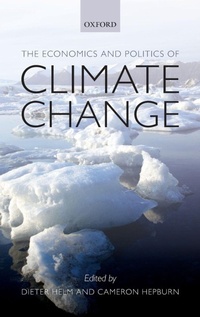
The Economics and Politics of Climate Change
Published on 29. October 2009
Book
Hardback
566 pages
978-0-19-957328-8 (ISBN)
Description
The international framework for a climate change agreement is up for review as the initial Kyoto period to 2012 comes to an end. Though there has been much enthusiasm from political and environmental groups, the underlying economics and politics remain highly controversial. This book takes a cool headed look at the critical roadblocks to agreement, examining the economics of climate change, the incentives of the main players (the US, EU, China) and examines the policies governments can put in place to reduce greenhouse gas emissions, and ultimately shift our economies onto a low-carbon path.
The volume brings together leading climate change policy experts to set out the economic analysis and the nature of the negotiations at Copenhagen and beyond. In addition to reviewing the main issues discussed above, a number of the articles question the basis of much of the climate change consensus, and debate the Stern Report's main findings.
The book is in four parts. Following an overview of the main issues, the first part is a reassessment of the economics of climate change. This is fundamental to the rest of the volume, and it contains new material which goes well beyond what might be called the new conventional wisdom. The second part looks at the geography of the costs and benefits of climate change - the very different perspectives of Africa, China, the US and Europe. These chapters provide a building block to considering the prospects for a new global agreement - the very different interests that will have to be reconciled at Copenhagen and beyond. The third part looks at policy instruments at the global level (whereas much of the literature to date is nationally and regionally based). Trading and R&D feature in the chapters, but so too do more radical unilateral options, including geo-engineering. Part four turns to the institutional architecture - drawing on evidence from previous attempts in other areas, as well as proposals for new bodies.
The volume brings together leading climate change policy experts to set out the economic analysis and the nature of the negotiations at Copenhagen and beyond. In addition to reviewing the main issues discussed above, a number of the articles question the basis of much of the climate change consensus, and debate the Stern Report's main findings.
The book is in four parts. Following an overview of the main issues, the first part is a reassessment of the economics of climate change. This is fundamental to the rest of the volume, and it contains new material which goes well beyond what might be called the new conventional wisdom. The second part looks at the geography of the costs and benefits of climate change - the very different perspectives of Africa, China, the US and Europe. These chapters provide a building block to considering the prospects for a new global agreement - the very different interests that will have to be reconciled at Copenhagen and beyond. The third part looks at policy instruments at the global level (whereas much of the literature to date is nationally and regionally based). Trading and R&D feature in the chapters, but so too do more radical unilateral options, including geo-engineering. Part four turns to the institutional architecture - drawing on evidence from previous attempts in other areas, as well as proposals for new bodies.
Reviews / Votes
Successfully illustrate[s] the immense complexity of the problem...a valuable compendium * Sir Crispin Tickell, Financial Times * Impressive * Roger Pielke Jr, Nature *More details
Language
English
Place of publication
Oxford
United Kingdom
Target group
College/higher education
Professional and scholarly
Academics, researchers and students in politics, economics, environmental and climate studies. NGO's and policymakers.
Illustrations
numerous figures and tables
numerous figures and tables
Dimensions
Height: 240 mm
Width: 161 mm
Thickness: 35 mm
Weight
1007 gr
ISBN-13
978-0-19-957328-8 (9780199573288)
Copyright in bibliographic data and cover images is held by Nielsen Book Services Limited or by the publishers or by their respective licensors: all rights reserved.
Schweitzer Classification
Other editions
Additional editions
Dieter Helm | Cameron Hepburn
The Economics and Politics of Climate Change
Book
09/2011
Oxford University Press
€63.00
Shipment within 15-20 days
Dieter Helm | Cameron Hepburn
Economics and Politics of Climate Change
E-Book
10/2009
1st Edition
OUP Oxford
€9.59
Available for download
Persons
Dieter Helm is Professor of Energy Policy at the University of Oxford and a Fellow of New College. He holds a number of advisory board appointments, including Chairman of the Academic Panel of the Department of Environment, Food and Rural Affairs and member of the Advisory Panel on Energy and Climate Security, Department for Energy and Climate Change. He was a member of the DTI Sustainable Energy Policy Advisory Board 2002-7 and of the Prime Minister's Council of Science and Technology 2004-7. He is an associate editor of the Oxford Review of Economic Policy. Dieter Helm's career to date has spanned academia, public policy, and business. He founded Oxera in 1982 and has published extensively on environmental, energy, infrastructure, and regulation topics.
Dr Cameron Hepburn is a Senior Research Fellow at Oxford University's new Smith School of Enterprise and the Environment. He has advised several governments and international institutions on climate and environmental policy, and he currently serves on UK Defra's Academic Panel. He is an Associate Editor of the Oxford Review of Economic Policy, a Research Fellow at New College, Oxford, and he has over a decade's experience working on environmental issues and climate change, with a particular focus on emissions trading and carbon markets. He holds a DPhil (PhD) in economics from Oxford, and undergraduate degrees in law and engineering from the University of Melbourne.
Dr Cameron Hepburn is a Senior Research Fellow at Oxford University's new Smith School of Enterprise and the Environment. He has advised several governments and international institutions on climate and environmental policy, and he currently serves on UK Defra's Academic Panel. He is an Associate Editor of the Oxford Review of Economic Policy, a Research Fellow at New College, Oxford, and he has over a decade's experience working on environmental issues and climate change, with a particular focus on emissions trading and carbon markets. He holds a DPhil (PhD) in economics from Oxford, and undergraduate degrees in law and engineering from the University of Melbourne.
Content
PART ONE: REVISITING THE ECONOMICS OF CLIMATE CHANGE; PART TWO: THE GLOBAL PLAYERS AND AGREEMENTS; PART THREE: LOW-CARBON TECHNOLOGIES; PART FOUR: NATIONAL AND INTERNATIONAL INSTRUMENTS; PART FIVE: INSTITUTIONAL ARCHITECTURE