

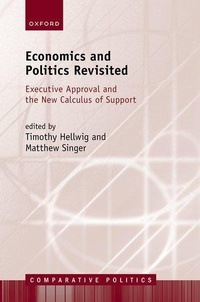
Economics and Politics Revisited
Executive Approval and the New Calculus of Support
Published on 17. August 2023
Book
Hardback
416 pages
978-0-19-287166-4 (ISBN)
Description
What drives government popularity? For decades, scholars, journalists, and political pundits alike have converged on a single answer: the economy. A rising economy lifts the popularity of the government, and if the economy's fortunes turn south, so too does that of the government. This conventional wisdom informs politicians' decisions as well as the scholarly commentary on parties and elections. Yet the conditions that underlie this model have changed in many countries as globalization has shifted control away from national policymakers, as non-economic cultural issues have risen in importance, and as our politics have become more polarized. At the same time, since the Great Recession in 2008 persistent economic volatility has kept the economy on the agenda. What, then, fuels government popularity in our current volatile environment? Are political fortunes tied to economic stability, as in the past? Or has the economy-popularity link-the popularity function-been severed by a host of new and less predictable factors in post-industrial societies?
To answer these questions, Economics and Politics Revisited uses data from the Executive Approval Project (EAP), a cross-nationally comparable data on leader popularity, to model the fundamental dynamics of government support in advanced industrial democracies. Eleven country-specific chapters, each written by experts in the politics of the country, examine the role of economic performance in generating leader support in each country. In all cases, chapter authors show that the economy matters for popularity. However, the economy-popularity link is stronger in some countries than others. Further, chapters leverage EAP series to highlight change over time. Pooled analyses extend these findings, highlighting how the public's responses to the economy are reduced when political campaigns shift to non-economic issues and when parties are polarization on non-economic issues. Collectively, the volume highlights how evolving issue agendas are changing the nature of political accountability in advanced industrialized democracies. While the economy remains important, the book calls on students of political accountability to give greater attention to the role of non-economic issues.
Comparative Politics is a series for researchers, teachers, and students of political science that deals with contemporary government and politics. Global in scope, books in the series are characterized by a stress on comparative analysis and strong methodological rigour. The series is published in association with the European Consortium for Political Research. For more information visit: www.ecprnet.eu .
The series is edited by Nicole Bolleyer, Chair of Comparative Political Science, Geschwister Scholl Institut, LMU Munich and Jonathan Slapin, Professor of Political Institutions and European Politics, Department of Political Science, University of Zurich.
To answer these questions, Economics and Politics Revisited uses data from the Executive Approval Project (EAP), a cross-nationally comparable data on leader popularity, to model the fundamental dynamics of government support in advanced industrial democracies. Eleven country-specific chapters, each written by experts in the politics of the country, examine the role of economic performance in generating leader support in each country. In all cases, chapter authors show that the economy matters for popularity. However, the economy-popularity link is stronger in some countries than others. Further, chapters leverage EAP series to highlight change over time. Pooled analyses extend these findings, highlighting how the public's responses to the economy are reduced when political campaigns shift to non-economic issues and when parties are polarization on non-economic issues. Collectively, the volume highlights how evolving issue agendas are changing the nature of political accountability in advanced industrialized democracies. While the economy remains important, the book calls on students of political accountability to give greater attention to the role of non-economic issues.
Comparative Politics is a series for researchers, teachers, and students of political science that deals with contemporary government and politics. Global in scope, books in the series are characterized by a stress on comparative analysis and strong methodological rigour. The series is published in association with the European Consortium for Political Research. For more information visit: www.ecprnet.eu .
The series is edited by Nicole Bolleyer, Chair of Comparative Political Science, Geschwister Scholl Institut, LMU Munich and Jonathan Slapin, Professor of Political Institutions and European Politics, Department of Political Science, University of Zurich.
More details
Series
Language
English
Place of publication
Oxford
United Kingdom
Target group
Professional and scholarly
Product notice
sewn/stitched
Cloth over boards
Dimensions
Height: 229 mm
Width: 157 mm
Thickness: 48 mm
Weight
771 gr
ISBN-13
978-0-19-287166-4 (9780192871664)
Copyright in bibliographic data and cover images is held by Nielsen Book Services Limited or by the publishers or by their respective licensors: all rights reserved.
Schweitzer Classification
Other editions
Additional editions
Timothy Hellwig | Matthew Singer
Economics and Politics Revisited
Executive Approval and the New Calculus of Support
E-Book
10/2023
1st Edition
OUP eBook
€98.99
Available for download
Timothy Hellwig | Matthew Singer
Economics and Politics Revisited
Executive Approval and the New Calculus of Support
E-Book
07/2023
1st Edition
OUP eBook
€98.99
Available for download
Persons
Timothy Hellwig is Professor of Political Science and Academic Director of the Europe Gateway, Indiana University, and a member of the Executive Approval Project. He is co-author of Democracy Under Siege? Parties, Voters, and Elections after the Great Recession. (2020) and author of Globalization and Mass Politics: Retaining the Room to Maneuver (2014). His research appears in the American Journal of Political Science, British Journal of Political Science, Journal of Politics, and other journals and edited volumes.
Professor Singer is the Alan R. Bennett Honors Professor of political science at the University of Connecticut, where he has taught since 2007, and he is a member of the Executive Approval Project. He is the co-editor of The Latin American Voter: Pursuing Representation and Accountability in Challenging Contexts (2015) and the author of numerous journal articles in Comparative Political Studies, British Journal of Political Science, Journal of Politics, and other journals and edited volumes. His 2018 Comparative Political Studies article was awarded the Seligson Prize for the best paper using data from the Latin American Public Opinion Project.
Professor Singer is the Alan R. Bennett Honors Professor of political science at the University of Connecticut, where he has taught since 2007, and he is a member of the Executive Approval Project. He is the co-editor of The Latin American Voter: Pursuing Representation and Accountability in Challenging Contexts (2015) and the author of numerous journal articles in Comparative Political Studies, British Journal of Political Science, Journal of Politics, and other journals and edited volumes. His 2018 Comparative Political Studies article was awarded the Seligson Prize for the best paper using data from the Latin American Public Opinion Project.
Content
Martin Paldam: Foreword
1: Ryan E. Carlin, Jonathan Hartlyn, Timothy Hellwig, Gregory J. Love, Cecilia Martinez-Gallardo & Matthew Singer: Introduction: Instability and Government Popularity in the 21st Century
2: Ryan E. Carlin, Jonathan Hartlyn, Timothy Hellwig, Gregory J. Love, Cecilia Martinez-Gallardo & Matthew Singer: The Executive Approval Database: Conceptual and Empirical Bases
3: John Bartle, Sebastian Dellepiane-Avellaneda & Anthony McGann: Executive Approval in Great Britain: Continuity and Change
4: Emiliano Grossman & Isabelle Guinaudeau: The Cost of Ruling Above Anything Else: Explaining Presidential Popularity in France
5: Luis Aguiar-Conraria, Bruno Fernandes & Pedro C. Magalhaes: The Economy and Executive Approval in a Semi-Presidential Regime: The Case of Portugal
6: Hanako Ohmura & Airo Hino: Economic Retrospection in Japan: Both Partisanship and Economic Evaluations Matter
7: Paolo Bellucci & Vincenzo Memoli: Government Popularity in Italy: From Valence to Positional Economic Accountability
8: Xavier Romero-Vidal, Lluis Orriols & Pedro Riera: Moving Beyond the Economy: Executive Approval in Spain
9: Eric Belanger & Olivier Jacques: Federal Government Approval in Canada: Economics, Politics, and Fiscal Policy in Changing Times
10: Mark A. Kayser & Arndt Leininger: The Economy and Chancellor Approval in Germany: A Cautionary Tale about Data Vintages and Measures
11: Panos Koliastasis & John Yfantopoulos: Economic Crisis, Polarization, and Prime Ministerial Approval in Greece
12: Henrik Bech Seeberg: Diminishing Class Voting and Increasing Influence of the Economy on Executive Approval in Denmark, 1974-2016
13: Kathleen Donovan, Paul M. Kellstedt, Ellen M. Key & Matthew J. Lebo: Weakened Ties: The Economy and Presidential Approval in the 21st Century United States
14: Mary Stegmaier, Brandon B. Park & Michael S. Lewis-Beck: Economics, Politics, and the Popularity Function: Past, Present and Future
15: Timothy Hellwig & Matthew Singer: Executive Approval from the 1990s to the 2010s: A Pooled Analysis of Twenty Countries
1: Ryan E. Carlin, Jonathan Hartlyn, Timothy Hellwig, Gregory J. Love, Cecilia Martinez-Gallardo & Matthew Singer: Introduction: Instability and Government Popularity in the 21st Century
2: Ryan E. Carlin, Jonathan Hartlyn, Timothy Hellwig, Gregory J. Love, Cecilia Martinez-Gallardo & Matthew Singer: The Executive Approval Database: Conceptual and Empirical Bases
3: John Bartle, Sebastian Dellepiane-Avellaneda & Anthony McGann: Executive Approval in Great Britain: Continuity and Change
4: Emiliano Grossman & Isabelle Guinaudeau: The Cost of Ruling Above Anything Else: Explaining Presidential Popularity in France
5: Luis Aguiar-Conraria, Bruno Fernandes & Pedro C. Magalhaes: The Economy and Executive Approval in a Semi-Presidential Regime: The Case of Portugal
6: Hanako Ohmura & Airo Hino: Economic Retrospection in Japan: Both Partisanship and Economic Evaluations Matter
7: Paolo Bellucci & Vincenzo Memoli: Government Popularity in Italy: From Valence to Positional Economic Accountability
8: Xavier Romero-Vidal, Lluis Orriols & Pedro Riera: Moving Beyond the Economy: Executive Approval in Spain
9: Eric Belanger & Olivier Jacques: Federal Government Approval in Canada: Economics, Politics, and Fiscal Policy in Changing Times
10: Mark A. Kayser & Arndt Leininger: The Economy and Chancellor Approval in Germany: A Cautionary Tale about Data Vintages and Measures
11: Panos Koliastasis & John Yfantopoulos: Economic Crisis, Polarization, and Prime Ministerial Approval in Greece
12: Henrik Bech Seeberg: Diminishing Class Voting and Increasing Influence of the Economy on Executive Approval in Denmark, 1974-2016
13: Kathleen Donovan, Paul M. Kellstedt, Ellen M. Key & Matthew J. Lebo: Weakened Ties: The Economy and Presidential Approval in the 21st Century United States
14: Mary Stegmaier, Brandon B. Park & Michael S. Lewis-Beck: Economics, Politics, and the Popularity Function: Past, Present and Future
15: Timothy Hellwig & Matthew Singer: Executive Approval from the 1990s to the 2010s: A Pooled Analysis of Twenty Countries