

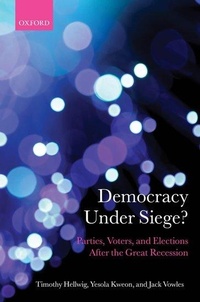
Democracy Under Siege?
Parties, Voters, and Elections After the Great Recession
Published on 1. July 2020
Book
Hardback
244 pages
978-0-19-884620-8 (ISBN)
Description
The Global Financial Crisis of 2008-2009 was catalyst for the most precipitous economic downturn in eight decades. This book examines how the GFC and ensuing Great Recession affected electoral politics in the world's developed democracies. The initial wave of research on the crisis concluded it did little to change the established relationships between voters, parties, and elections. Yet nearly a decade since the initial shock, the political landscape has changed in many ways, the extent to which has not been fully explained by existing studies. Democracy Under Siege? pushes against the received wisdom by advancing a framework for understanding citizen attitudes, preferences, and behaviour. It makes two central claims. First, while previous studies of the GFC tend to focus on an immediate impact of the crisis, Hellwig, Kweon, and Vowles argue that economic malaise has a long lasting impact. In addition to economic shock, the economic recovery has a significant impact on citizens' assessment of political elites. Second, the authors argue that unanticipated exogenous shocks like the GFC grants party elites an opening for political manoeuvre through public policy and rhetoric. As a result, political elites have a high degree of agency to shape public perceptions and behaviour. Political parties can strategically moderate citizens' economic uncertainty, mobilise/demobilise voters, and alter individuals' political preferences. By leveraging data from over 150,000 individuals across over 100 nationally-representative post-election surveys from the 1990s to 2017, this book shows how economic change during a tumultuous era affected economic perceptions, policy demands, political participation, and the vote.
The Comparative Study of Electoral Systems (CSES) is a collaborative program of research among election study teams from around the world. Participating countries include a common module of survey questions in their post-election studies. The resulting data are deposited along with voting, demographic, district, and macro variables. The studies are then merged into a single, free, public dataset for use in comparative study and cross-level analysis. The set of volumes in this series is based on these CSES modules, and the volumes address the key theoretical issues and empirical debates in the study of elections and representative democracy. Some of the volumes will be organized around the theoretical issues raised by a particular module, while others will be thematic in their focus. Taken together, these volumes will provide a rigorous and ongoing contribution to understanding the expansion and consolidation of democracy in the twenty-first century.
Series editors: Hans-Dieter Klingemann and Ian McAllister.
The Comparative Study of Electoral Systems (CSES) is a collaborative program of research among election study teams from around the world. Participating countries include a common module of survey questions in their post-election studies. The resulting data are deposited along with voting, demographic, district, and macro variables. The studies are then merged into a single, free, public dataset for use in comparative study and cross-level analysis. The set of volumes in this series is based on these CSES modules, and the volumes address the key theoretical issues and empirical debates in the study of elections and representative democracy. Some of the volumes will be organized around the theoretical issues raised by a particular module, while others will be thematic in their focus. Taken together, these volumes will provide a rigorous and ongoing contribution to understanding the expansion and consolidation of democracy in the twenty-first century.
Series editors: Hans-Dieter Klingemann and Ian McAllister.
Reviews / Votes
Examines the impact of the 2007-08 global financial crisis (GFC) on public opinion toward democracy, focusing on how the policy preferences of political elites and the policy responses of governments shaped citizens' experiences of crisis and recovery. * Journal of Economic Literature (Volume 59, no. 1) *More details
Series
Language
English
Place of publication
Oxford
United Kingdom
Target group
Professional and scholarly
Product notice
sewn/stitched
Cloth over boards
Dimensions
Height: 236 mm
Width: 147 mm
Thickness: 20 mm
Weight
499 gr
ISBN-13
978-0-19-884620-8 (9780198846208)
Copyright in bibliographic data and cover images is held by Nielsen Book Services Limited or by the publishers or by their respective licensors: all rights reserved.
Schweitzer Classification
Other editions
Additional editions
Timothy Hellwig | Yesola Kweon | Jack Vowles
Democracy Under Siege?
Parties, Voters, and Elections After the Great Recession
E-Book
06/2020
1st Edition
OUP eBook
€56.99
Available for download
Timothy Hellwig | Yesola Kweon | Jack Vowles
Democracy Under Siege?
Parties, Voters, and Elections After the Great Recession
E-Book
06/2020
1st Edition
OUP eBook
€49.99
Available for download
Persons
Timothy Hellwig is Professor of Political Science and Remak Professor of European Studies at Indiana University. His publications include Globalization and Mass Politics: Retaining the Room to Maneuver (Cambridge University Press, 2014).
Yesola Kweon is Assistant Professor of Political Science at Utah State University. Her work has been published in distinguished journals such as Electoral Studies, International Interactions, and West European Politics.
Jack Vowles is Professor of Comparative Politics at Victoria University of Wellington. His publications include Globalization and Domestic Politics ( co-edited with Georgios Xezonakis, OUP, 2016).
Yesola Kweon is Assistant Professor of Political Science at Utah State University. Her work has been published in distinguished journals such as Electoral Studies, International Interactions, and West European Politics.
Jack Vowles is Professor of Comparative Politics at Victoria University of Wellington. His publications include Globalization and Domestic Politics ( co-edited with Georgios Xezonakis, OUP, 2016).
Content
Part I: The Crisis' Long Shadow on Democratic Politics
1: Continuity and Change: The Shock, the Recovery, and the Mass Politics of Economic Crises
2: The Great Recession and Electoral Politics, 2007-2016
Part II: Public Perceptions and Policy Demands
3: Breaking the Bargain? Economic Decline, Party Cues, and the Politics of Insecurity
4: Revising the Bargain? Policy Preferences after the Crisis
Part III: Political Choices in Uncertain Times
5: There is No Difference? The Global Financial Crisis and Electoral Turnout
6: The Shock, the Recovery, and Economic Voting Before and After the Crisis
7: Shaping Their Own Destiny: Political Parties and Voter Choices Before and After the Crisis
8: Mass Politics in a Post-Crisis World: Whither Democracy?
1: Continuity and Change: The Shock, the Recovery, and the Mass Politics of Economic Crises
2: The Great Recession and Electoral Politics, 2007-2016
Part II: Public Perceptions and Policy Demands
3: Breaking the Bargain? Economic Decline, Party Cues, and the Politics of Insecurity
4: Revising the Bargain? Policy Preferences after the Crisis
Part III: Political Choices in Uncertain Times
5: There is No Difference? The Global Financial Crisis and Electoral Turnout
6: The Shock, the Recovery, and Economic Voting Before and After the Crisis
7: Shaping Their Own Destiny: Political Parties and Voter Choices Before and After the Crisis
8: Mass Politics in a Post-Crisis World: Whither Democracy?