

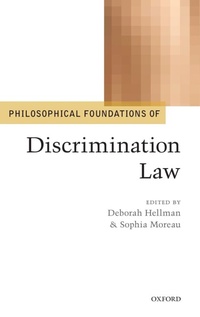
Philosophical Foundations of Discrimination Law
Published on 28. November 2013
Book
Hardback
304 pages
978-0-19-966431-3 (ISBN)
Description
How do we understand and justify the particular partialities that discrimination law tries to protect against? Are different discrimination laws from around the world grounded in a single set of norms? And does discrimination law fail to treat people as individuals?
The philosophical study around discrimination law in the private and public sector is a relatively young field of inquiry. This is owing to the fact that anti-discrimination laws are relatively new. It is arguably only since the Second World War that these rights have been adopted by countries in a broad sense, ensuring that all citizens have civil rights and the right to non-discrimination. Theory around discrimination law has until recently been threefold, doctrinal in its approach, questioning equality - why it matters and why should it influence legislatures in the design of policy - and thirdly focusing on the issue of affirmative action.
This volume takes a fresh look at the philosophy of discrimination law, identifying points of discussion in need of further study. It addresses how we are to understand and justify laws prohibiting discrimination. For instance, how discrimination might be best conceived - as a personal wrong or as an unfair distribution of resources. The volume then turns to a number of meta-theoretical questions, whether different discrimination laws are coherent and grounded in collectively held beliefs or are instead a collection of very different rules that have no underlying coherence. Lastly, the authors focus on issues in discrimination law that are currently the topic of considerable political debate. The questions raised here are urgent and necessary and it is the hope of the authors that other academics and philosophers may join in their discussions.
The philosophical study around discrimination law in the private and public sector is a relatively young field of inquiry. This is owing to the fact that anti-discrimination laws are relatively new. It is arguably only since the Second World War that these rights have been adopted by countries in a broad sense, ensuring that all citizens have civil rights and the right to non-discrimination. Theory around discrimination law has until recently been threefold, doctrinal in its approach, questioning equality - why it matters and why should it influence legislatures in the design of policy - and thirdly focusing on the issue of affirmative action.
This volume takes a fresh look at the philosophy of discrimination law, identifying points of discussion in need of further study. It addresses how we are to understand and justify laws prohibiting discrimination. For instance, how discrimination might be best conceived - as a personal wrong or as an unfair distribution of resources. The volume then turns to a number of meta-theoretical questions, whether different discrimination laws are coherent and grounded in collectively held beliefs or are instead a collection of very different rules that have no underlying coherence. Lastly, the authors focus on issues in discrimination law that are currently the topic of considerable political debate. The questions raised here are urgent and necessary and it is the hope of the authors that other academics and philosophers may join in their discussions.
Reviews / Votes
This book would be suitable for any academic law library or any library serving students in philosophy or political scienceit would be important reading for a lawyer interested in discrimination law. * Kristina Oldenburg, Canadian Law Library Review * The editors stress that one aim of their volume is "to demonstrate that certain questions are worth investigation". The book does so in an exemplary manner, and, invariably, the chapters provide interesting arguments for the conclusions their authors advocate. I suspect the volume will become a standard reference in philosophical discussions of discrimination and discrimination law. * Kasper Lippert-Rasmussen, Notre Dame Philosophical Reviews *More details
Series
Language
English
Place of publication
Oxford
United Kingdom
Target group
College/higher education
Professional and scholarly
Dimensions
Height: 240 mm
Width: 161 mm
Thickness: 20 mm
Weight
605 gr
ISBN-13
978-0-19-966431-3 (9780199664313)
Copyright in bibliographic data and cover images is held by Nielsen Book Services Limited or by the publishers or by their respective licensors: all rights reserved.
Schweitzer Classification
Other editions
Additional editions
Deborah Hellman | Sophia Moreau
Philosophical Foundations of Discrimination Law
E-Book
11/2013
1st Edition
OUP eBook
€72.99
Available for download
Deborah Hellman | Sophia Moreau
Philosophical Foundations of Discrimination Law
E-Book
11/2013
1st Edition
OUP eBook
€81.49
Available for download
Persons
Deborah Hellman is Professor of Law at the University of Virginia School of Law. She is the author of 'When is Discrimination Wrong?' (Harvard U. Press, 2008). Prior to joining the University of Virginia law faculty, Hellman taught at the University of Maryland School of Law
Sophia Moreau is Associate Professor of Law and Philosophy at the University of Toronto. Professor Moreau is working on a book manuscript which elaborates a liberty-based account of why discrimination is wrong, for which she holds a SSHRC grant from the Government of Canada.
Sophia Moreau is Associate Professor of Law and Philosophy at the University of Toronto. Professor Moreau is working on a book manuscript which elaborates a liberty-based account of why discrimination is wrong, for which she holds a SSHRC grant from the Government of Canada.
Content
PART I: WHAT MAKES DISCRIMINATION WRONG? ; PART II: PROBLEMS OF CONSTRUCTING A THEORY OF WRONGFUL DISCRIMINATION ; PART III: THEORETICAL LESSONS DERIVED FROM PRACTICE