

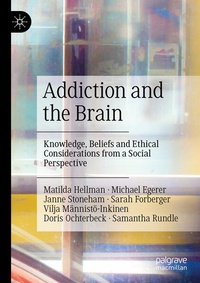
Addiction and the Brain
Description
This book investigates the neuroscientific knowledge on addiction as an epistemic project.
Reviews / Votes
"Whether or not addiction is best seen as a chronic brain disease is perhaps the most crucial issue facing the field of addiction studies in our time. In the midst of this debate, it is essential that we acquire an understanding of the brain disease model as a socio-cultural process - its influence on how people and societies perceive forms of addiction as problems. This book goes a long way to achieving that aim. By giving an independent role to constructs, notions and representations, the authors are able to depict the symbolic force by which neuroscience and other stakeholders in the brain disease understanding of addiction have an impact on both expert and popular perceptions. The social and ethical consequences of this cannot be stressed enough."-Nick Heather , PhD, Department of Psychology, Northumbria University, UK.
"In this welcome study, Hellman and her team reframe the debate on the nature of addiction to consider the various practical uses made of the braindisease model of addiction in different social contexts and the ethical ramifications thereof. By doing so, they provide an innovative and important contribution to the literature in critical addiction studies."
-Darin Weinberg , Professor of Sociology, University of Cambridge
"This important book adds much to current debates about brain disease models of addiction. Drawing on an exciting range of datasets, and acknowledging that to study a concept is to materialise it, the book poses pressing ethical questions about the risks and dilemmas of focusing on the brain in constituting the ontopolitical object of addiction."
-Suzanne Fraser , La Trobe University, Australia
"The Brain Disease Model of Addiction has reigned as the dominant conceptual framework for understanding pathological drug use, despite its many logical and factual inconsistencies. This volume illuminates the limits of the model and offers new analyses and insights that ensure a more nuanced understanding of the causal elements of addiction and its treatment."
-Sally Satel , M.D., resident scholar at American Enterprise Institute
More details
Other editions
Additional editions
Persons
Dr. Matilda Hellman is a research director at the Faculty of Social Sciences, University of Helsinki and head of the Centre for Research on Addiction, Control and Governance (CEACG).
Dr. Michael Egerer is a university researcher at the University of Helsinki Centre for Research on Addiction, Control and Governance (CEACG).
Janne Stoneham (BA Hons Soc. Sci.) works as a research assistant at the University of Helsinki Centre for Research on Addiction, Control and Governance (CEACG).
Dr. Sarah Forberger is a senior scientist at the Leibniz Institute for Prevention Research and Epidemiology - BIPS.
Vilja Männistö-Inkinen (M.Soc.Sci) works as a technical assistant at the University of Helsinki Centre for Research on Addiction, Control and Governance (CEACG).
Doris Ochterbeck (MSc) works as a research associate at the Leibnitz Institute for Prevention Research and Epidemiology -BIPS.
Samantha Rundle (MA) is a PhD candidate and graduate trainee at the University of Toronto and the Centre for Addiction and Mental Health.Content
1 Introduction- 2 Brain-Based Addiction as an Epistemic Project- 3 Popular Representations- 4 Epistemic Frameworks, Science Fields and Researchers- 5 The Brain Paradigm in the Addiction Service Field- 6 The Brain in Treatment Settings- 7 The Brain in Substance Use Prevention- 8 Conclusions.