

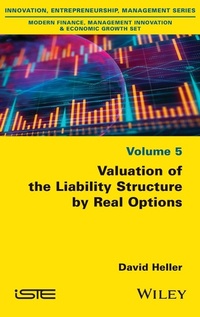
Valuation of the Liability Structure by Real Options
1st Edition
Published on 12. July 2022
Book
Hardback
208 pages
978-1-78630-734-7 (ISBN)
Description
The valuation of the liability structure can be determined by real options because the shares of a company can be regarded as similar to the purchase of a financial call option. Therefore, from this perspective, debt can be viewed as the sale of a financial put option. As a result, financial analysts are able to establish different valuations of a company, according to these two financing methods.
Valuation of the Liability Structure by Real Options explains how the real options method works in conjunction with traditional methods. This innovative approach is particularly suited to the valuation of companies in industries where an underlying asset has high volatility (such as the mining or oil industries) or where research and development costs are high (for example, the pharmaceutical industry). Integration of the economic value of net debt (rather than the accounting value) and integration of the asset volatility are the main advantages of this approach.
Valuation of the Liability Structure by Real Options explains how the real options method works in conjunction with traditional methods. This innovative approach is particularly suited to the valuation of companies in industries where an underlying asset has high volatility (such as the mining or oil industries) or where research and development costs are high (for example, the pharmaceutical industry). Integration of the economic value of net debt (rather than the accounting value) and integration of the asset volatility are the main advantages of this approach.
More details
Language
English
Place of publication
London
United Kingdom
Target group
Professional and scholarly
Product notice
sewn/stitched
Cloth over boards
Dimensions
Height: 240 mm
Width: 161 mm
Thickness: 15 mm
Weight
466 gr
ISBN-13
978-1-78630-734-7 (9781786307347)
Copyright in bibliographic data and cover images is held by Nielsen Book Services Limited or by the publishers or by their respective licensors: all rights reserved.
Schweitzer Classification
Other editions
Additional editions
David Heller
Valuation of the Liability Structure by Real Options
E-Book
06/2022
1st Edition
Wiley
€130.99
Available for download
David Heller
Valuation of the Liability Structure by Real Options
E-Book
06/2022
1st Edition
Wiley
€130.99
Available for download
Person
David Heller is a teacher-researcher in finance and leads the masters in finance program at the ISC in Paris, France.
Content
Introduction ix
Chapter 1 The Utility of Real Options in the Valuation of Liabilities 1
1.1 Introduction 1
1.2 Real options: a mitigating alternative to the deficiency of traditional valuation methods 2
1.2.1 The limits of traditional approaches 3
1.2.2 The alternative of real options 7
1.2.3 Black-Scholes optional modeling 10
1.3 Intersections between approaches to assets valuation 12
1.3.1 Convergence between the Cox-Ross-Rubinstein (1979) and the Black-Scholes (1973) models and the Merton formula (1973) 12
1.3.2 Convergence between the CAPM and the Modigliani-Miller theory 15
1.3.3 Convergence between the Black-Scholes model and the Modigliani-Miller theory outside of taxation 18
1.4 Valuation of liabilities structures with real options 22
1.4.1 The economic value of equity and net debt 22
1.4.2 The impact of the risk debt on the time value of equity and he resolution of conflict between creditors and shareholders 27
1.5 Conclusion 30
Chapter 2 The New Allocation of Company Value Using the Optional Approach 31
2.1 Introduction 31
2.2 Economic value of debt and systematic risk adjustment of equity 34
2.2.1 Optional valuation of debt and the issues associated with getting into debt 34
2.2.2 Combination of CAPM and the options model: the systematic risk of equity and the rate of return required by shareholders 36
2.2.3 Situations that impact financial structure 42
2.3 Integration of organizational problems between shareholders and debtors 45
2.3.1 The interaction of financing decisions 47
2.3.2 Accounting for information costs and protection clauses 53
2.3.3 Bankruptcy costs, getting into permanent debt and optimizing the debt ratio 61
2.4 Mechanisms of refinancing debt and the impact on the value of equity 70
2.4.1 Risks of refinancing 71
2.4.2 Reimbursing loans at intermediate intervals and the impact on the value of equity 76
2.5 Conclusion 82
Chapter 3 Applications of Real Options on Financial Structure Valuation 85
3.1 Introduction 85
3.2 Application to the stock market index of a country: the CAC 40 86
3.2.1 Databases, methodology and hypotheses 87
3.2.2 Equality test for asset and equity volatility and the interpretation of results 94
3.2.3 Equality test for growth potential of stock prices based on the approach of brokers and Black-Scholes-Merton and the interpretation of results 94
3.2.4 Equality test for debt ratios based on net debt from the financial states of companies and the recalculation of net debt using the Black-Scholes-Merton approach, and the interpretation of results 95
3.2.5 Regression coefficient to explain growth potential of stock prices 96
3.3 Application to a business sector: the cinema industry 97
3.3.1 Databases, methodology and hypotheses 97
3.3.2 Equality test for volatility of assets and equity and interpretation of results 100
3.3.3 Equality test for the growth potential of stock prices based on the approach of brokers and Black-Scholes-Merton 100
3.3.4 Test for equal debt ratios based on net debt from the financial reports of companies and the recalculation of net debts using the Black-Scholes-Merton approach 101
Conclusion 103
Appendices 105
Appendix 1 107
Appendix 2 109
Appendix 3 111
Appendix 4 113
Appendix 5 115
Appendix 6 117
Appendix 7 119
Appendix 8 123
Appendix 9 125
Appendix 10 127
Appendix 11 129
Appendix 12 131
Appendix 13 133
Appendix 14 135
Appendix 15 137
Appendix 16 139
Appendix 17 141
Appendix 18 143
Appendix 19 145
Appendix 20 147
Appendix 21 149
Appendix 22 151
Appendix 23 153
Bibliography 159
Index 165
Chapter 1 The Utility of Real Options in the Valuation of Liabilities 1
1.1 Introduction 1
1.2 Real options: a mitigating alternative to the deficiency of traditional valuation methods 2
1.2.1 The limits of traditional approaches 3
1.2.2 The alternative of real options 7
1.2.3 Black-Scholes optional modeling 10
1.3 Intersections between approaches to assets valuation 12
1.3.1 Convergence between the Cox-Ross-Rubinstein (1979) and the Black-Scholes (1973) models and the Merton formula (1973) 12
1.3.2 Convergence between the CAPM and the Modigliani-Miller theory 15
1.3.3 Convergence between the Black-Scholes model and the Modigliani-Miller theory outside of taxation 18
1.4 Valuation of liabilities structures with real options 22
1.4.1 The economic value of equity and net debt 22
1.4.2 The impact of the risk debt on the time value of equity and he resolution of conflict between creditors and shareholders 27
1.5 Conclusion 30
Chapter 2 The New Allocation of Company Value Using the Optional Approach 31
2.1 Introduction 31
2.2 Economic value of debt and systematic risk adjustment of equity 34
2.2.1 Optional valuation of debt and the issues associated with getting into debt 34
2.2.2 Combination of CAPM and the options model: the systematic risk of equity and the rate of return required by shareholders 36
2.2.3 Situations that impact financial structure 42
2.3 Integration of organizational problems between shareholders and debtors 45
2.3.1 The interaction of financing decisions 47
2.3.2 Accounting for information costs and protection clauses 53
2.3.3 Bankruptcy costs, getting into permanent debt and optimizing the debt ratio 61
2.4 Mechanisms of refinancing debt and the impact on the value of equity 70
2.4.1 Risks of refinancing 71
2.4.2 Reimbursing loans at intermediate intervals and the impact on the value of equity 76
2.5 Conclusion 82
Chapter 3 Applications of Real Options on Financial Structure Valuation 85
3.1 Introduction 85
3.2 Application to the stock market index of a country: the CAC 40 86
3.2.1 Databases, methodology and hypotheses 87
3.2.2 Equality test for asset and equity volatility and the interpretation of results 94
3.2.3 Equality test for growth potential of stock prices based on the approach of brokers and Black-Scholes-Merton and the interpretation of results 94
3.2.4 Equality test for debt ratios based on net debt from the financial states of companies and the recalculation of net debt using the Black-Scholes-Merton approach, and the interpretation of results 95
3.2.5 Regression coefficient to explain growth potential of stock prices 96
3.3 Application to a business sector: the cinema industry 97
3.3.1 Databases, methodology and hypotheses 97
3.3.2 Equality test for volatility of assets and equity and interpretation of results 100
3.3.3 Equality test for the growth potential of stock prices based on the approach of brokers and Black-Scholes-Merton 100
3.3.4 Test for equal debt ratios based on net debt from the financial reports of companies and the recalculation of net debts using the Black-Scholes-Merton approach 101
Conclusion 103
Appendices 105
Appendix 1 107
Appendix 2 109
Appendix 3 111
Appendix 4 113
Appendix 5 115
Appendix 6 117
Appendix 7 119
Appendix 8 123
Appendix 9 125
Appendix 10 127
Appendix 11 129
Appendix 12 131
Appendix 13 133
Appendix 14 135
Appendix 15 137
Appendix 16 139
Appendix 17 141
Appendix 18 143
Appendix 19 145
Appendix 20 147
Appendix 21 149
Appendix 22 151
Appendix 23 153
Bibliography 159
Index 165