

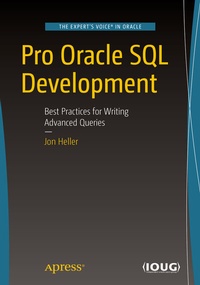
Pro Oracle SQL Development
Best Practices for Writing Advanced Queries
Published on 10. May 2019
Book
Paperback/Softback
XXXV, 596 pages
978-1-4842-4516-3 (ISBN)
Description
Write SQL statements that are more powerful, simpler, and faster using Oracle SQL and its full range of features. This book provides a clearer way of thinking about SQL by building sets, and provides practical advice for using complex features while avoiding anti-patterns that lead to poor performance and wrong results. Relevant theories, real-world best practices, and style guidelines help you get the most out of Oracle SQL.
Pro Oracle SQL Development is for anyone who already knows Oracle SQL and is ready to take their skills to the next level. Many developers, analysts, testers, and administrators use Oracle databases frequently, but their queries are limited because they do not have the knowledge, experience, or right environment to help them take full advantage of Oracle's advanced features. This book will inspire you to achieve more with your Oracle SQL statements through tips for creating your own style for writing simple, yet powerful, SQL. It teaches you how to think about and solve performance problems in Oracle SQL, and covers advanced topics and shows you how to become an Oracle expert.
What You'll Learn
Who This Book Is For
Developers, testers, analysts, and administrators who want to harness the full power of Oracle SQL to solve their problems as simply and as quickly as possible. For traditional database professionals the book offers new ways of thinking about the language they have used for so long. For modern full stack developers the book explains how a database can be much more than simply a place to store data.
Pro Oracle SQL Development is for anyone who already knows Oracle SQL and is ready to take their skills to the next level. Many developers, analysts, testers, and administrators use Oracle databases frequently, but their queries are limited because they do not have the knowledge, experience, or right environment to help them take full advantage of Oracle's advanced features. This book will inspire you to achieve more with your Oracle SQL statements through tips for creating your own style for writing simple, yet powerful, SQL. It teaches you how to think about and solve performance problems in Oracle SQL, and covers advanced topics and shows you how to become an Oracle expert.
What You'll Learn
-
Understand the power of Oracle SQL and where to apply it
- Create a database development environment that is simple, scalable, and conducive to learning
-
Solve complex problems that were previously solved in a procedural language
-
Write large Oracle SQL statements that are powerful, simple, and fast
-
Apply coding styles to make your SQL statements more readable
- Tune large Oracle SQL statements to eliminate and avoid performance problems
Who This Book Is For
Developers, testers, analysts, and administrators who want to harness the full power of Oracle SQL to solve their problems as simply and as quickly as possible. For traditional database professionals the book offers new ways of thinking about the language they have used for so long. For modern full stack developers the book explains how a database can be much more than simply a place to store data.
More details
Edition
1st ed.
Language
English
Place of publication
CA
United States
Target group
Professional and scholarly
Illustrations
53 s/w Abbildungen
XXXV, 596 p. 53 illus.
Dimensions
Height: 25.4 cm
Width: 17.8 cm
Weight
1185 gr
ISBN-13
978-1-4842-4516-3 (9781484245163)
DOI
10.1007/978-1-4842-4517-0
Schweitzer Classification
Other editions
New editions
Book
12/2022
2nd Edition
APress
€69.54
Shipment within 15-20 days
Additional editions
E-Book
05/2019
APress
€56.99
Available for download
Person
Jon Heller
is an expert SQL and PL/SQL programmer with 17 years of Oracle experience. During that time he has worked as a database analyst, developer, and administrator. In his spare time he is active on Stack Overflow where he is a top user in the Oracle and PL/SQL tags. He enjoys creating open source software for Oracle, such as the remote execution program Method5. He has a master of computer science degree from North Carolina State University and lives in Iowa with his wife and two sons.
Content
Part I: Learn How to Learn
Chapter 1: Understand Relational DatabasesChapter 2: Create an Efficient Database Development ProcessChapter 3: Increase Confidence and Knowledge with TestingChapter 4: Find Reliable SourcesChapter 5: Master the Entire Stack
Part II: Write Powerful SQL with Sets and Advanced Features Chapter 6: Build Sets with Inline Views and ANSI Join SyntaxChapter 7: Query the Database with Advanced SELECT FeaturesChapter 8: Modify Data with Advanced DML Chapter 9: Improve the Database with Advanced Oracle Schema ObjectsChapter 10: Optimize the Database with Oracle Architecture
Part III: Write Elegant SQL with Patterns and Styles Chapter 11: Stop Coding and Start WritingChapter 12: Write Large SQL StatementsChapter 13: Write Beautiful SQL StatementsChapter 14: Use SQL More Often with Basic Dynamic SQLChapter 15: Avoid Anti-Patterns
Part IV: Improve SQL Performance Chapter 16: Understand SQL Performance with Algorithm AnalysisChapter 17: Understand SQL Tuning TheoriesChapter 18: Improve SQL Performance
Part V: Solve Anything with Oracle SQL Chapter 19: Solve Challenging Problems with Arcane SQL FeaturesChapter 20: Use SQL More Often with Advanced Dynamic SQLChapter 21: Level Up Your Skills with PL/SQL
Part VI: Appendixes Appendix A: SQL Style Guide Cheat SheetAppendix B: Computer Science Topics
Part II: Write Powerful SQL with Sets and Advanced Features Chapter 6: Build Sets with Inline Views and ANSI Join SyntaxChapter 7: Query the Database with Advanced SELECT FeaturesChapter 8: Modify Data with Advanced DML Chapter 9: Improve the Database with Advanced Oracle Schema ObjectsChapter 10: Optimize the Database with Oracle Architecture
Part III: Write Elegant SQL with Patterns and Styles Chapter 11: Stop Coding and Start WritingChapter 12: Write Large SQL StatementsChapter 13: Write Beautiful SQL StatementsChapter 14: Use SQL More Often with Basic Dynamic SQLChapter 15: Avoid Anti-Patterns
Part IV: Improve SQL Performance Chapter 16: Understand SQL Performance with Algorithm AnalysisChapter 17: Understand SQL Tuning TheoriesChapter 18: Improve SQL Performance
Part V: Solve Anything with Oracle SQL Chapter 19: Solve Challenging Problems with Arcane SQL FeaturesChapter 20: Use SQL More Often with Advanced Dynamic SQLChapter 21: Level Up Your Skills with PL/SQL
Part VI: Appendixes Appendix A: SQL Style Guide Cheat SheetAppendix B: Computer Science Topics