

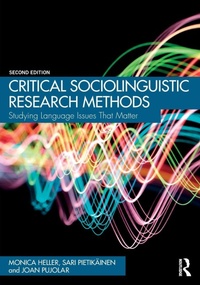
Critical Sociolinguistic Research Methods
Studying Language Issues That Matter
2nd Edition
Published on 27. May 2024
Book
Paperback/Softback
226 pages
978-1-032-49526-2 (ISBN)
Description
Critical Sociolinguistic Research Methods is a guide to conducting concrete ethnographic and discourse analytic research projects, written by top scholars for students and researchers in social science fields. Adopting a critical perspective focusing on the role of language in the construction of social difference and social inequality, the authors walk the reader through five key moments in the life of a research project: composing research questions, designing the project, doing fieldwork, performing data analysis and writing academic texts or otherwise engaging in conversation with different types of social actors about the project. These moments are illustrated by colour-coded examples from the authors' experiences that help researchers and students follow the sequential stages of a project.
Now in its second edition, this popular and original text has been revised and updated to reflect the latest developments in this field, including expanded sections on the centrality of the ethnographic gaze for the understanding of social processes, and on experiences of diversification in the communication of research results. Through the adoption of multimodal genres, authors share recent experiences of research presentations addressed to non-academic audiences, such as installations and photography, and interactive maps.
Clear and highly applicable, with a detailed workbook full of practical tips and examples, this book is a great resource for graduate-level qualitative methods courses in linguistics and anthropology, as well as methods courses in the humanities and social sciences that focus on the role of language in research. It is a timely text for investigating language issues that matter and have consequences for people's lives.
Now in its second edition, this popular and original text has been revised and updated to reflect the latest developments in this field, including expanded sections on the centrality of the ethnographic gaze for the understanding of social processes, and on experiences of diversification in the communication of research results. Through the adoption of multimodal genres, authors share recent experiences of research presentations addressed to non-academic audiences, such as installations and photography, and interactive maps.
Clear and highly applicable, with a detailed workbook full of practical tips and examples, this book is a great resource for graduate-level qualitative methods courses in linguistics and anthropology, as well as methods courses in the humanities and social sciences that focus on the role of language in research. It is a timely text for investigating language issues that matter and have consequences for people's lives.
More details
Edition
2nd edition
Language
English
Place of publication
London
United Kingdom
Publishing group
Taylor & Francis Ltd
Target group
College/higher education
Postgraduate and Undergraduate Advanced
Illustrations
5 s/w Abbildungen, 3 farbige Abbildungen, 3 Farbfotos bzw. farbige Rasterbilder, 5 s/w Zeichnungen, 7 s/w Tabellen
7 Tables, black and white; 5 Line drawings, black and white; 3 Halftones, color; 3 Illustrations, color; 5 Illustrations, black and white
Dimensions
Height: 254 mm
Width: 178 mm
Thickness: 13 mm
Weight
456 gr
ISBN-13
978-1-032-49526-2 (9781032495262)
Copyright in bibliographic data and cover images is held by Nielsen Book Services Limited or by the publishers or by their respective licensors: all rights reserved.
Schweitzer Classification
Other editions
Additional editions
Monica Heller | Sari Pietikaeinen | Joan Pujolar
Critical Sociolinguistic Research Methods
Studying Language Issues That Matter
Book
05/2024
2nd Edition
Routledge
€222.60
Shipment within 10-20 days
Monica Heller | Sari Pietikaeinen | Joan Pujolar
Critical Sociolinguistic Research Methods
Studying Language Issues That Matter
E-Book
05/2024
2nd Edition
Routledge
€55.49
Available for download
Previous edition
Monica Heller | Sari Pietikaeinen | Joan Pujolar
Critical Sociolinguistic Research Methods
Studying Language Issues That Matter
Book
10/2017
1st Edition
Routledge
€53.50
Article exhausted; check for reprint
Persons
Monica Heller is Professor Emerita at the Ontario Institute for Studies in Education and the Department of Anthropology, University of Toronto, Canada. A Fellow of the Royal Society of Canada, she is also a Past President of the American Anthropological Association.
Sari Pietikaeinen is Professor of Discourse Studies in the Department of Language and Communication Studies, University of Jyvaeskylae, Finland. She is also Director of the Jyvaeskylae Discourse Hub.
Joan Pujolar is Professor of Sociolinguistics in the Arts and Humanities Department at the Universitat Oberta de Catalunya, Spain. He is also Director of the Research Group on Language, Culture and Identity in the Global World and a Past President of the Catalan Society of Sociolinguistics.
Sari Pietikaeinen is Professor of Discourse Studies in the Department of Language and Communication Studies, University of Jyvaeskylae, Finland. She is also Director of the Jyvaeskylae Discourse Hub.
Joan Pujolar is Professor of Sociolinguistics in the Arts and Humanities Department at the Universitat Oberta de Catalunya, Spain. He is also Director of the Research Group on Language, Culture and Identity in the Global World and a Past President of the Catalan Society of Sociolinguistics.
Content
List of Illustrations
Acknowledgements
Introduction
0.1 Why Language Matters Now
0.2 Research as Socially Constructed Knowledge
0.3 Research as Experience and as Conversation
0.4 The Research Process: Sequencing, Recursivity and Rhizome
0.5 The Authors as Your Guides and Conversational Partners
0.6 Summary
1 First Key Moment: Formulating Your Research Question
1.1 Research Questions as (Hi)Stories and Conversations
1.2 Different Ways to Get to Your Research Questions
1.3 Reflexivity, Ethics and Research Questions
1.4 Summary
2 Second Key Moment: Designing Your Research
2.1 What Is Research Design?
2.2 Research Design as Projected Work Plan
2.3 Where to Start? With Whom?
2.4 Approaches and Evidence
2.5 Data Recording and Documentation
2.6 Ethics and Politics
2.7 Research Design as Discursive Genre
2.8 Summary
3 Third Key Moment: Generating your Data
3.1 Fieldwork: Producing Data
3.2 Observing: Finding Out What People Do
3.3 Eliciting: Finding Out What People Say
3.4 Material Traces: Other Voices
3.5 Summary
4 Fourth Key Moment: Analyzing Your Data
4.1 What Is Analysis? What Does It Feel Like to Do It?
4.2 Mapping (and Categorizing)
4.3 Tracing
4.4 Connecting
4.5 Claiming
4.6 Analysis as Ethical and Political Conversation
4.7 Pulling It Together
4.8 Summary
5 Fifth Key Moment: Making Your Story
5.1 Writing the Story the Research Tells
5.2 Researchers as Knowledge Producers
5.3 Genre Expectations
5.4 Knowledge Mobilization
5.5 Summary
6 Shop Floor
6.1 Introduction: What Do We Mean by Shop Floor?
6.2 Moment 2: Designing Your Research
6.3 Moment 3: Generating Your Data
6.4 Moment 4: Analyzing Your Data
6.5 Moment 5: Making Your Story
Epilogue
References
Further Reading
Index
Acknowledgements
Introduction
0.1 Why Language Matters Now
0.2 Research as Socially Constructed Knowledge
0.3 Research as Experience and as Conversation
0.4 The Research Process: Sequencing, Recursivity and Rhizome
0.5 The Authors as Your Guides and Conversational Partners
0.6 Summary
1 First Key Moment: Formulating Your Research Question
1.1 Research Questions as (Hi)Stories and Conversations
1.2 Different Ways to Get to Your Research Questions
1.3 Reflexivity, Ethics and Research Questions
1.4 Summary
2 Second Key Moment: Designing Your Research
2.1 What Is Research Design?
2.2 Research Design as Projected Work Plan
2.3 Where to Start? With Whom?
2.4 Approaches and Evidence
2.5 Data Recording and Documentation
2.6 Ethics and Politics
2.7 Research Design as Discursive Genre
2.8 Summary
3 Third Key Moment: Generating your Data
3.1 Fieldwork: Producing Data
3.2 Observing: Finding Out What People Do
3.3 Eliciting: Finding Out What People Say
3.4 Material Traces: Other Voices
3.5 Summary
4 Fourth Key Moment: Analyzing Your Data
4.1 What Is Analysis? What Does It Feel Like to Do It?
4.2 Mapping (and Categorizing)
4.3 Tracing
4.4 Connecting
4.5 Claiming
4.6 Analysis as Ethical and Political Conversation
4.7 Pulling It Together
4.8 Summary
5 Fifth Key Moment: Making Your Story
5.1 Writing the Story the Research Tells
5.2 Researchers as Knowledge Producers
5.3 Genre Expectations
5.4 Knowledge Mobilization
5.5 Summary
6 Shop Floor
6.1 Introduction: What Do We Mean by Shop Floor?
6.2 Moment 2: Designing Your Research
6.3 Moment 3: Generating Your Data
6.4 Moment 4: Analyzing Your Data
6.5 Moment 5: Making Your Story
Epilogue
References
Further Reading
Index