

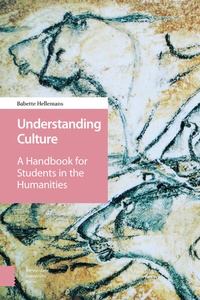
Understanding Culture
A Handbook for Students in the Humanities
Published on 3. August 2017
Book
Paperback/Softback
180 pages
978-90-8964-991-1 (ISBN)
Description
This pioneering textbook explores the theoretical background of cultural variety, both in past and present. How is it possible to study 'culture' when the topic covers the arts, literature, movies, history, sociology, anthropology and gender studies? 'Understanding Culture' examines the evolution of a concept with varying meanings depending on changing norms. Offering a long-duration analysis of the relationship between culture and nature, this book looks at the origins of studying culture from an international perspective.
Using examples from the several scholarly traditions in the practice of studying culture, the book is a key introduction to the area. It identifies the history of interpreting culture as a meeting point between the long-standing historical investigation of 'humanism' and 'postmodernism' and is a comprehensive resource for those who wish to further their engagement with culture as both a historical and contemporary phenomenon.
Using examples from the several scholarly traditions in the practice of studying culture, the book is a key introduction to the area. It identifies the history of interpreting culture as a meeting point between the long-standing historical investigation of 'humanism' and 'postmodernism' and is a comprehensive resource for those who wish to further their engagement with culture as both a historical and contemporary phenomenon.
Reviews / Votes
In this concise, lucid, and elegant introduction to the concept and study of "culture" for all those interested and invested in the increasing relevance of humanities in a day and age in which the exponential growth of commerce and communication gives us less and less pause, time to breath and think twice, Babette Hellemans reminds us of a simple but wide-ranging insight and truth: culture matters and the different and often subtle methods for its historical and intellectual inquiry are as many expressions of the variable ways in which we, as modern subjects and citizens, understand and commemorate our past, live and inhabit our present, and anticipate as well as realize our future. Aptly illustrated and richly documented, this book forms a trusted guide through a pantheon of original and influential thinkers and hotly contested debates, whose terms, the author brilliantly shows, are everything but abstract or merely theoretical. To think about culture high and low, in non-Western no less than classical or modern Western contexts, is nothing short of an ongoing "conversation of mankind," and one whose stakes couldn't be higher today. - Hent de Vries, Russ Family Professor in the Humanities and Philosophy, Johns Hopkins University, Baltimore & Director, School of Criticism and Theory at Cornell University, IthacaThis much-needed and very welcome textbook excels at the challenging task of conveying the intricacies of theory in a crisp and accessible manner to the reader. Abundant in illuminating examples, it is a guide to culture in the best sense of the world: it provides a lasting inspiration for reflection (well after it has been read). - Monika Baar, Professor in Cultural History and the History of Political Thought at the University of Leiden, the Netherlands
More details
Language
English
Place of publication
Amsterdam
Netherlands
Target group
College/higher education
Undergraduate Advanced
Illustrations
Illustrations: 0 black and white; 20 full color.
Dimensions
Height: 234 mm
Width: 156 mm
Weight
300 gr
ISBN-13
978-90-8964-991-1 (9789089649911)
Copyright in bibliographic data and cover images is held by Nielsen Book Services Limited or by the publishers or by their respective licensors: all rights reserved.
Schweitzer Classification
Persons
Babette Hellemans teaches Cultural History and Medieval History at the University of Groningen, the Netherlands. She has published books and articles in English, French and Dutch focusing especially on the French intellectual tradition, the relationship between religion, academic discourse and the anthropology of images.
Content
1) Introduction 2) The Classics 3) Man, mentality and society 4) Language 5) The Silence of the Archives 6) Non-Western Culture 7) Image, Memory and Practice